

Welcome to Fix The News on Substack
A letter from our new home
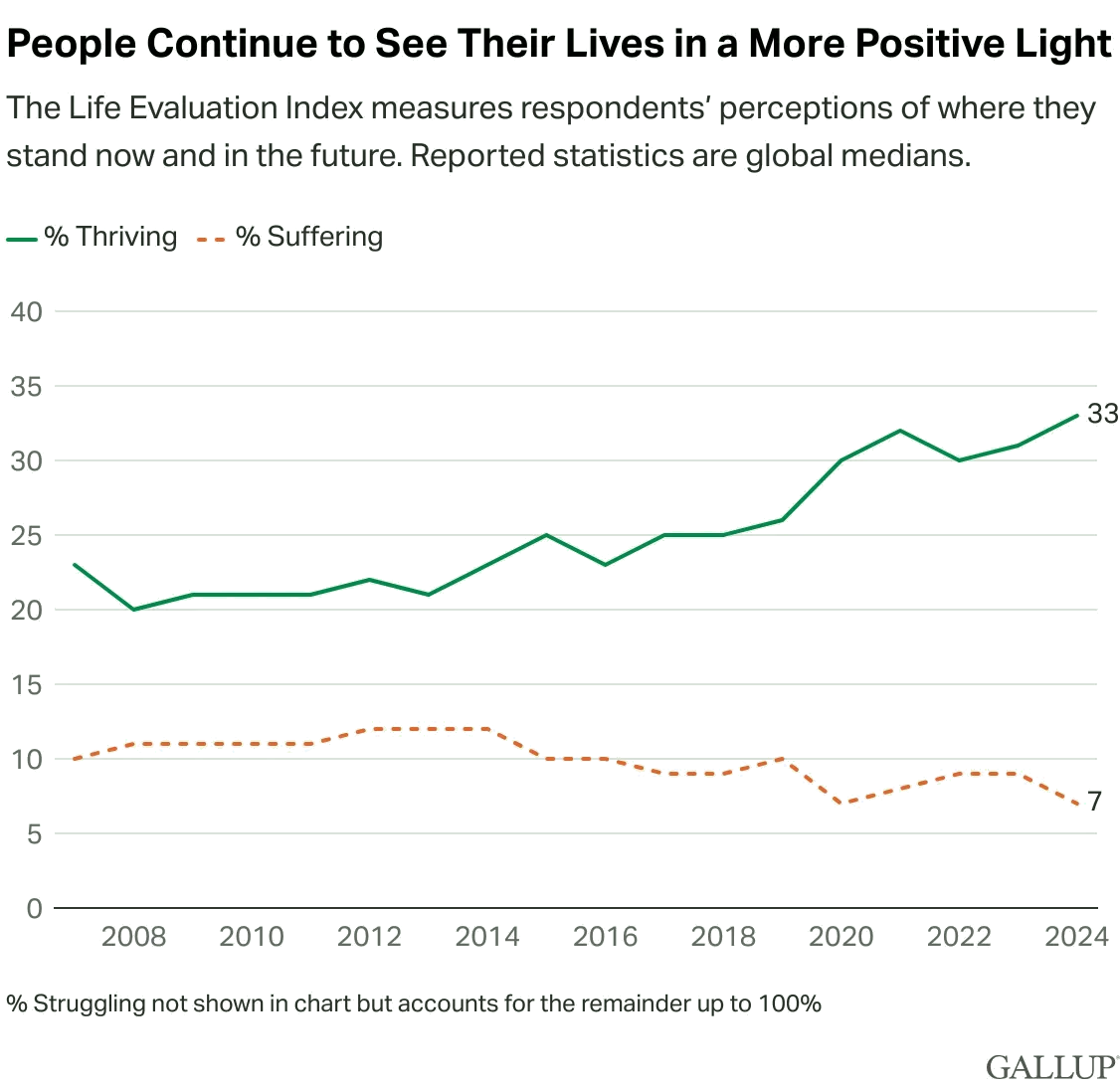
According to the latest edition of the Gallup World Poll, more people are feeling optimistic about their lives than at any point since measurements began. This is the world’s most comprehensive survey, covering almost the entire global population, and it shows that 33% of humanity are ‘thriving,’ while global rates of suffering have fallen to 7%, the lowest level since 2007.
So why does it feel like civilisation is circling the drain?
Two things can be true at the same time
I started this newsletter in 2016 to document the world’s hidden stories of progress. The news that never makes headlines. The quiet victories in health and development, the steady expansion of human rights, the technological breakthroughs solving problems we thought were intractable.
I wanted to track what was working and find out who was making it work. I’m really proud of what we’ve achieved - Steven Pinker calls us "by an order of magnitude, the best source for positive news on the internet."
However, almost a decade into this work, I’ve discovered something troubling: the better the world gets by most objective measures, the harder it becomes to see that progress. It's as if we're living in parallel universes; one where billions of lives are steadily improving, and another where everything is perpetually on fire. The machinery of fear has become more sophisticated, the algorithms more addictive, the rage more profitable.
Each day, we wake to news of some fresh new hell. Armed troops in the streets of peaceful cities (again), the latest perversion of justice, rampant grift, economic vandalism, feckless politicians, another venerated institution folding like a cheap tent in a storm. Gaza is a nightmare from which there is no relief, a permanent stain on the world’s conscience, Ukraine stands alone against an implacable invader, and once again, the lobbyists are hard at work sabotaging global efforts to fix the plastic crisis.
I’ve often wondered, like many journalists do, whether telling stories of progress in the midst of all this collapse is a dangerous distraction. But then I remember: realistic optimism isn't naïve. It's armour. It helps us face a challenging, sometimes frightening future with resilience.
Researching and writing these stories of progress gives me balance. It's my own medicine. And over the years, that balance has spread to tens of thousands of you who tell us the same thing - that this newsletter has helped you stay sane, restored your faith in humanity, reminded you that we're capable of more than just destruction.
Two things can be true at the same time. The same decade that’s given us a pandemic, populism and record temperatures has also produced the greatest ever expansion of global electricity access, record low murder rates in the United States, and the legalisation of same-sex marriage on every continent save one. We are winning the war on cancer, more than half the world’s children now get a high school education, and while climate disasters dominate headlines, renewable energy has grown so fast that global emissions may already have peaked.
Here’s another way of looking at it. In June 2025, while the United States was busy bombing Iran, French Polynesia created the world’s largest marine protected area, Bolivia advanced legislation to ban child marriage, the Global Vaccine Alliance secured enough funding to vaccinate 500 million kids by 2030, Indonesia announced that it had reduced childhood stunting by half, Ireland shut down its last coal plant, the European Union upheld a ban on bottom trawling (inspired by David Attenborough), and England and Wales decriminalised abortion. Guess which story dominated headlines?
When these kinds of victories remain unseen, they cannot reinforce policy, inspire replication, or steel movements for the long work ahead. That’s why Fix The News exists. It’s a rejection of fatalism, a manual for moving from despair and overwhelm to clarity and agency. It helps readers see past the distortion of the daily news cycle and replace reactive doomscrolling with a deeper, clearer sense of what’s working and why.
Why the move to Substack?
After five very happy years on Ghost we’re moving. The decision comes down to two things: better engagement with our community, and network effects. We’re excited about the tools Substack gives us to interact with our readers, more video content, discussion threads and short ‘news fixes.’ The ability to have real, two-way conversations will improve what we do.
However, the biggest opportunity is access. There are a lot more people on Substack than any comparable platform, and if we can reach them, it means more stories shared, more solutions spread, more momentum for the changes that are already working.
We will continue to donate 30% of our revenue to small charities. Not 30% of profit, 30 cents for every dollar we get from making this newsletter. Thanks to our paid subscribers we've ensured safer births in Myanmar's conflict zones, delivered Kindles to Afghan girls forbidden from attending school, protected elephants with satellite tracking, and stopped hundreds of kilograms of plastic from reaching the ocean in Bali.
Today, 30,000 people in Kenya receive fortified flour daily from mills that we helped equip. In the last three months, we’ve sent critical supplies to a clinic in Gaza, funded life-changing procedures for 33 kids with clubfoot in Pakistan, and purchased a hundred bunk beds for young mothers in Uganda.
Every intervention is chosen carefully, every dollar tracked transparently. We find people doing quiet, uncelebrated work, then help them do more of it. This circular news model turns stories into subscriptions, subscriptions into action, and action into more stories about how progress is possible. Substack offers us the chance to take this to the next level. More readers, more engagement, more donations to the people that need it most.

What you can expect
Once a week, all subscribers will receive our signature roundup of global progress. 15-20 of the most important stories from around the world, always free, rigorously fact-checked, no fluff, never sugar-coated. Hidden advances in public health, democracy, conservation, human rights, clean energy, and economic development. No other source offers such a comprehensive, cleanly curated collection of genuine good news.
Our Hope Is A Verb podcast will keep bringing you conversations with people on the frontlines of change. Recent guests include Boyan Slat, whose Ocean Cleanup is already stopping a significant amount of the world’s plastic from entering the oceans, and Wawira Njiru, the founder of Food 4 Education, now feeding half a million Kenyan schoolchildren every day. These are the real human beings behind the statistics, the ones doing the work while the cameras point elsewhere.
For US$8/month, or US$80/year, you'll get access to another 25-30 stories each week. Even more stories of human progress, environmental conservation and restoration, one of the best energy and climate solutions feeds on the internet, and my own, secret favourite section - the week’s latest, most astonishing breakthroughs in science and technology.
Paid subscribers also get access to a new community forum here on Substack, and 30% of your subscription goes directly to our chosen charities, no overheads, just money delivered straight into their hands, to do what they do best.
We don't have all the answers about where this goes next. Some weeks will be experiments. Some will fail. But if we're attempting to fix the news, we need to try things that traditional media won't.
Hold on, what exactly needs fixing?
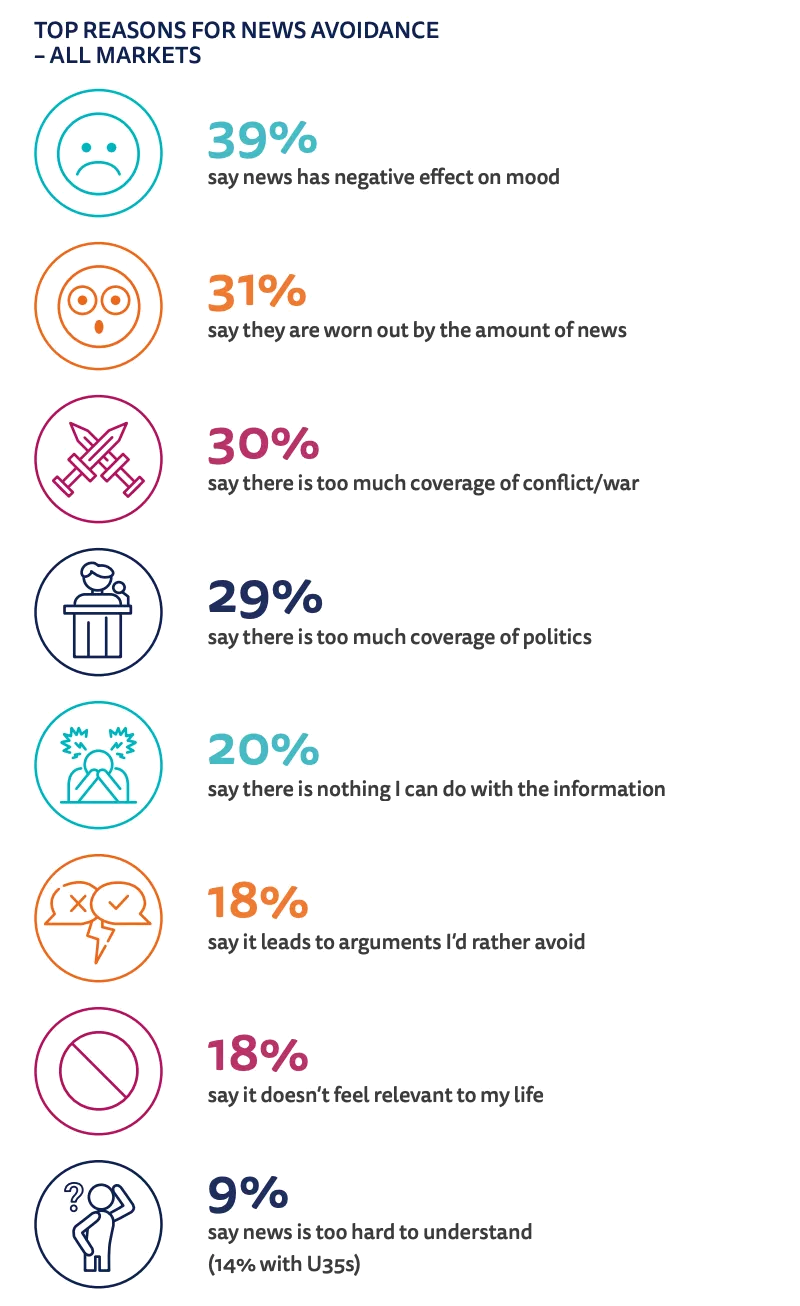
The news media is in crisis, but in more ways than you might think. Yes, there are sweeping layoffs and collapsing trust. But the real problem is that journalism has become a machine for manufacturing despair. What started as a way to inform us has evolved into a system designed to agitate us. It’s not because journalists are malicious, but because that's what the attention economy rewards. It probably comes as no surprise that the latest survey from Reuters shows almost four in ten people who avoid the news do so because it’s too negative.
The problem runs deeper than negativity bias. There's an American echo chamber that dramatically distorts our understanding of the world. Seven of the top 10 English-language news websites are U.S-based, and American news makes up more than 25% of all the world’s news, despite it being home to less than 5% of the world’s population. Canadian newspapers for example, dedicate around half of their foreign coverage to the United States, while American outlets allocate a mere 1.72% to Canada. And, when American outlets do cover international stories, U.S. involvement in those events is the strongest predictor of whether they get reported at all.
This creates a bizarre funhouse mirror where the latest outrage from the Trump administration generates a hundred op-eds, while vast new protected areas in the Amazon or the elimination of another tropical disease in Africa never register. And, since American social media platforms have become the primary news source for 54% of people worldwide, their anxieties have become our anxieties. We're all consuming their political psychodrama as if it were the only story that matters.
I am not suggesting that everything is rosy. The world faces very real challenges, and America’s current dysfunction has made those challenges even more difficult. But, what all these years of tracking progress has taught me is that along almost every dimension we’re losing sleep over, it’s been worse before. The old men making war, the creeping slide into authoritarianism, even our flirtation with annihilation - none of these things are new, and yet somehow we muddled through. We are not uniquely more doomed than any previous generation, and we have far more tools at our disposal than they ever did.
What people think about Fix The News
Our readers have shaped this newsletter. Your emails telling us how it has helped you through dark times, your suggestions for coverage, your eagle-eyed corrections, your donations that have literally saved lives - it’s what keeps us going. You've proved there’s a genuine market for people who don't just want to just passively consume good news, but be part of making it happen.
We’ve got subscribers in 159 countries. One in New York refers to us as "the antidote to the bitter political pill we have swallowed," while someone else in London tells us we made them "feel glad to be alive in this age of wonder" rather than "sad during an age of turmoil."A subscriber in Amsterdam insists we're "the only newsletter that I voluntarily signed up for and actually can't wait to read." Another in Kuwait City recently thanked us for “spreading the good, for being better than mass media, for taking the time to sift through the interwebz to find the true unsung heroes (keep crushin’ it).”
The impact goes beyond just feeling better. A teacher in Vancouver uses our stories in her classroom exercises, graphing problems alongside solutions. A journalist in Washington says he "can't count the number of times I've referred to, quoted and blatantly plagiarised your material (all in a good cause of course)." Mental health professionals in multiple Australian cities recommend us to patients struggling with news-induced anxiety, and parents everywhere write to share how the newsletter has helped their anxious children see beyond the doom they’re being taught in school.
Or, as one of our long-time readers puts it…
Fix The News has helped me de-clutter my inbox. I unsubscribed from so many other lists because the sheer contrast from its brilliance to the pile of crap one usually receives was suddenly painful. I neglect my life when it arrives. I will leave things burning on the stove, ignore any request made of me - come hell or high water I will read every word.
Or, I follow my husband around the house, reading it to him aloud, whether he's about to walk out the door or trying to fall asleep. Then I clutch my tablet to my chest, eyes all a-sparkle (the way I imagine people felt about their nightly newsreader in the 70s) and say 'Isn't it just great?' until the cycle repeats itself a week later. I am now that intense person at a dinner party, telling everyone how they HAVE TO get this newsletter, hustling for it like I'm paid a commission.
There is so much self-serving noise online these days, weakly disguising itself as a valuable contribution. Fix The News feels like a gift. A hard-won, deeply intelligent, thoroughly inspiring gift to all of us. The lack of visibility around positive news stories is a major problem, with consequences we can all see every day - rampant cynicism and apathy.But it's a problem Fix The News is taking on like a boss. Reading their stuff will make you want to celebrate, to support, to take part, without a trace of irony, but with a sense of humour intact. Give yourself the gift of feeling so much better about the future.
Over the years, I've watched myself, my husband, and readers close to us gradually and permanently change how they think about the world thanks to this newsletter. It's changed how we react to gloomy assumptions shared in common conversation, helped us think more skeptically about news coverage choice, and left us with much more nuanced feelings about the future, in awe of all those who are quietly, getting shit done.
What Fix The News is doing is important. It's honest and courageous, smart and entertaining. How many newsletters out there leave you feeling sincerely inspired about the potential of the human race? If you're not already reading it, OH MY GOD why aren't you reading it?!?
Katie Gertsch, British Columbia, Canada
You can't navigate by panic. You can't build on what you can't see. And you can't replicate successes you don't know exist.
The news wants you to be anxious and addicted, and the tech bros want you to perform outrage for engagement metrics. We want you to be informed about what's actually happening, connected to others who care about evidence and narrative, and equipped with stories of progress that you can share, support, and scale.
Join us. Together, we can ensure that the biggest story of our time - the slow, uneven, but measurable improvement in human wellbeing - doesn't remain the most untold story of our time.
Thank you for reminding us that are GOOD things happening in the world. My younger son is actually in French Polynesia right now with a group that is trying to replenish the world's coral reefs. Today he sent me a video of a humpback whale playfully swimming along side him. Also, very glad you made the crossover to Substack. . .now I can post the link to your SubStack page in other newsletters (e.g. Heather Cox Richardson, Robert Hubbell) to provide some positive inspiration!!!😃🙌
Though I would follow you anywhere, great you moved to Substack! Your reporting, research, focus on the positive, dedication, philanthropy and more are awesome. Deeply grateful - love who you are and what you do.