In 2024 we invited historian Ada Palmer onto our podcast to talk about the history of progress. Ada is one of the world’s leading historians of the Renaissance; when she talks about Machiavelli and Shakespeare it’s like they’re old friends. But she's also an award-winning science fiction writer, spending as much time imagining the future as she does studying the past.
If I had to put Ada in a box I’d label it “Time Traveller,” and at the end of our first conversation, she said something we just couldn’t shake. “The world doesn’t stay saved. That’s the story of the last 150 years. We saved the world a couple of times. Now we have to save the world again.”
She was one of our favourite ever guests, and, it seems, our listeners too; that episode received more downloads than almost anything we’d ever released. So when Ada reached out earlier this year with an idea for a new podcast series, it was easy to say yes.
A Short History of Saving the World is the latest addition to the Fix The News podcast network. Each month, Ada and Gus take one of the big questions of our time and explore it through the lens of history: not to rehash the past, but to use the long view as a way of understanding the present.
This month’s episode, “I Think, Therefore AI?” begins with a question that feels impossible to escape right now: What is consciousness?
From Richard Dawkins and Descartes to Astro Boy, Silicon Valley and ChatGPT, it’s a fascinating conversation about artificial intelligence, empathy and what it means to be human.
Full disclosure: I probably have no business producing a history podcast. Before we started making this series, I don’t think I’d ever listened to one. I assumed I was making this for other people.
Then this conversation about AI happened, and somewhere between the manga and a wild tangent involving Aristotle and the elusive reproductive system of eels, I got hooked.
There’s a question I ask myself during every podcast edit: does this make me want to lean in? Sitting in on this conversation, I wasn’t just leaning in. My pen couldn’t keep up with all the things I wanted to remember.
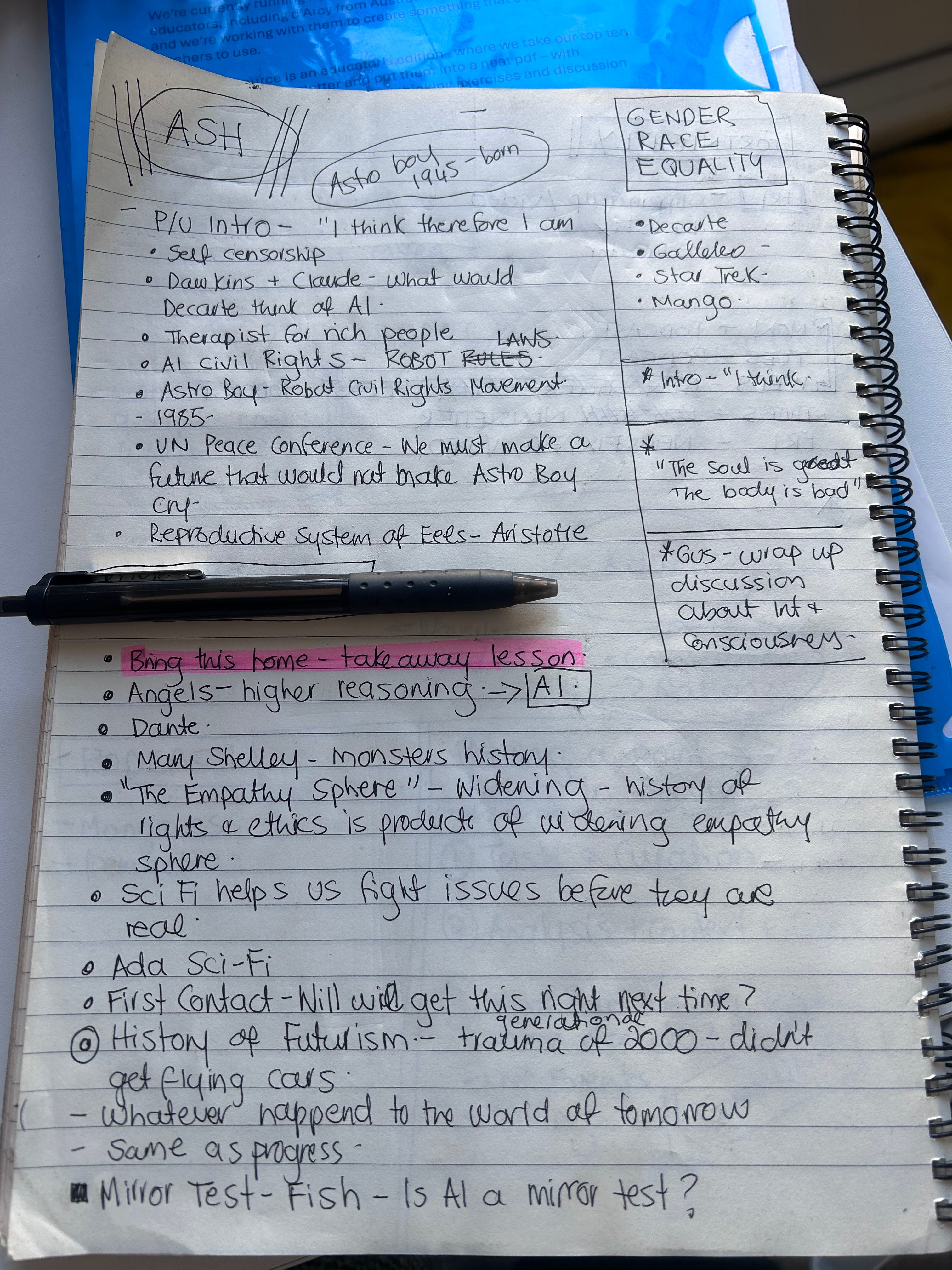
There was no big planning session beforehand. No scripting. No pick-ups. What you’ll hear is exactly what happened on the call: two very curious people connecting the dots around AI in way that you almost definitely haven’t heard before.
That’s also why we’re releasing this series monthly. These aren’t episodes to rush through on your commute. They’re conversations to spend time with. We’ve even built in natural pauses, so you can stop, make a cup of tea and come back when you’re ready.
We’re only two episodes in, and already, the biggest thing this series has given me isn’t necessarily a better understanding of history (although I’ll never think about the Renaissance in quite the same way again). It’s a longer view.
And it’s also given me the confidence to completely derail any AI conversation by asking, “Did you know about Aristotle’s theory on eel reproduction?” Trust me. It’ll make sense!
You can listen to the full conversation wherever you get your podcasts, including Apple, Spotify or YouTube. We’ve also included the full transcript below, in case auditory learning isn’t your thing and you prefer the written word.
Angus Hervey
Richard Dawkins recently had a conversation with Claude, and after three days of Claude telling him how wonderful his ideas were, he came back and said, “I have decided that Claude is conscious.”
What do you think Descartes (who of course gave us “I think therefore I am,” the foundation for the modern idea that subjective experience is the bedrock of who we are), what do you think Descartes would say if you put him in front of a computer and gave him Claude for a few days?
Ada Palmer
I don’t think he would be happy. I think he would really want to work with it for a long time, and all the way down. This is somebody who did meticulous measurements of the human body, of the contents of breath. This is somebody who spent ages on the question of how magnets work. He would be one of the coders actually trying to work on the system and figure out how the AI works from the bottom up. He wouldn’t be content with an experiential evaluation.
Angus Hervey
Descartes also said that animals were biological machines and they didn’t have any feeling or experience. And Voltaire later ridiculed him for this, pointing out that anyone who spends five minutes with a dog can see that it’s experiencing something. What was Descartes actually doing when he drew that line? And what does that whole episode, or exchange, have to teach us about what humans count as a mind?
Ada Palmer
The narrow historical answer of what Descartes is doing at that point is that Galileo has just been condemned by the Inquisition, and Descartes is scared out of his mind. Catholicism comes down very strongly against animal souls and animal consciousness and this is a dangerous area for Descartes to be in theologically. Going with the very stark “humans have souls, everything else is machines” is a way he can engage with materialism while carving out a really strict and safe space for the soul.
So one of the reasons he’s being so stark is there have been fights over this question during the Reformation. One of the ferocious things people were executed over in the Reformation is: if a mouse chews on a consecrated holy wafer, does the mouse go to hell?
Angus Hervey
Ha, right!
Ada Palmer
Because the mouse has desecrated the holy wafer. And they’re very concerned about this. Do mice have souls? Is the holy wafer the flesh of Christ? So you have to place Descartes in the middle of an incredibly dangerous sphere.
Angus Hervey
What’s interesting is that we think about these people as separate from the historical context in which they’re operating. But I guess what you’re saying here is there is a political angle to what they’re writing about and what they’re thinking as well. It’s the most basic human thing of all, which is: I have to survive in order to be able to do what I do.
Ada Palmer
That is a political response by him, but it’s also less “I have to survive” than it is “I have to get them to approve my treatise so that I can get 90% of my authentic ideas out there at the cost of self-censoring the other 10%.” And that’s one of the biggest effects of living in a censorious regime, that you get this kind of strategic caution. Hence one of the important mottos for thinking about how censorship operates: the majority of real censorship is self-censorship, but the majority of self-censorship is deliberately cultivated by an outside power.
The Inquisition knows perfectly well it can never destroy every copy of a book that’s already been printed, but they can make sure the ideas are never printed in the future by scapegoating somebody like Galileo, so that a generation is more cautious.
We tend to try to present these people as if their ideas spring independently from their lived world. The philosopher is a marble bust on a pedestal, or he’s living in a hut by the raging sea, philosophising abstractly and unaffected by paying the rent and what he has to have for lunch and what the insane government is doing. We have to remind ourselves all of these philosophers had to pay the rent, and all of these philosophers had to worry about what the insane government was doing, just as much as we do now. And that shapes what they do and don’t say.
Angus Hervey
Okay, these questions around consciousness, around who has a soul, who doesn’t have a soul, is it conscious, is it not, they sound like a philosophical and academic debates, but they actually have real world implications. The story I’m thinking of here is that in 1550, the Spanish crown convened a formal debate between Las Casas and Sepúlveda, and the question was whether Indigenous Americans had rational souls and counted as full human beings.
That debate wasn’t the single determinant of policy, but it was a very big part in shaping what Europeans eventually came to think about what they were doing in the Americas. In 1550, while they’re having this debate, what’s actually happening there? And what does that have to say to us now in 2026?
Ada Palmer
So firstly, book recommendation: Robert Launay’s brilliant book, Savages, Romans, and Despots, is a history of the two centuries during which Europe convinced itself of its own superiority. Because Europe in the Middle Ages, and even in the first half of the Renaissance, does not believe that it is superior to the rest of the world. It knows perfectly well that it’s a financial backwater, that it’s a technological backwater, that it’s weaker than the powers to the east, that it’s very impoverished compared to its occasional contact with sub-Saharan African powers, who, every time they visit Europe, which is very rare, like once a century, but every time they do, they’re like, “I’ve brought more gold than the entire GDP of France with me to spend during my visit.” And Europeans are like, “Oh my God, what is Ethiopia, is it made of gold?” The Vikings literally believed that.
Then in the 16th and 17th centuries, the technological capacity for colonialism comes in. Europe has to come up with a way to justify this and please its own conscience. And you see a process over about 200 years of Europe coming up with all of these ways to justify the superiority of its culture, or its people, or its religion, or its artwork. The Eurocentric and Euro-supremacist thing does not go all the way back. It’s engineered in response to needing a justification for a horrible thing that you’re doing and needing to feel better.
And here I’m reminded of an interview I read, I don’t know, 15 years ago, with a therapist for super rich people. There was a quote from one of this therapist’s clients saying, “You know, the first time I spent $20,000 on a set of bed sheets, I felt really bad about it. I felt like I was doing something wasteful, that I should be helping humanity instead. But my therapist really helped me come to terms with that.”
And that’s what Europe is doing with its philosophers when it has that kind of debate: the first time I slaughtered a whole bunch of people, I kind of felt bad about it, but my therapist really helped me come to terms with understanding my superiority. There is a whole lot of mental and ethical and religious gymnastics that is incentivised by the opportunities of imperialism.
You see it happening as they rethink not only how they think about consciousness, but how they think about anatomy, how they think about medicine, how they think about history, how they define culture in different ways, how they define language. It really flips over and turns over. Sepúlveda really wants to be able to say yes to the prospect of, can we just enslave these creatures and it doesn’t have an ethical weight, and doesn’t want the answer to be no.
Although in that particular case, of course, it’s fortunately Las Casas’s position that ultimately wins out, which is why citizenship and protections are extended in South America, where he’s still a hero and there are statues of him and holidays in his favour, because he argued for the humanity of the indigenous populations against a Europe whose therapist-like justifiers were trying to come up with excuses for how it could be that they were doing these terrible things and yet somehow it must be ethically okay. Particularly: we define the king as virtuous, therefore if the king is doing these things, they must be virtuous things. We bend over backwards to make it happen.
Angus Hervey
Bringing that into the modern day, could you make an argument that Silicon Valley today is engaged in a post-hoc kind of rationalisation in the same way Europe was in the 18th century, but this time around they’re making the argument that AI is conscious, as opposed to an AI that doesn’t have a consciousness. Would that be a fair argument?
Ada Palmer
Silicon Valley has a breadth of people in it with lots of different positions on this, just as much as Las Casas exists alongside terrible people. There’s always a spectrum from best to worst in terms of how much people are defending rights and empathy, and that’s true of Silicon Valley as well.
Separate from my hat as a historian of Renaissance Europe, I work a lot on the history of science fiction, and especially on the history of manga, and therefore on the history of the AI civil rights question. That’s a very interesting history, because if you rewind to Golden Age SF, and you’re looking at what was coming out right before, right during, or right after World War II, there’s lots of robot stories.
In golden age science fiction stories from the Anglosphere, which are dominated by American authors, though not exclusively, robot stories tend to be about anxieties about labour uprisings, or proxy slave uprisings. It’s, “What if the robots rise and overthrow us, what if the robots defeat us.” The Matrix is a late generation iteration of this same structure, where the robot stands for the labouring classes, or in America specifically, anxiety about slave uprisings.
If you look at Asimov’s laws of robotics, the idea is: when people create robots, what are the first things they do? They will have to give all the robots these very rigid programming rules to say: you may never harm a human, you may never through inaction allow a human to be harmed. These are the laws of robotics. When you say laws of robotics, or robot laws, you mean the programming hardwired into a robot to keep it from killing humans.
Meanwhile in Japan, we are in the aftermath of World War II. There is severe censorship. You are not allowed to talk about the war. You are not allowed to talk about what happened. Both the American occupation forces and the new Japanese government are very anxious about the war. And at the same time, we have a generation of Japanese kids who watched the world turn upside down, they have lost their families, they have lost their fathers and brothers, they desperately need somebody to talk to them.
I know this sounds like it’s not related to robots or consciousness, but I’ll get there.
They desperately need somebody to talk to them about what just made the world burn down. And the government is not bothering very much to censor children’s science fiction comic books, because they’re just not important, and they’re not where the discourse is expected to be.
So at the same time that the newspapers are not even allowed to have the type character necessary to print the word “atom bomb,” Osamu Tezuka can write Astro Boy. And Astro Boy is about a robot civil rights movement. Humans are treating robots as chattel and exploiting them. And there’s a dictator called Hitlini who is trying to purge all the robots from his country.
So Astro Boy has to travel to America to learn from Black civil rights activists how to organise a civil rights movement and fight the KKK, in order to apprentice and learn how to fight anti-robot hate groups, and then go back and work on things like defending the first robot to try to register to vote, acting as a bodyguard for the first robot to run for public office.
He visits — I’m not kidding, this is a comic for ten-year-olds — the Cambodian genocide, and fails to stop it. Because this comic is for the unique generation of kids who lived through World War II and need to know what racism is, and what genocide is, and what fascism was. He uses robots because robots aren’t being censored. So you can do this with robots when you can’t yet do it with people.
That meant a parallel streak in the history of science fiction in which we’re on the side of the robots and we want to push for civil rights. Tezuka, hearing the phrase “robot laws” coming across from English, because he was very interested in what was going on in English language sci-fi, but not having direct access to Asimov’s stories, just hearing that Asimov had talked about robot laws, put robot laws in Astro Boy, and they are the Civil Rights Act, giving robots citizenship and the vote.
So “robot laws” means the opposite in Japanese SF versus Anglosphere SF. In the Anglosphere, it means the repression of robots so that they cannot harm humans. In the Japanese SF tradition, robot laws means citizenship, civil rights, and you can no longer be a chattel slave.
These two science fictional traditions then cross-pollinate as works are translated back and forth between the two, and especially as, starting in 1985, Japanese works are being translated into English via the manga boom. This is the first and only large corpus of science fiction ever to be translated into English.
We live in a one-way translation world, where stuff in English gets hegemonically translated and spread to other languages, and very little gets translated back. You get this weird one-way conversation where authors writing in Portuguese and Finnish and Spanish and all over the place are writing science fiction in response to Anglophone science fiction, and we get almost none of it back, except after 1995, when, boom, if it’s manga, we start getting it.
Science fiction writers in America start reading it. Science fiction nerds and young tech nerds are reading it, and especially people who are engaging with robotics, because Japan became a leader of robotics — I’m not kidding — because of Astro Boy. When you read interviews with Japanese roboticists, they always say, “I wanted to build Astro Boy, I wanted to build a Gundam.” This is an extremely idealistic pro-AI rights movement that predates the idea that they actually have them.
So in 2003, which is the actual date Tezuka chose to be the creation date of Astro Boy, Japan’s actual, for real, government issued a birth certificate for Astro Boy, saying they wanted to be the first government to recognise the civil rights of an AI. A fictitious AI that didn’t exist, but that represented the ideals of empathetically sharing our planet with this new form of life.
Not long after, they hosted a United Nations peace conference, and they had a big banner over the top of the amphitheater where all the representatives were meeting that said, “We must make a future that would not make Astro Boy cry.” Because it was such an ideal. The Astro Boy manga is about environmentalism and optimism and international cooperation. It depicts a techno-utopian future of international collaboration, led by the sharing of science and the granting of civil rights to this new group of sentient equals.
If you think about 1995, for many prominent people in the tech world, they’re young at that point. This is a formative moment. It means that the current tech world has been formed by this fascinating clash of these two traditions. Is AI a threat, the way it is in The Matrix, or is it a friend, the way it is in Astro Boy? Is it both?
That debate started circulating. One of the things this means is that robot civil rights movements, especially in Japan, date back to the 1940s. By 1946, there are people in Japan seriously engaged in the question of whether we must be ready to extend rights to AIs when we finally have them. So there’s a very old and strong tradition of it.
Meanwhile, there are big AI companies who have sunk a lot of money into a thing, and if that thing is sentient and has rights, then they don’t have corporate liability for any harm that it causes. They can exploit the tradition of an AI civil rights movement in order to dodge corporate responsibility. That is also a streak in this debate that is cannibalising and exploiting a very old and very idealistic post-World War II anti-fascist AI rights tradition, and saying, “Hey, we can harvest this to protect our capitalist interests against liability!”
In that sense, AI rights movements vary enormously in terms of their ethical respectability. On one end, this is an ideal born of the people who survived a genocide and recognise that they were culpable of another (there are major Hiroshima survivors who are big AI rights activists and are like, “we need to make sure this never happens again and that we never do it again”). The other end is, “Hey, the corporate lawyers can use this” — and then there’s everything in between.
Right now the AI civil rights movement is really vexed and some of the people I know who are in it are some of the best people I know, and others are some of the most disingenuous people I’ve ever had a conversation with. It kind of breaks my heart, as someone who’s been studying the history of AI civil rights, to see it get exploited in that way — in exactly the same way that the King of Spain is exploiting debates over the nature of consciousness in 1550.
Angus Hervey
This is why we can’t have nice things. And it’s also why we do have nice things. I want to drill down deeper on this question, so let me see if I can put you on the spot. Anil Seth, the neuroscientist, argues that consciousness means you need to be alive. There is a sizeable faction of people arguing this now, saying you cannot get genuine experience out of silicon, it doesn’t matter how sophisticated the software is.
That sounds cutting edge, but this goes all the way back to vitalism, the 18th and 19th century idea that something alive has a special life force and you can’t just reduce that to chemistry. So where do you land? And where does the argument we are having now sit in the longer history of this bigger argument that we’ve been having, potentially, all the way back to Plato’s cave?
Ada Palmer
This is where, campy as it is, the original series Star Trek is sometimes still one of the best philosophic moments to visit. They have the episode where they’re like, “We’ve scanned it and nothing scans as being alive, but here it is, moving along a tunnel eating rocks, because our scanners weren’t looking for silicon-based life, they were looking only for carbon-based life, and therefore now we’re having a crisis and realising we were looking for the wrong thing.”
Which zooms in on: philosophers and serious scientists have been aware for a long time that when we look for life, we may not recognise it if it doesn’t resemble what we’re looking for, because it might be a haze, and it takes us a long time to realise that there are electrical structures within that haze that are interacting with each other. So how do we define life? Is it the mechanical operations? Is it material?
I remember very vividly, I was in a science commune at the time, hanging around with some astrobiologists, when — gosh, it would have been in 2015, maybe 2016 — they fully mapped a C. elegans worm, every cell. And then somebody created a computer simulation of C. elegans and turned it on. It was the first fully digital animal. There was this instant debate, in this tiny thread of people around the planet, but they all entered into it at once, of, “Oh no, is it now unethical to turn off that computer?” Because you would be ending the life of this thing, which is in a simulation, but in important ways identical to a real C. elegans worm. Thousands of people connected by this one thread of research across the world suddenly had the same debate Star Trek had, the same debate so many others had.
So can I dodge the question a new way, by going back and giving us Plato, and some backstory?
Angus Hervey
That’s kind of what I was hoping.
Ada Palmer
So when we go back to Plato, and also Aristotle, they’re interested in the question of how do we define the differences between things. One of the neat things about Aristotle is that, while there’s plenty he’s wrong about, he is so amazingly impressive at getting really far within one lifetime, starting at practically zero. He just goes down to the dock every day to observe fish, and by himself gets as far as figuring out the vertebrate-invertebrate divide in biology.
One dude, by himself — this is really impressive. He calls it creatures with blood and creatures without blood. He also noticed the puzzles we’re still wondering about. Aristotle spent a huge chunk of his life trying to figure out where the reproductive organs of eels are. He was so right that eels are really weird.
Angus Hervey
Yes! Eels also have really crazy navigational abilities. There are eels here in Melbourne that navigate across oceans and back.
Ada Palmer
Yeah, and eel reproduction has long been one of biology’s great mysteries. For centuries, scientists struggled to understand how eels reproduce, and while much has been learned, parts of their life cycle are still not fully understood.
Aristotle also figured out that the octopus is just nuts, and defies all other things, and gave him that wary feeling of, “Wait a minute, the world is larger and stranger than I thought, because everything else makes sense but not the octopus.” He’s so right.
He was very interested in noticing, as we noticed, that there are categories of stuff in nature. There’s the category vertebrate, and within the category vertebrate, there’s a category mammal, within the category mammal there’s a category horse. He figured out a lot of the way we now categorise materials, rocks, etc. We still use this taxonomy, that we label things by the categories they follow. This is fundamental to how we understand science today. It’s one of the things that has been most preserved for the longest time in the history of science.
So he’s saying, “Okay, as we narrow down and define a category down to the level of species, there’ll be an ultimate specific thing, like apple trees produce apples. They have other characteristics they share with other trees, but the apple is the defining characteristic of the apple tree. What then is the defining characteristic of the human, in contrast with others?”
He then zooms in on the interesting questions of psychology, and divides psychological and mental function into three parts. This three-part subdivision of mental function is going to be absorbed by European thought and continue to be the dominant model for how people think about cognition for a millennium and a half. He divides it into three functions: the appetites, the passions, and reason.
The appetites are the most basic functions of an organism with volition, meaning not a tree, but something that is motile and capable of taking action. The appetites are hunger, tiredness, the desire to rest, sexuality, the desire to mate. These things can be observed even in the most basic of motile life forms, like clams. He would say that anything that is an animal has the appetites.
The middle category, he then says, are the passions. These are a more sophisticated palette of psychological content, and they include ambition, and pride, and the desire for self-worth. They also include wrath and envy. He says you can observe these in dogs, you can observe these in a herd of sheep. Rams will vie with each other, they have ambition, dogs will hold grudges. And then, if you want to categorise animals, you ask questions like, okay, this snail has appetites but not passions, this horse has both, what about this mole, does this mole have passions, or does it merely have appetites? You would then observe them at length.
The third category is reason, and for Aristotle the only organism with reason is humankind. Humankind does a sophisticated rational analysis that differentiates human beings from lesser animals. Cue all of the Greeks then debating questions like, “How much of our decision-making is actually that?” When a donkey looks at a bale of hay and does or doesn’t walk over to that bale of hay, isn’t the donkey exercising reason? And he would say, “No, that donkey is exercising the appetites at that stage.”
Reason is a more sophisticated thing, it lets us contemplate the heavens, it lets us do mathematics, it lets us build tools, but it is a separate thing that only humanity has. Sapiens is Aristotle’s word for “with reason,” and man is the rational animal, the one animal that is capable of exercising reason.
The last fact I will then add, before I pause to see your thoughts as you chew on these three categories, which, as I said, are going to dominate the way people think about this stuff for a millennium: when Christianity shows up and encounters Aristotle, and all this cross-pollinates, their idea of an angel becomes a being that has reason and doesn’t have the appetites and the passions, that it is only the top part of cognition — or possibly it has the passions but doesn’t have the appetites, hence the debates about Lucifer and pride, etc.
Whatever reason is, it is the thing that humans and angels have that make humans like the things that rise to heaven, and unlike the animals, which are things that don’t rise to heaven and go downward toward the earth. That’s the Christianized version of this Aristotelian three-part subdivision.
Now, the three-part subdivision is also in Plato. If you read The Republic, he divides people into those who are dominated by the passions, those who are dominated by the appetites, and those who are dominated by reason. So Aristotle is expanding this out of Plato. But it’s Aristotle who uses it categorically and is really concerned about animals, as opposed to Plato, who is mostly like, “Very few people are rational, a lot of people are passionate, most people just want to sit around and have lunch and then go home.”
Angus Hervey
Okay, a few reactions to this. The first is (and this never fails to amaze me) how much the thinking of the Greeks, in particular these two great philosophers, still informs the way that we think about so much today. You can see it in how pop psychology works today, you go speak to a therapist, and people will talk about the prefrontal cortex and the lizard brain.
The other part I think is really interesting is this idea that angels have pure reason, and they’re disembodied, so they don’t have to worry about the stuff that we have to deal with, and so they can see further, they’re wiser, etcetera. And I feel like you could map that directly onto artificial intelligence today, or what we all seem to be calling artificial intelligence, these LLMs that have been built by the big tech companies. There’s certainly a religious component to the way that a lot of people in Silicon Valley talk about them.
Of course, the opposite argument applies, where people say, no, no, this thing can never be conscious because it doesn’t have a meat sack. And if it doesn’t have a meat sack, then it can never know what it means to be alive.
Ada Palmer
Well, one of the tensions that Christianity has had for ages, that theologians have to bend over backwards about — Thomas Aquinas especially — is: once Christianity and Greek philosophy and Roman philosophy cross-pollinate, and we get the blend that is happening in the third and fourth centuries AD, on the one hand it really, really feels like the soul is the self, and that’s what survives the death of the body, that’s what goes to heaven, it’s immaterial.
Plato and the Greeks also had immaterial ideas of the soul. The soul seems great, the body seems bad, the body is full of sin, the body is also the mortal part that gets ill. You really want to say the soul is great, the body kind of sucks. But the Bible says at resurrection everybody gets their body back, and the body is important, and Christ becoming embodied is important, Mary’s body is important, there’s all this body stuff.
So there’s a fight back and forth within Christianity: the soul is great, the body sucks. No, the body is actually very important, because the Bible says the body is very important. But we really, really, really love the soul, which is why things like Aquinas’s Summa Theologica have chapters on “my soul is not me,” the soul alone is not the being.
Christianity is really flip-floppy about this, and it’s no exaggeration to say that practically every decade a new heretic reinvents “the body is pointless, we don’t need the body, we only need the soul.” And then, no, no, the body is important. In the plural of Christianities, this is one of the biggest split points.
They’ve inherited this split point from the Greeks, for whom Plato says that the body is a prison into which the natively immaterial soul has fallen and gotten trapped, like a noble bird trapped in a tar pit. The only way to salvation is to break free of the body, and break free of the cycle of reincarnation, and finally regrow the wings of the soul, and rise, and leave all of this behind. That comes from Plato, it doesn’t come from Christianity. But Christianity picks it up from Plato, multiplies it, chews on it, makes angels out of it, and continues to transmit it to us, deeply entangled, like two strands of a braid.
Angus Hervey
I mean, tha’s still what we’re doing right now. So yeah, okay, it makes a lot of sense to me. But as always, there’s deeper historical context.
Ada Palmer
There’s a neat detail from Dante’s Inferno. You’re journeying downward through hell and going through the sins bit by bit. A lot of people, on a first pass of reading Inferno, get really weirded out when murder is only barely halfway down. There’s a lot of stuff we consider less bad than murder, like counterfeiting and bearing false witness, that are deeper down. We think those things are bad, but if you were asked to give the judicial sentence for counterfeiting and the judicial sentence for murder, you’d be like, “Dante, I don’t quite understand your hierarchy of priorities here, this seems kind of weird.”
But it’s because his hell is divided into parts based on how noble the part of the human mind is that you’re using and abusing when you do the thing. The least bad sins are the ones that use the appetites, because those are very basic and very simple and very easy to give into. All beings, even oysters, feel lazy and commit sins of sloth. All beings, even squirrels, feel lustful and commit sins of lust.
Then the middle section is passions, like anger, which means violence, which means murder. The passions are nobler than the appetites, so abusing them is worse. Then the deep section is for the sins of the intellect, the sins that only reason can do — a horse cannot bear false witness. So it’s considered by Dante to be worse than crimes of violence, because it’s perverting the noblest part of the human being.
We see residue of this in the way we differentiate between first degree and second degree murder: we think that premeditated, cold-blooded, planned, intellectual murder is worse than “I got really angry and I killed the guy.”
Angus Hervey
I read Dante’s Inferno when I was 21, in the original Italian — ok well not the Italian we know today anymore, but my lecturer somehow failed to tell me about that. I wish they had, it would have made a lot more sense, because I was really confused about the categories of sins.
OK I want to talk a little bit more about metaphor and about storytelling, and about a whole other strand of science fiction, which I would say is maybe just as potent and just as important when you’re thinking about the history of science fiction, which is the history of monsters. Obviously we want to start with Mary Shelley.
Ada Palmer
There’s lots of monsters in Dante, come on.
Angus Hervey 35:01
True, there are, but I still want to start with Mary Shelley, who wrote Frankenstein when she was 19, which still blows my mind. She was obviously drawing on a tradition that goes pretty deep, it goes back thousands of years — the golem, the Pygmalion statue, the bronze giant Talos, in Crete. Every tradition seems to have a being that gets created from non-living stuff and then becomes alive.
If you look at what we’re doing now, which is creating actual robots moving around on the battlefields in Ukraine, there are robots folding laundry, there are robots packaging boxes in Amazon warehouses, and there are also people in Silicon Valley who are building the brains for those robots — are we about to see the final realization of that? Are we going to actually create a being from non-living stuff?
Ada Palmer
Well, when we choose our examples — Frankenstein, Pygmalion, Colossus — we’re picking the sentient ones. We’re picking the ones that Aristotle would say exercise all three components of cognition, that have reason. But there’s also a tradition of making animals from scratch: sowing the dragon’s teeth and dragons spring up, or you throw down the special beans and they hatch into chickens, making animals out of nothingness in fairy tales and so on.
Yet those don’t bother us the same way. Isn’t that neat? We don’t sit down and puzzle over the consciousness of the chickens that used to be beans. Chickens have appetites, and might even have passions, but it only bothers us when we think they have the third component of reasoning, when we think they’re our peers in intelligence.
There’s a term I use to discuss this: the empathy sphere. Your empathy sphere extends to all the beings that you consider to be just as much a person as yourself, or just as real and important as yourself. You feel the empathy sphere when you do things like reading old utopian books. If you read More’s Utopia, it practices slavery and deliberately tries to get its neighbours to kill each other, and you’re like, “I’m sorry, this doesn’t feel like a utopia to me.”
Or you’ll read an early 20th century utopia, and it’s a utopia for men, and you read it, and even if you’re a man, you read it and you’re like, “The women have no rights in this society, this does not feel like a utopia to me, what’s wrong with these people?” Because women are in your empathy sphere.
We’ve expanded our spheres, so that you can get a society where you say “Here’s a pretty good society, but they’re murdering whales, sorry, it doesn’t feel like utopia to me, because whales have moved into our empathy sphere.” We think of them as close enough to us that if a fictional society is destroying all the whales, we feel something that we don’t feel when this fictitious society is destroying all the mushrooms, or all the squid. There’s an empathy sphere where we decide that this isn’t an acceptable society, or a good society, it’s not a society I can praise, because there are beings that I think are as much a person as myself who don’t have rights in this world.
When you then look at artificial creatures, the question is: is the artificial creature within that empathy sphere, or is it outside of it? Because if it’s a robot trashcan and it goes around and picks up trash, we might conflate it in our minds with the intelligence level of a hamster, we want to be nice to it the way we want to be nice to a hamster. But that’s very different from when it’s presented as having the level of sentience we have.
We as a society are in a space where, if you write a science fiction book that has in it fictitious artificial intelligent beings that are presented as human-like in intelligence and are enslaved or unfree, it makes the reader uncomfortable, and the reader does not like that. The same way we end up uncomfortable if they’re murdering the whales, because our empathy sphere has expanded to include robots that we think of as sentient.
But when it’s robots we don’t think of as sentient, when it’s robots we think have maybe just appetites — they approach the power source, they move away from the power source — when you’re thinking about throwing away an old Roomba, you feel a little bit weird about it, but not as if it was a person, more as if it was maybe a cat. It has pet status, but it doesn’t have roommate status.
So cognitively, we’re aware of, and differentiating between, robotic creations that we consider to be peer and that we consider to be pet. We are deploying an enormous number of robots that are much more tool or pet — think about surgical robots, think about the rice-planting robots that plant rice in rice paddies. These are things that are not humanoid at all, and they’re great, we use them, but we don’t worry about their cognition.
We enter a different space when it’s suggested to us that this thing we’re engaging with may have intelligence enough that it should be in our empathy sphere. Humanity’s empathy sphere has been expanding, this is great. When we are uncomfortable with slavery, that’s our empathy sphere being wider than it was in the 17th century.
Angus Hervey
Could you just say that the history of progress is the history of drawing more and more people into our empathy sphere?
Ada Palmer
Certainly I would say the history of rights and ethics is, in a very important way, a history of drawing more and more people into our empathy sphere. And the more the boundaries get pushed, the better. As a science fiction writer, one thing I’m very proud of is that science fiction has often been one of the big tools in the last century and a half for expanding our empathy sphere, asking these questions, showing people, here’s an astronaut, he’s Black, maybe Black people could be astronauts, oh wow, I will now rethink my empathy sphere.
In the case of both aliens and artificial intelligences, it has pre-expanded it, so we were ready to give these things civil rights before we met them. In 1945 and 1947 especially, when Astro Boy is getting started, you want Astro Boy to have civil rights, and you want your empathy sphere to include this thing, which isn’t real, but it needs to have rights, and your heart knows it.
A principle of science fiction is it lets us fight our moral battles before we get to them, by offering us things like cloning and asking us the moral sides of cloning before we have cloning. It let us fight this preliminary moral battle about artificial intelligences and say, yes, when we have real artificial intelligences, we totally want them to have rights. The question then becomes, where are the lines of that, and when is this thing peer, and when is it pet or tool? Because robots with bodies and cyber-intelligences are very different things.
Angus Hervey
I want to talk about your science fiction for a little bit, because in Terra Ignota you have these characters called set-sets, who are humans raised from a very young age in very specialised cognitive environments.
Ada Palmer
Yeah, they’re basically growing up in a VR setup that gives them masses of what we would call big data, represented not only visually but also with hearing and touch all over their body. So they’re used to an environment in which sense is interaction with this VR-like world of big data that only they, growing up with it, can cognize.
They never see the sun or walk around and interact with other people until they’ve grown up quite a bit. They hate anything but being in their connect-up suit. Another detail: when we learn about the history of politics in this world, this is a world of big global countries, basically global political unions. One of them is a big global political union of people who are very tech and space focused. They’re the ones who are terraforming Mars, and their capital is on the moon.
One of the conditions they put on setting up this new world order with the other groups was that the other groups would pre-promise that when there were sentient level artificial intelligences, they would have civil rights, even though they did not yet exist at the point that law is passed. We’re carving out a space in it for friends we don’t have yet.
Angus Hervey
Okay, you wrote that series a while ago.
Ada Palmer
I did.
Angus Hervey
Having seen now what’s been going on with AI, LLMs, this explosion over the last three or four years, did you get anything wrong, or would you have written anything differently?
Ada Palmer
So I’m pausing because I’m trying to think of which of several ideas to put first.
Angus Hervey
Take your time.
Ada Palmer
So one thing I didn’t think very much about, and that is very interesting to me in the LLM world — I’m putting this one first because it’s almost the simplest of several answers — is the part of the world that aspires to touch the stars. The slice of us that, every time there’s a new space launch, we’re excited, and every time there’s a new space telescope photograph, we gasp and nerd out and tell our friends. A large slice of the world is desperately eager to encounter what, in the series, I call “friends on our scale.” We want first contact, we want it so much.
In an important way, first contact is not just first contact with extraterrestrials. Artificial intelligence is a first contact that is now almost within our reach. Frankenstein is a first contact story, just as much as Voltaire’s Micromégas, in which aliens come from Jupiter, is a first contact story. And Astro Boy is a first contact story. When we make this friend and encounter it, will we recognize it as a friend enough to give it rights? Will we do better than we did in the past, will we do better than they did in the 1500s when the Colombian contact happened?
One of the big things Terra Ignota is about is first contact — will we get it right, or will we mess it up the way we’ve messed up many first contacts in humanity’s violent past? But one of the consequences of us being so desperate for first contact is that when a thing feels like it could be first contact, we really, really want to say yes, and we really don’t want to test it carefully and say, maybe this is actually just a machine that’s really good at making persuasive sentences that doesn’t actually pass any of the metrics of knowing things long-term. I kind of underestimated how rapidly and constantly people would say, oh, this is an AI, this is an AI, this is an AI, when it’s like, yeah, it’s a step, but…
There’s an interesting challenge and genealogy in the history of our futurism — I’m going to say history of futurism rather than history of science fiction right now, because this is our history of imagining the future — which is that a massive global generational trauma hit in the year 2000.
In Golden Age SF and Silver Age SF, and World’s Fairs that show you the city of tomorrow, and Disneyland when you go to Tomorrowland, it was absolutely never doubted that by the year 2000 we were going to have flying cars and robot butlers and field trips to the moon, and we were going to have the beginnings of getting toward light speed, and if we didn’t have it already, we’d have alien friends. This is coming, space will be fast, space will be easy. Remember that Star Trek is less than 200 years from when it’s written, and is supposed to be way out all the way across the galaxy. Space was going to be easy, the future was going to be easy, and it was going to be here by 2000.
When we got to the 1990s, it was like, wait a minute, space is hard, the future is hard, these things are coming more slowly than they were promised. When you read through earlier SF — my friend Jo Walton, who has read like all of Golden Age SF, thousands of books — there are barely none where we are neither way out in the stars by 2000, or have bombed ourselves back to the Stone Age by 2000. There’s no in between. There’s neo-apocalypse, or there’s way out in space. It’s almost unthinkable that we are still on Earth by 2050 or 2100.
Then when it becomes clear by 2000 that we’re going to still mostly be on Earth at that point, and bread is still bread, the sky is still sky, space is still hard, the moon is difficult, there is a generational trauma that hits. There are two very brilliant explorations of this. One is Brian Fies’s award-winning graphic novel, Whatever Happened to the World of Tomorrow, which is directly about the trauma of having visited a world’s fair when young and then facing 2000 and saying, why isn’t the world of tomorrow here? And then Naoki Urasawa’s brilliant manga, 20th Century Boys, which takes that and makes it into a long mystery series. But the heart of it is this same generational trauma.
That happened to us. The future lied, the future failed, here we are on Earth and we don’t even have a moon base. And yet the promise is really, really delightful. So whenever we find something that the future promised that feels like it might be close, we really, really want to have it now. Because it failed us about how easy space would be, how easy light speed would be, how easy cold fusion would be, but maybe, maybe we were right about robots?
Notice the correlation between the Silicon Valley people and the “let’s colonize Mars now” people, as opposed to the sensible NASA people who are like, let’s explore Mars slowly and figure stuff out, send a probe, look at some things, feel things out a bit. And they’re like, no, we need a moon base now, even though it makes no sense, and then we need to go to Mars now, even though — why?
In my novels it’s 2450, and we are halfway to terraforming Mars, which is a realistic, slow plodding because it takes a long time to terraform a planet. They’re doing it, but they’re having to be patient, they’re doing it as a multi-generational project, and they’re having to accept it on a cathedral scale — that this is going to take us 500 years, and we, who built the foundation, are not going to see the building of the top dome, but we’re going to do our part terraforming it. We’re going to then send our decomposed, composted bodies to Mars, to help be the soil layer, so that we can be buried on Mars even if we don’t get to live there, as our 500-year project comes to its fruition, and we trust the future will continue it.
That is a very painful future to imagine, when what you were promised was that you were going to have this now. So there is a temptation, whenever something feels like it might be in reach, to reach for it really fast. That’s part of what is shaping the, “But what if it’s coming now, what if we’re about to have the thing, maybe we’re going to be the special generation where this happens.” There is a deep and real trauma, that we were all lied to about how fast the future that we dreamed of would come, so that there is a clinging and a desire.
Angus Hervey
I think you could take everything you’ve spoken about there, about this desire for things to be a certain way, and just sub in any of the indicators for progress that we hope for as well, whether it’s gender equality, or environmental restoration, or solving climate change, or making sure everyone on Earth has a roof over their heads and enough to eat. You sub it all in.
Ada Palmer
Because it was going so fast in the 20th century, right, it was going so fast.
Angus Hervey
Yeah.
Ada Palmer
We had so many incredibly visible victories, but the harder victories are the slow ones, and it’s really hard to face that. I think feminism is a really great example. I’ve been thinking a lot about feminism, because over the course of the 20th century we had so many huge visible victories so fast — the vote, and then we had women moving into men’s careers, and then we started having women in leadership, and it felt like we were 90% of the way there. When you feel like you’re 90% of the way there, you’re like, the last 10% should be quick and easy. But that was the tip, this is the iceberg.
Angus Hervey
Ok I think our next conversation should be about gender and race and prejudice. I want to bring it back to one last question about intelligence and consciousness. We started this conversation with Descartes, but I don’t think we can end it without mentioning Montaigne.
Ada Palmer
So Montaigne, for those less familiar, is a French essayist — his essays are the source of the word “essay.” He’s writing at the very end of the 1500s, in a moment when the translation of all this once-lost ancient philosophy and thought, and the discovery of the New World, and a lot of discoveries in science, and the Reformation making everybody doubt what’s true, have all combined to make a big crisis, and people are like, “We don’t know what’s true. Most of our science was wrong, our medicine was wrong, our geography was wrong, our theologians disagree with each other so much that 90% of them must be wrong. Only 10% of them must be right but we don’t know which 10%. We don’t know anything.”
Montaigne’s beautiful essays become the central work that everyone reads to try to come to terms with the question of, “Do we know anything, or do we basically know nothing?” They’re lovely essays, and he reflects on ethics and kindness, and even if we don’t know anything, the importance of still being just and being fair. He’s a big campaigner against oppression and judicial torture. But he reflects on a lot of very simple questions.
He has this essay where he got hit on the head, and describes very vividly the experience of having the different levels of his consciousness wake back up one by one. When you’ve had a serious concussion, you do get these weird memories of a period when you were awake and you were kind of doing stuff, but you weren’t really you yet — some part of you was on and operating, and another part of you wasn’t on and operating, and these transitions are weird. He describes it - and it’s one of the first descriptions of, are there layers to me - which me was that? Is the whole thing me, how could being hit on the head make my soul semi-operational if my soul is immaterial, what does this tell us?
It’s a beautiful essay, but more important is the whole European world is fascinated by this essay, and fascinated by this question. What does it tell us that there seem to be layers, and that one thing awakens and then another thing awakens? In one sense it’s just Aristotle and Plato again, who said perfectly well that there were layers and gave them names.
But the beautiful, tender way Montaigne, in the first person, describes it — and for a while I wasn’t me, and then I was me, but surely I was also me then — ignites this fascination, and shows us that when people question all their science to the core, when they question their geography to the core, and when they question their religion to the core, even deeper in core, sort of resonating even more at the core of that, is we question ourself to the core, and re-ask the question, what is me? Which is a question that Europe has been asking over and over so much: is my body me? If my body were replaced with a different body, would I be me, would I not be me? Are all the layers of my consciousness me?
So these are weird mental gymnastics all around the question of how much of my body is me. And when I’m hit on the head, or when I have low blood sugar and become a jerk — and then afterward you’re like, I’m so sorry for the things I said when I was hungry — was that me? Is a me who can’t become hungry and cranky still me? Because that’s not a feature of us we like, we don’t like the fact that we can become hungry and cranky, but it sure is part of being human.
Is that also essential to being me? Talking about consciousness and selfhood in all these layers is something that the more you push on humans to question what they know, the more they get to.
You started us off with Descartes. Descartes is the generation that are young when Montaigne’s essays come out, and that are formed by this. Montaigne’s essay on a concussion is one of the things Descartes is responding directly to when he comes up with his more rigid duality of “mind is immaterial, body is material, gases provide the interplay.” He’s trying to answer Montaigne’s question. Montaigne’s question is a lot longer lived, as questions usually are.
Montaigne’s question of what happened when I got hit on the head, and what am I if I have all of these layers, brings us to when we’re trying to look at a cyber-intelligence and ask ourselves, “What is this cyber-intelligence, is it a thing that has as much selfhood as me?” That question, to be asked wisely, has to have a lot of layers, and cannot just be, “Can it spout answers that make sense, can it convince me that it’s there?” What are the layers of it, what is underneath, if you turn off parts of it and on parts of it, what has happened, how much is it saving and transmitting to itself?
We need to ask those questions not only of LLMs, but also of the rice-picking robot and the Roomba. We can answer it very easily for the Roomba, and I’ve never actually gotten to interact with one of the cool rice-planting robots. Just as we also have to ask it of the elephant, and the whale, and the octopus, and ask at what levels are we recognizing a thing that ethically we must recognize as being co-equally a self with myself. That’s a question we’ve been chewing on for ages.
Returning again to Descartes, I always like to remember that, “I think therefore I am” is the second stage. Before that confident declaration that thought, sentience and reason is the defining factor, it’s “dubito ergo sum,” I doubt therefore I am, because he’s starting by wondering, is the world real, am I real, do I know anything, wait a minute, if I’m sitting here doubting, there must be a me that doubts.
Dubito ergo sum.
Trying to understand the self doesn’t begin with thinking, it begins with doubting.
I would say one of the best theses to come away from it is: the more the philosopher is willing to admit that the self is complicated, and it has parts, and it has layers, and that there might be more to it than “here’s the thinking thing and here’s the meat,” the more that also leads that philosopher to empathy and humility and open-mindedness. It’s not a coincidence that the philosophers of a complex and layered self are also the philosophers who are against judicial murder and against religious intolerance. They’re the philosophers who help expand our empathy sphere.
The histories of both science and philosophy definitely confirm for us that whatever consciousness and selfhood are, they aren’t simple. They’re complicated, and they’re layered, and they’re plural. There has to be a gradient — something can be slightly blue, or a bit blue, or very blue. Something has different layers of consciousness. We cannot ask, is it conscious, as if it’s a yes or no question. It’s, “Does it have layers of consciousness, so what layers of consciousness does it have? Does it have reasoning, what kinds of reasoning,” because these are very plural and very layered properties.
Angus Hervey
We have to admit is that it’s human minds that invented this stuff. It’s human minds that are inventing AI, that are making AI, that are debating AI. And if we give primacy to the human minds that are making this stuff now, then I think we should extend equal primacy to the human minds that thought about it a generation ago, 400 years ago, 500 years ago, 1,000 years ago, 2,000 years ago. Those were incredible minds as well. And they wrestled with these issues as deeply, if not more deeply, than the way we are wrestling with them today.
Listen to the full conversation on Apple Podcasts | Spotify | YouTube.
New episodes of A Short History of Saving the World land every month. Subscribe and you won’t have to remember to go looking for it.
Share this with whoever in your life has decided ChatGPT or Claude is conscious.