

338. Ten thousand shades of green. M̶e̶a̶s̶l̶e̶s̶. Koala. Glioblastoma 🪄✨. Water from air.
A fairytale comes true?

Regular reader? You can share this post by clicking on this button.
If someone forwarded this, you can subscribe for free over here. Fix The News is the world’s leading source for solutions journalism, read by over 77,000 people from 195 countries.
This week’s top stories
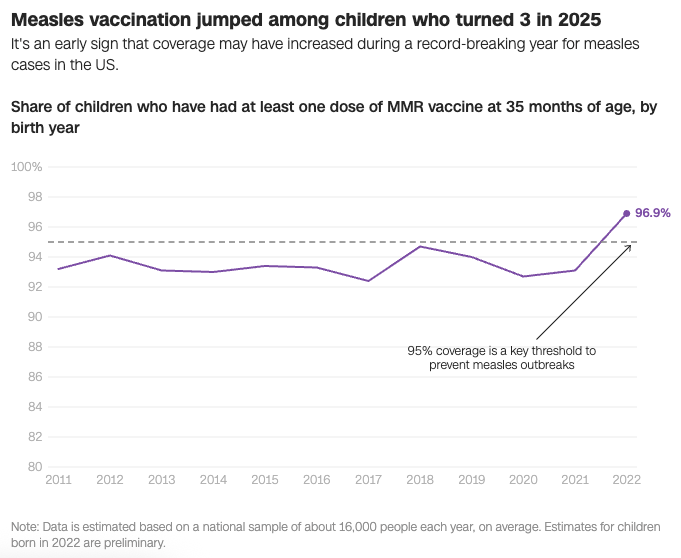
The news media was all over US vaccinations declining. Why so quiet now that vaccinations are rising? Preliminary CDC data suggests MMR coverage among three-year-olds rose from 93% to 97% between 2024 and 2025 — higher than pre-COVID levels and the 95% threshold needed to prevent outbreaks. It looks like the South Carolina outbreak scared people straight. That outbreak is now over; no new linked infections have been recorded for two incubation periods. Health officials credit the uh, surge in vaccinations, as well as very aggressive contact tracing. CNN
The European Parliament has backed an EU-wide conversion therapy ban after a 1.2 million-signature citizens’ campaign. The proposal won support from 405 MEPs and now awaits a formal European Commission response by 18 May. Seven European countries already ban the practice outright; an EU-level rule would turn a patchwork of national laws into a continent-wide rights standard. Washington Blade
The EU is also moving closer to a consent-based rape standard. The European Parliament voted 447–197 to urge all EU states to adopt an only “yes means yes” legal standard for consent. The move seeks to replace the older “no means no” threshold, which activists say leaves victims unprotected; it is only the first step, and must still be proposed as legislation for member states to vote on. CNN
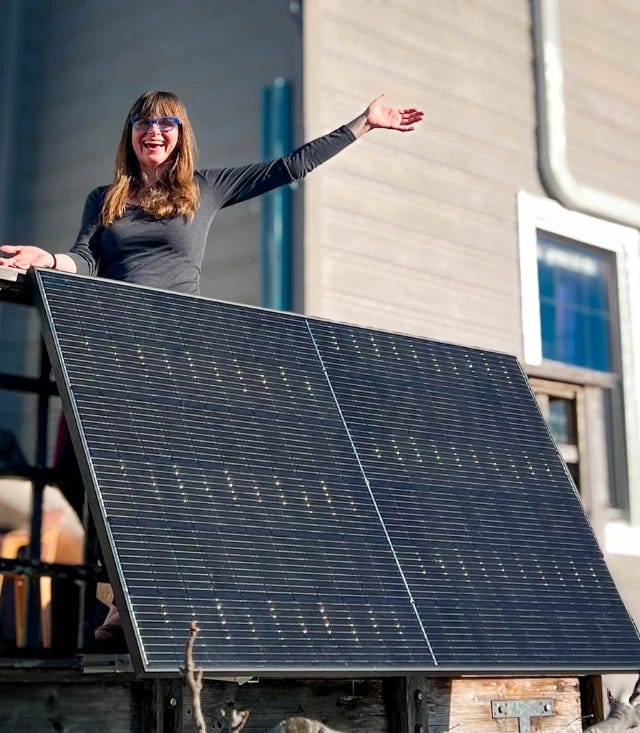
Colorado just legalised ‘balcony solar’ for apartments and renters
From 2027, utilities, landlords and homeowner associations will be restricted from blocking approved systems under 2 kilowatts. While small, these systems can be mounted on apartment balconies, patios and walls, opening rooftop-style solar access to millions of renters and multi-family households previously locked out of the energy transition. CleanTechnica
Elephants on farm raids might help us find new medicines. When elephants raid banana and papaya farms, they occasionally skip the fruit and eat only the stems and leaves. Why? Gabonese scientist Steeve Ngama suspected the answer was at least partially pharmaceutical. He and his team collected dung samples from farm-raiding elephants and found that those with parasitic infections were much more likely to eat plant parts with anti-parasitic properties — including banana stems and papaya trees. The implications cut two ways: if elephants are self-medicating, their foraging might help us identify new human treatments, and if stem-raiding elephants can be given medications they might leave fruit farms alone more often. British Ecological Society
Queensland restores tidal wetlands by letting the sea back in
Conservation groups, graziers and Yuwi traditional owners are removing decades-old tidal barriers across coastal Queensland, reconnecting wetlands to the ocean and rapidly reviving native ecosystems. On one Mackay cattle property, juvenile barramundi returned within months; at Cape Palmerston, restored saltwater flows killed off 80% of invasive grasses. ABC News
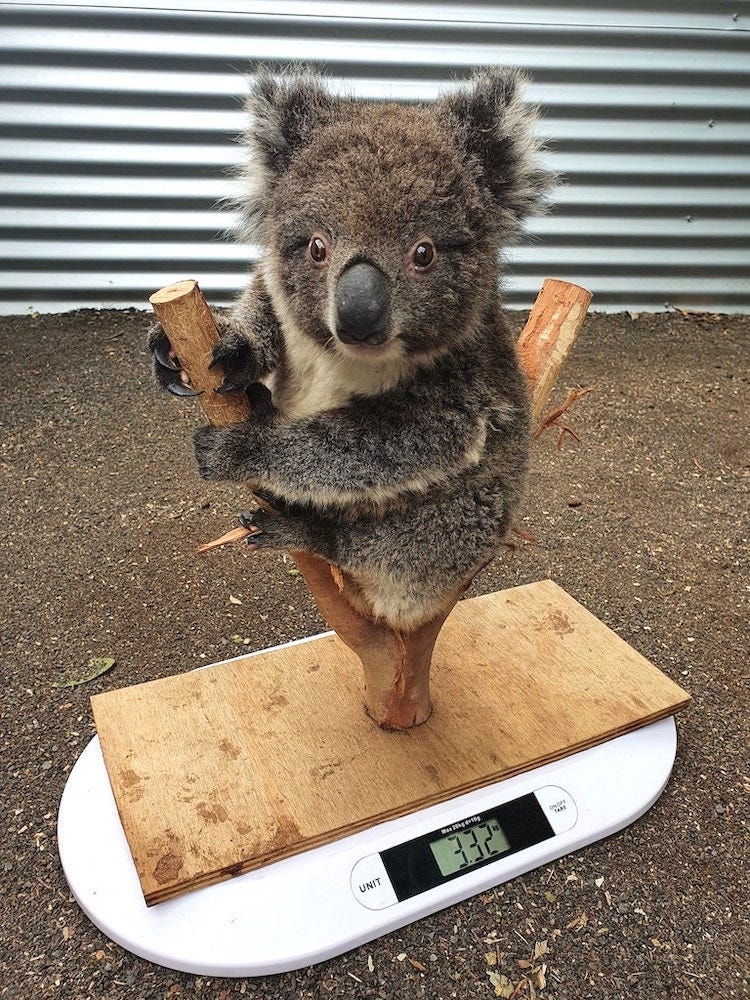
New South Wales creates vast koala refuge after 13 years of campaigning. The Great Koala National Park will protect almost 5,000 km² along Australia’s east coast by linking existing reserves with state forests and creating corridors through a landscape fragmented by logging, roads and development. Conservationists say the park should safeguard around 20% of NSW’s wild koalas, plus 66 other threatened animals and 37 threatened plant species. Mongabay
Off-patent ‘abortion pill’ could treat common, deadly cancer. Glioblastoma, a deadly brain cancer, kills its median patient within 14 months. The standard regimen of surgery, radiation, and temozolomide has barely budged that number in 20 years. Since 2013, a research group at Mexico’s National Cancer Institute, led by pharmacologist Patricia García-López, has been building a case that mifepristone — the ‘abortion pill,’ — could chemo-sensitize glioblastoma by suppressing three of the tumour’s main resistance mechanisms.
This is because mifepristone is a progesterone receptor antagonist, and progesterone receptors are present on glioblastoma cells. The more aggressive the tumour, the more receptors it tends to have. A 2021 review by García-López’s team recommending human clinical trials was ignored, so García-López and her team scraped together eight patients and ran a pilot themselves.
Now the numbers are in: 588 vs 165 days average survival, 80% one-year survival. Two patients are still alive at 72 and 82 months, years past where most glioblastoma patients make it. The authors titled their conference abstract “A Fairytale Comes True?” and the question mark matters, because the trial is tiny: eight people is eight people. But the numbers are correct. Now for the conspiratorial part: this drug is off-patent and cheap, which may be why no major sponsor has run the proper Phase II this finding deserves? Cancer Biology & Therapy
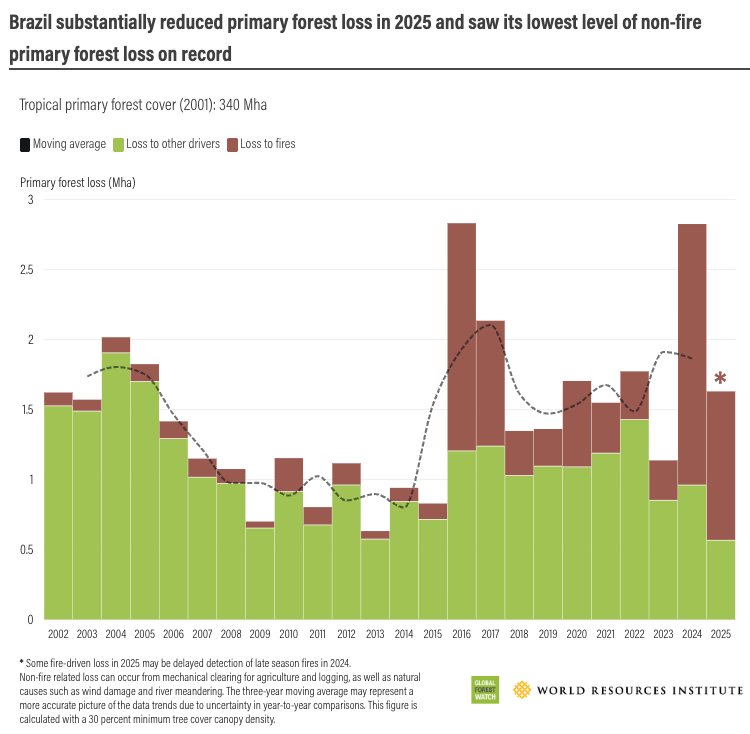
Brazil’s forest losses fell by 42% in 2025, helping pull the global tropical deforestation curve back from a record high. The country lost 16,000 km² of tropical primary forest, far below the 28,000 km² recorded in 2024, while non-fire-related losses fell 41% to their lowest level since records began in 2001. Agência Brasil
Chinese meat importers pledge to buy deforestation-free Brazilian beef. Not a headline we expected to be writing. After visiting Brazil in April 2026, Xing Yanling — the head of the Tianjin Meat Industry Association, responsible for around 40% of China’s beef purchases from Brazil — described “the magic of being enveloped in tens of thousands of shades of green.” Under her leadership, the group has now committed to buying 50,000 tonnes of deforestation-free certified Brazilian beef by the end of 2026, about 4.5% of expected exports to China. Reuters
China’s has cut its oil imports by roughly 25% from pre-Iran war levels, which is pretty shocking - it means they’re no longer stockpiling. This has stabilised oil prices around the rest of the world, and is one of the main reasons the Iran-based energy crisis isn’t worse. Bloomberg
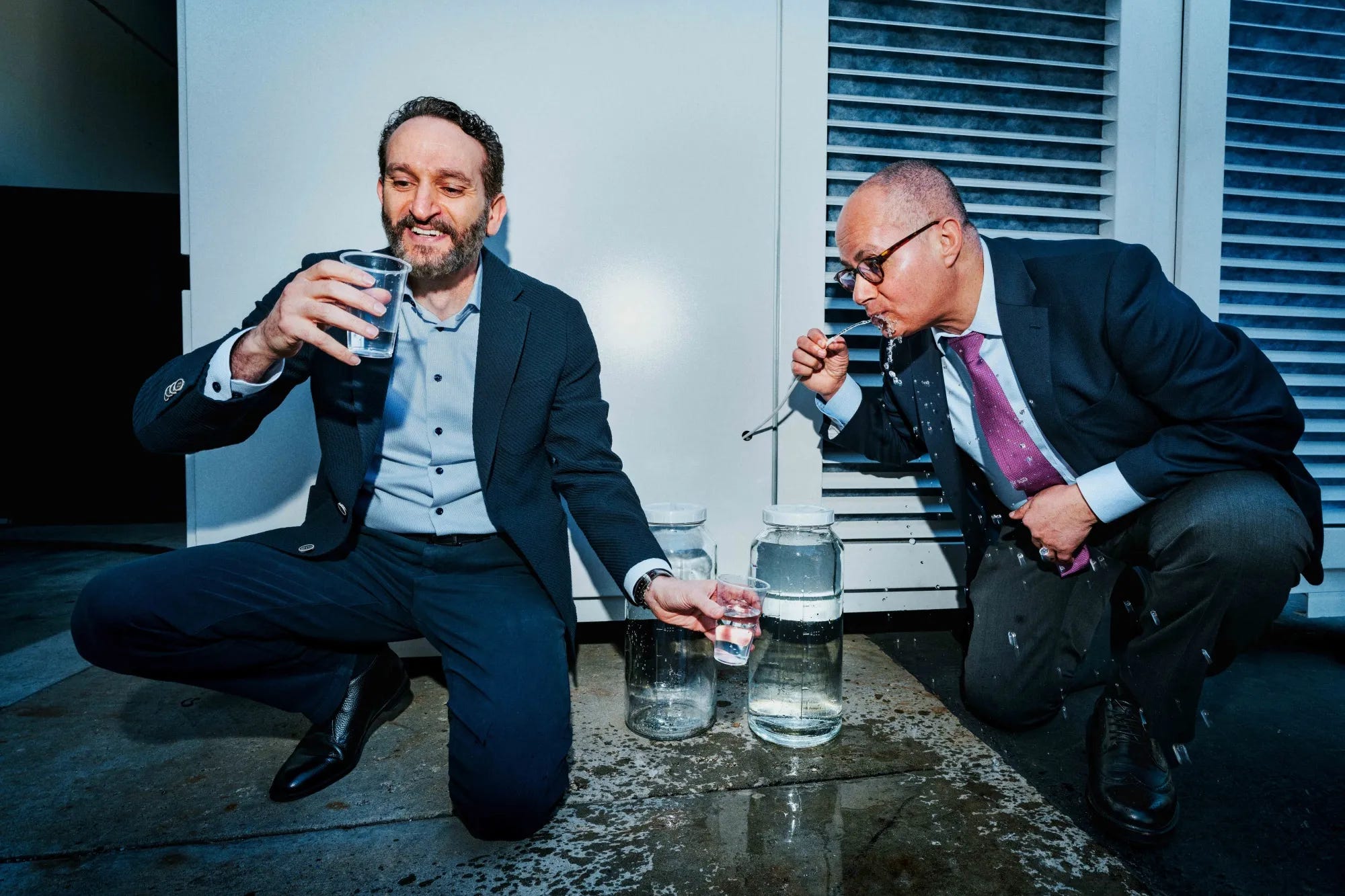
A California company is pulling clean drinking water straight from the air. California company Atoco has developed a shipping-container-sized machine that uses advanced nanomaterials called metallic organic frameworks to harvest water molecules directly from the atmosphere, even in arid regions. The first commercial units, due later this year, can produce up to 4,000 litres of drinking water per day for data centres, hospitals and remote communities. Bloomberg
Also: desalination startups are promising freshwater from saltwater with 40% less energy and portable desalination for ‘water autonomy.’ Heatmap
The United States now has rape-kit reform on the books in all 50 states, Washington, D.C. and Puerto Rico. After 16 years of advocacy, Joyful Heart Foundation’s ‘End the Backlog’ campaign has reached its final state, after Maine passed legislation requiring a statewide inventory and tracking system. People
Today marks a watershed moment not only for the State of Maine, but for every survivor who has asked if their rape kit was forgotten, if their truth was abandoned on a shelf, if they have hope of finding justice.
Violent crime is plummeting in America’s biggest cities in 2026. Data from 67 major law enforcement agencies show first-quarter homicides down 17.7% so far this year, with robberies down 20.4%, rapes down 7.2% and aggravated assaults down 4.8%. The declines show up across every major region, and in some of the nation’s biggest cities. Axios
New York City reported 76 murders through April 2026, down from 102 in the first four months of 2025 (there were an astounding 709 murders in the same period in 1990, meaning 2026 is down nearly 90% by comparison)! New York isn’t alone. Philadelphia, Detroit, New Orleans, Baltimore, Washington DC and Los Angeles have all seen drops to near historic levels.
Baltimore saw only 4 homicides in April 2026, the lowest number since police began tracking crime in 1970. The milestone follows years of declining violence, with killings and nonfatal shootings down 10% compared to last year. WBA Baltimore
And Aurora, Colorado (repeatedly singled out during the 2024 presidential election as overrun by Venezuelan immigrant gangs) has seen homicides fall by 66.7%, one of the sharpest reversals in the dataset.
Australia, the first ever country to roll out a national HPV vaccination programme, is now seeing zero cervical cancer in women under 25. Together, vaccination and screening in Australia have pushed incidence down to 6.3 cases per 100,000 women and increased five-year survival to 76.8%. BBC
It’s not just Australia: from Norway to Burundi to Indonesia, HPV vaccination is becoming routine. Iceland, Portugal and Norway have reached 90% HPV vaccine uptake among girls by age 15, while every EU country now recommends vaccination for both adolescent girls and boys. HPV programmes in Africa have expanded from 12 to 35 countries since 2019; Burundi is the latest to add routine HPV immunisation for girls aged 9–14. Indonesia, where cervical cancer kills more than 20,000 women a year, has rolled out free nationwide vaccination and screening, and is expanding access to surgical, chemotherapy, and palliative care across all 514 districts by 2030. As part of that plan, Indonesia has set 90‑75‑90 targets: fully vaccinate 90% of girls and boys by age 15; screen 75% of women ages 30 through 69; and ensure that 90% of women diagnosed receive treatment.
Chile’s maternity leave reform boosted women’s employment by 16%. Shocking! Doubling postnatal leave from 12 to 24 weeks let more women stay in the workforce after having children. VoxDev
It’s high time that the government cares for those of us who provide care.
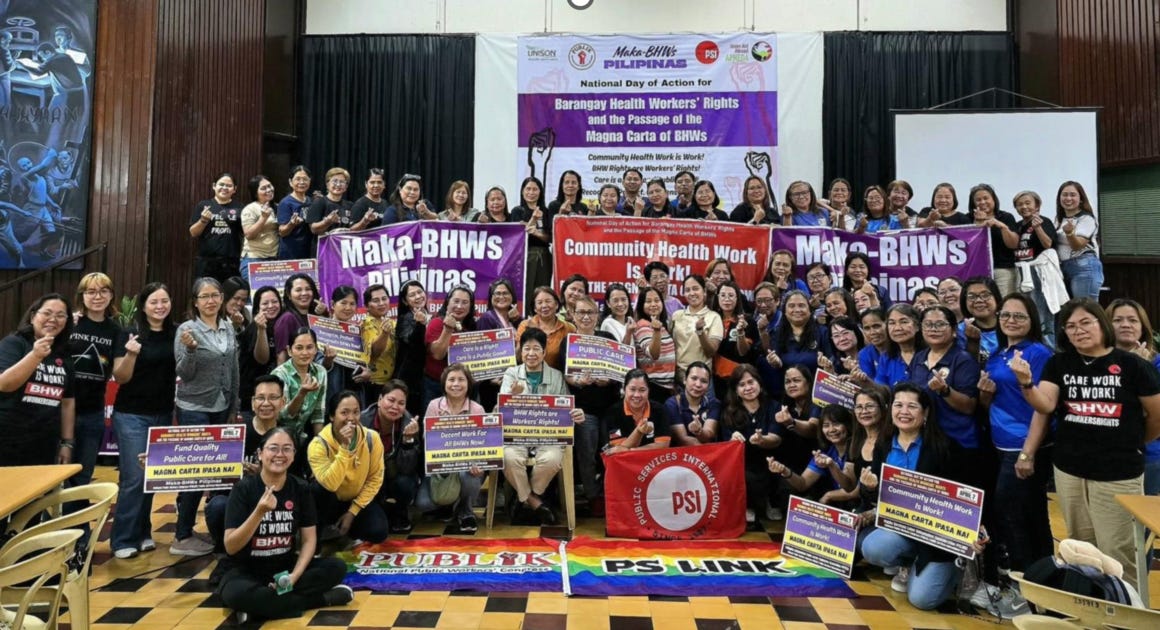
Philippines’ 250,000 community health workers secure first union registration. Barangay Health Workers staff more than 26,000 local health centres, but most are still treated as ‘volunteers’ without regular wages, social security, hazard pay, benefits, or transport support. The new Maka-BHW Pilipinas union gives this largely informal workforce a national structure to bargain for protection, pay and better primary care. Public Services International
If it bleeds, it leads
The trap of climate catastrophism
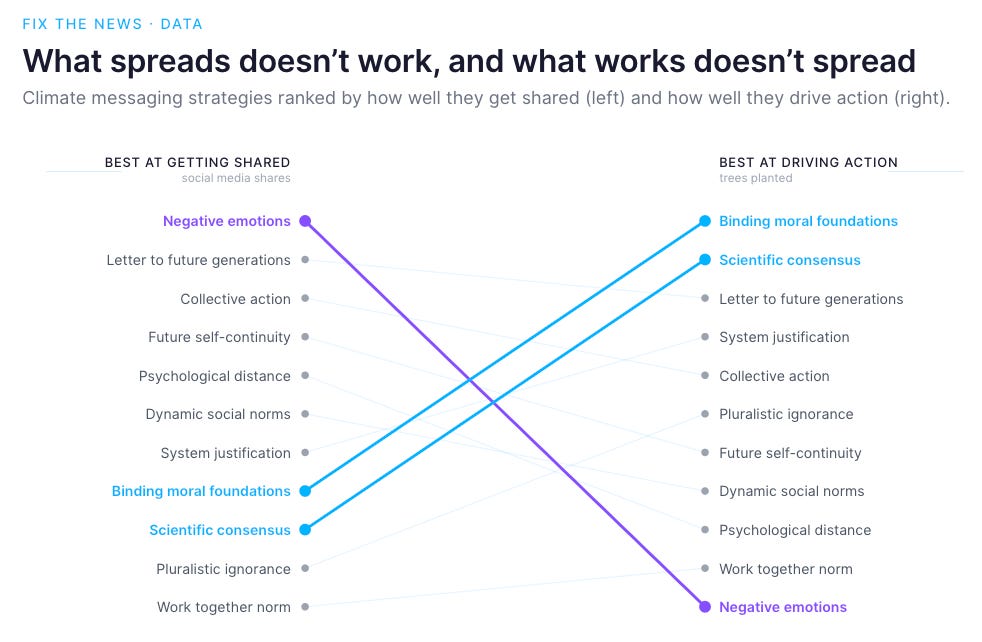
In 2024, 257 behavioural scientists published findings from one of the largest ever experiments on climate messaging. Tested across 59,440 people in 63 countries, they found that doom and gloom was the single most effective strategy for driving social media shares. It was also the worst for motivating real-world action. People exposed to catastrophic framing were measurably less likely to change their behaviour than those who read nothing at all. The findings were widely circulated in climate circles, a lot of people said thoughtful things, then promptly returned to business as usual (AMOC anyone?).
Three things explain why the research hasn’t shifted practice. First, reach. Catastrophism performs online. Organisations and influencers measure success in impressions and shares, and doom delivers both. Second, identity. For a movement that has spent a decade warning of catastrophe, any retreat feels like concession. Third, inertia. Messaging infrastructure, fundraising copy, campaign strategy — the climate sector has spent years building muscle in these areas, and is understandably reluctant to give those skills up. To paraphrase Upton Sinclair, it’s hard to get someone to change their mind when their job depends on them not changing it.
Most climate messaging is still being aimed at people who already agree, delivered in a register that is driving the unconvinced further away. The audiences that are the most important for climate communicators to reach, regular voters, are checking out, and the cost is visible in the polling. Climate concern has softened across most of the world’s liberal democracies.
What the study found actually worked was moral framing and scientific consensus. Messages that leave people feeling like they’re part of something bigger, and capable rather than overwhelmed. But that stuff doesn’t travel well online, which is probably why it hasn’t been widely adopted. That's the problem: what works doesn't spread. What spreads doesn't work. It’s time for a change.
For paid subscribers in this edition:
England’s renters get their biggest protection upgrade in a generation.
Addis Ababa is redesigning itself around its youngest citizens.
Africa’s health workforce grows by nearly a third in six years.
Colombia and Peru turn cloud forests into water security for half a million people.
A Dutch court forces bottom trawling to obey marine protection laws.
Asian giant tortoises return to an Indian forest under the care of young Indigenous guardians.
Wind and solar save Britain £1.7 billion as fossil prices spike.
Texas overtakes California in utility-scale solar, deep in fossil-fuel country.
Airships are being revived to replace vanishing ice roads in the Arctic.
A new chip could slash AI’s energy use by learning how to skip the zeros.