

335: Transition. Flagellar motor. Measles in Africa. Clitoris. Wild horses.
If you like what you see, then just look a little deeper.
This week’s top stories
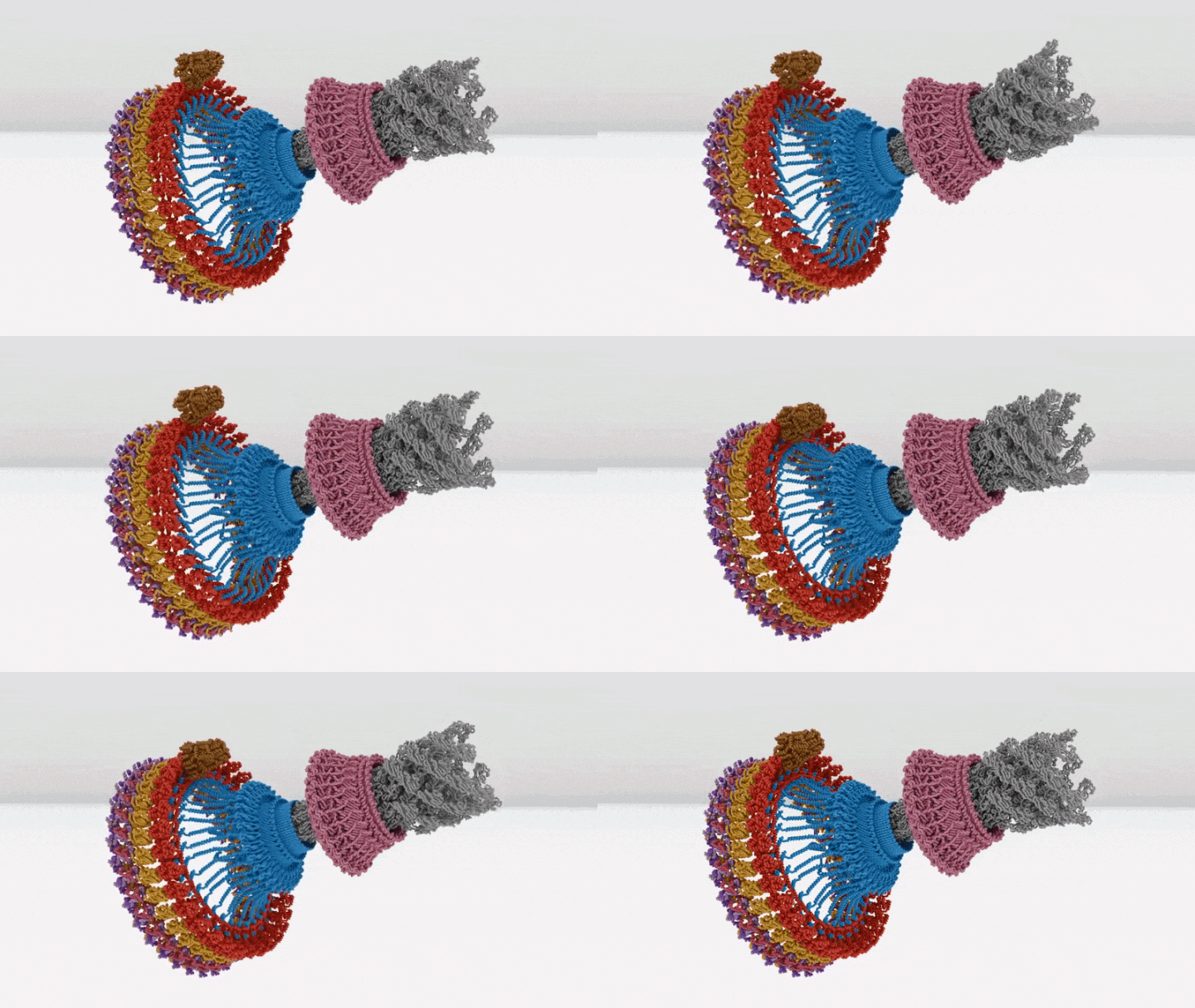
The bacterial flagellar motor is finally understood after 50 years.
The flagellar motor is the combination propeller/brain that enables single-celled bacteria to move toward food sources. It rotates at several hundred revolutions per second — faster than the flywheel in a race car engine — to twirl a tail-like flagellum that pushes the cell along.
This amazing, self-assembling, signal-processing, direction-switching molecular machine is so powerful, yet so spare, that billions of years later, it’s still used by bacteria in virtually every gut and puddle on Earth. Now, more than half a century after its discovery, scientists have figured out its its molecular structure. The final pieces of the puzzle fell into place in March 2026.
“My lifelong quest is now fulfilled. I finally understand how this thing I’ve been studying for 50 years actually works. That’s about as satisfying as can be.”
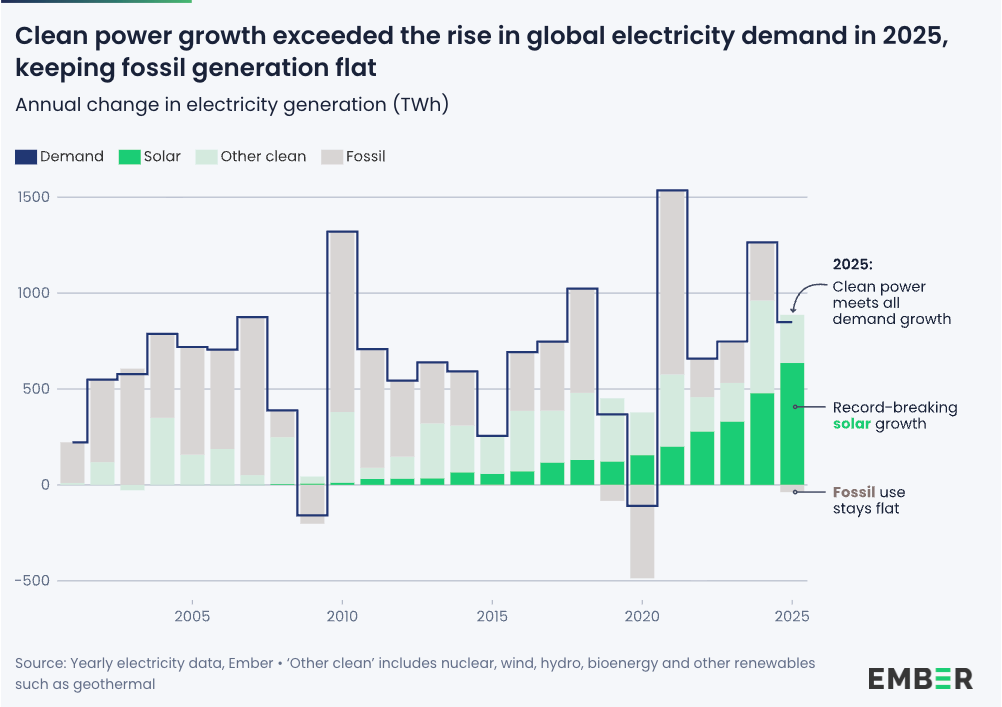
For the first time, clean energy has met all of the world’s growth in electricity demand. Last year global electricity demand rose by 2.8%, but, for the first time ever, every additional bit of that new demand was met by clean power. Fossil fuel generation fell by 0.2%. This last number is the important one, and needs some context.
There have been three other years in this century where fossil fuel generation hasn’t grown, but all of those have been due to economic shocks. This is the first time that global electricity demand has grown at a normal rate and fossil fuels haven’t budged. Solar and wind together covered 99%, and nuclear and hydro pushed it past 100%.
The structural turning point we have spent so many decades waiting for has finally arrived. It is really, really good news. Take a moment to savour it.
There are so many other highlights in Ember’s Global Electricity Review 2026.
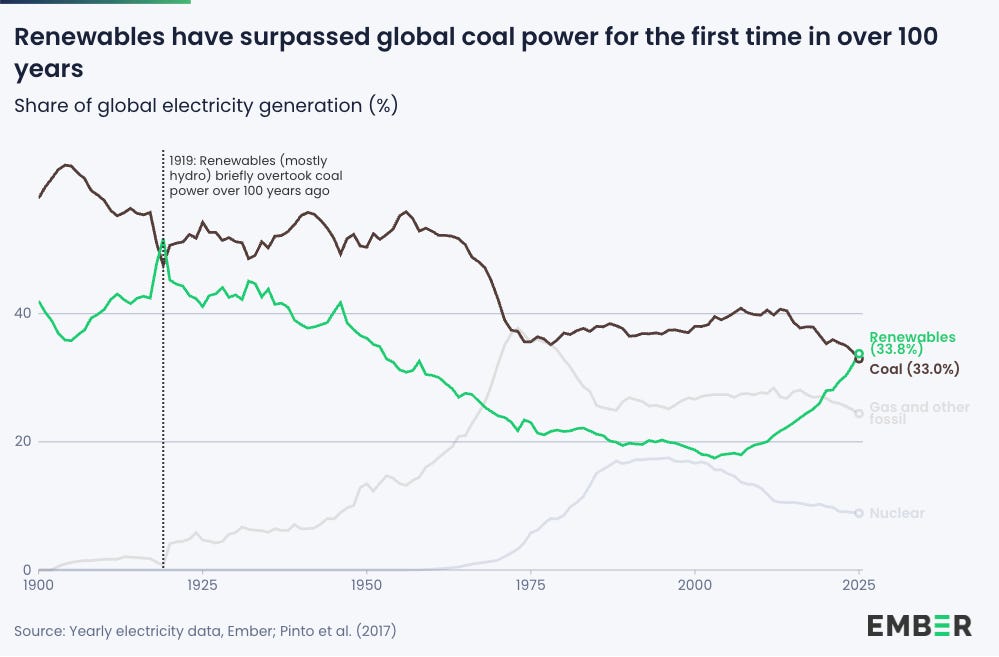
📈 Renewables overtook coal in 2025 for the first time in over 100 years.
🔥 Coal fell below a third of global electricity for the first time ever, and is now losing market share In every major region including Asia.
🇨🇳 🇮🇳 Fossil generation declined in China and India last year due to record clean power growth, balancing out small increases in the EU and the US.
🌍 The transition is global - several other growth markets, including Brazil and Pakistan, met their entire increase (100%+) in electricity demand with low-carbon sources.
🔋 Battery storage deployment rose 46% year-on-year, while pack prices fell 45%.
The war has plunged the energy world into a kind of time warp: The last boats to exit the Strait of Hormuz before the war are just now approaching their refineries, and seven weeks is not a terrifically long time in which to recalibrate national energy systems.
But between February and March, the world didn’t just tighten its fossil fuel use; it spent money on new green stuff. China’s solar, battery and E.V. exports grew 39 percent. The country’s solar exports alone more than doubled during that time. In South Korea, March saw new E.V. registrations double compared with the same time last year. In New Zealand, new registrations nearly doubled over two weeks.
New clean energy investments and initiatives have been declared by France, Egypt, India, Indonesia, Turkey — and many others. The president of the E.U. Commission called for an expedited rollout of grid improvement and electrification plans. Jigar Shah, a former Biden administration official and a liberal energy guru, says he expects monthly global clean energy spending to double by the end of this year.
Perhaps this seems like rosy spin, given the context. It may even strike you as perverse to celebrate the clean energy silver lining of an illegal, punishing and chaotic war. To be honest, I agree.
Still, I’ll take the good news where I can find it.
Who is the green hero behind it all?
President Donald Trump calls environmentalists “terrorists.” Yet he is responsible for destroying more oil and gas infrastructure, and possibly more fossil-fuel demand, than the most optimistic ecoterrorist could in their wildest dreams. By going to war with Iran, the president, who has been openly hostile toward the clean-energy transition, may unintentionally turn out to be one of its greatest allies.
Mark Gongloff - BloombergDonald Trump has done more to accelerate the energy transition than anyone else alive. The attack on Iran is not the way any of us wanted this to happen, but the unintended consequences of Trump’s pointless war could help sink Trumpism everywhere – and the corrupt and filthy industry that props it up.
George Monbiot - The Guardian
Africa’s measles drive has saved millions of lives. 44 African countries have added a second dose of the measles vaccine to their schedules since the turn of the century, lifting coverage from 5% in 2000 to 55% by 2024. Those efforts have halved measles deaths, cut overall cases by 40%, and averted an estimated 19.5 million deaths. WHO Africa
One-shot gene therapy is helping the deaf hear. The OTOF gene makes otoferlin, a protein the inner ear needs to send sound to the brain. Those born without this gene are deaf… but maybe only temporarily. Researchers at Sweden’s Karolinska Institute injected ten OTOF-deaf people with a working copy of the otoferlin-making gene, delivered straight into the cochlea via synthetic virus.
The hearing of all ten improved drastically: on average, the quietest sound they could hear dropped from 106 decibels to 52, roughly the difference between a chainsaw and normal conversation. Children responded fastest; one seven-year-old was chatting with her mother four months after therapy. The treatment has shown no adverse side effects, so the Karolinska team is now looking to try the same setup on different deafness genes. ScienceDaily
China’s 40-year “Wild Horse Return Program” has pushed Przewalski’s horse from extinction in the wild, to self-sustaining herds, with the national population now above 900. That gives China roughly one-third of the global total, a striking turnaround for the world’s only surviving wild horse species after it vanished in the 1970s. China Daily
Colombia and the Netherlands have gathered more than 50 countries for a new “coalition of the willing” to advance a transition away from fossil fuels, sidestepping stalled UN climate talks. Representing about one-third of global demand, the bloc aims to design financing and policy pathways as energy shocks expose fossil dependence, signalling a shift toward smaller, faster-moving alliances to drive change. The Guardian
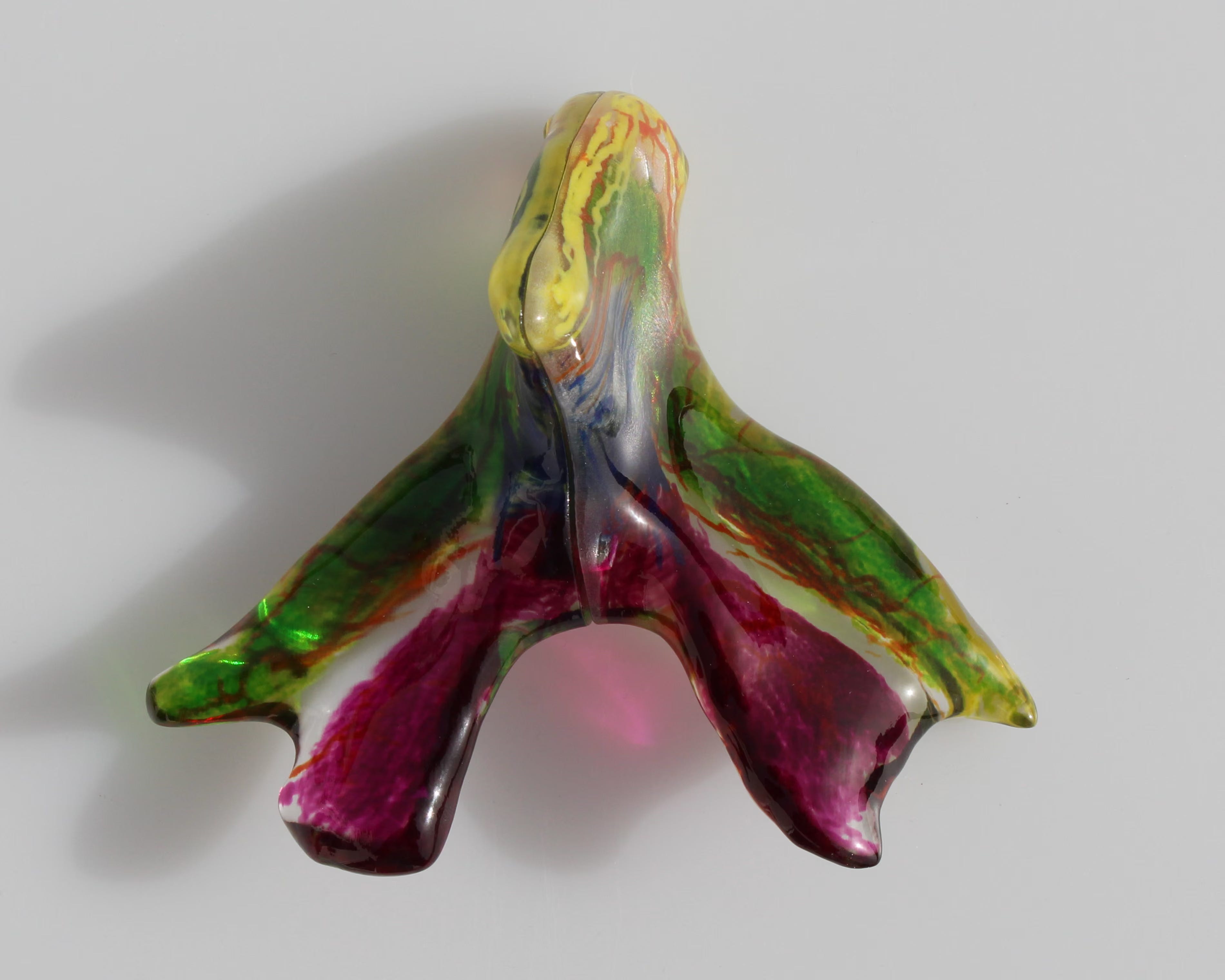
Scientists have created the first-ever detailed 3D map of the clitoris using super-powered X-rays from a particle accelerator called a synchrotron, the kind of equipment normally reserved for materials science and particle physics. What they found: five large nerve trunks inside the clitoral glans, branching toward the surface in a tree-like pattern, with extensions into the hood and mons pubis unaccounted for by previous anatomical models.
This has immediate consequences for anyone performing pelvic surgery, gender-affirming procedures, or reconstructions after female genital mutilation. Right now, about 22% of women who undergo clitoral reconstructive surgery experience reduced sensation afterward, and a better nerve map could reduce that number. The study is a preprint (not yet peer-reviewed) but is, as lead author Ju Young Lee put it, a “starting point” for clitoris science. The Guardian
India overhauls its legal code to restore proportionality. The recently passed Jan Vishwas Act changes 79 laws, decriminalising more than 700 minor offences and replacing imprisonment with warnings and fines. Previously, a street vendor without a licence could land in prison for a year; a company failing to file returns faced the same criminal exposure as genuinely harmful conduct. That era is now, formally, over. The reform marks one of the country’s largest ever efforts to curb criminalisation. Financial Express
Seagrass is rebounding off the coast of France, and could provide a model for the rest of the Mediterranean. Wastewater treatment and coastal protections in Marseille have enabled the dramatic recovery of Neptune grass (Posidonia oceanica), the Mediterranean’s most important endemic seagrass. In some areas coverage has has risen from 6% to 81%. Researchers say it’s a valuable lesson in “passive restoration”: sometimes the most efficient way to restore an ecosystem is to reduce human pressure and let it recover on its own. Mongabay
... but sometimes, efficiency be damned, people choose to replant it. In Australia’s Shark Bay, an Indigenous-led effort is replanting 4,500-year-old seagrass by hand. The enormous seagrass (the size of Paris) is a self-cloning hybrid, likely an unusual polyploid that carries two full sets of chromosomes and can’t reproduce in the “usual way.” This hasn’t stopped it thriving for several millennia, but in 2011, the seagrass lost a quarter of its area in a single heat wave. Michael Wear, an Indigenous Australian whose family has lived in Shark Bay for millennia, saw the collapse of the meadow in real time.
I remember thinking, okay. What do we do now? When Country changes, you ask why, and you act.
In response, he founded Tidal Moon, a startup replanting the seagrass by hand. To fund the work, Tidal Moon is reviving an ancient sea cucumber trade: the animals are a delicacy across Asia, and as bottom-feeders they enrich sediment in ways that help seagrass regrow. Conservation International
Teen births plummet in the United States thanks to decades of family planning. Teen birth rates reached 11.7 births per 1,000 in 2025, down from 61.8 in 1991. The decline reflects decades of expanded access to contraception and reproductive health services, including Title X, which has prevented an estimated 20 million unintended pregnancies. NPR
Paraguay’s poverty reduction shows what happens when governments focus not just on growth, but on productivity and jobs. In the last 20 years, poverty has plummeted from over 50% to 16%; 300,000 people have escaped poverty in the last two years alone. The World Bank says the decisive factor is how the gains from growth has been distributed: labour income has been the main driver of poverty reduction as employment has shifted towards more stable, better- paid work.
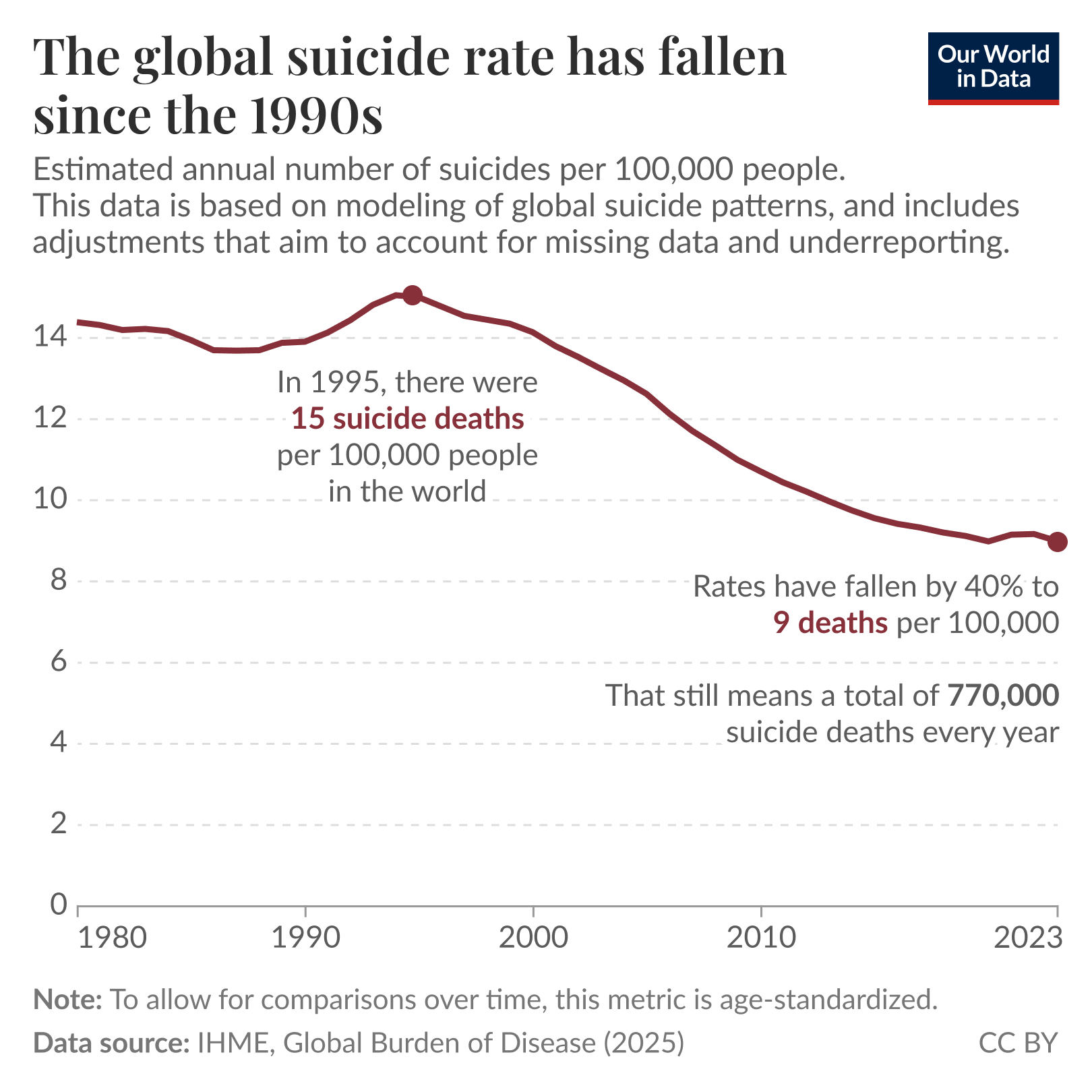
The global suicide rate has fallen by around 40% since the 1990s. Our World in Data reports that the age-standardised global rate fell from about 15 to 9 deaths per 100,000 people between the mid-1990s and 2023.
Chicago has made every public school ID a library card. This is so good. More than 315,000 public school students will gain immediate access to the cities’s libraries using existing school IDs. A pilot launched in 2022 increased library access by 63% among economically disadvantaged students and by 81% among English language learners. Block Club Chicago
With this expansion, every student — no matter their ZIP code, school enrollment or their age, will have access to library cards and programs and resources that make their lives more enriched.
Brandon Johnson, Mayor of Chicago
HIV miracle drug begins rollout in earnest. Lenacapavir is a twice-yearly drug offering near-complete protection against HIV. Nigeria just became the seventh African country to begin deliveries, and The Global Fund plans to provide support to 15 additional countries by the end of this year, including Thailand, Indonesia, Honduras, Georgia, the Philippines, and Ukraine. Early distribution is still limited, but new manufacturing methods could cut costs and expand supply.
Germany turns former coal pits into vast lake district. Eastern Germany is completing the transformation of former coal mines into the 144 km² Lusatian Lakeland, Europe’s largest artificial lake landscape, with Lake Sedlitz opening this month. The €13.8 billion restoration is converting a fossil fuel scar into water storage, tourism infrastructure and new regional employment. What was once considered a wound in the landscape is thus gradually becoming one of the most unusual natural paradises in Europe. Euronews
Mexico is planning free universal healthcare for 120 million people. President Claudia Sheinbaum’s recent decree aims to unify a system currently defined by unequal access, patchy coverage and out-of-pocket costs. It also builds on a longer record of expanding public health coverage. The first phase began this month, with citizens aged 85 and older now eligible. From January 2027, healthcare institutions will start working together to bridge gaps in access. Novara Media
Next-generation batteries cut EV charging times to just a few minutes. China’s CATL has unveiled new EV batteries capable of charging from 10% to nearly full in about six minutes, and with a range of 1,500 km (more than you get from any tank of fuel). Financial Times
A federal court has struck down major Trump-era attacks on the Endangered Species Act. The first Trump administration pushed through a series of rollbacks that weakened habitat protections and made it easier for agencies to approve harmful projects based on vague, future mitigation promises. During the Biden administration, some of that damage was reversed through new regulations, but not enough to fully restore the ESA’s original protective force; now a federal court has made clear that agencies must use the best available science and must firmly commit to any measures they rely on to reduce harm to imperilled species. Earthjustice
And finally, from four people that have been further than anyone else:
You’re not looking at us. We are a mirror reflecting you. And if you like what you see, then just look a little deeper.
CORRECTION
Augh! In our last issue, we wrote about Artemis II, and ended with “What’s next? Artemis III. Boots on the ground. The first Moon landing since 1972.” We should have said “What’s next? Artemis III & IV.
Artemis III is not going to the moon. Instead Artemis III is a “test everything” mission so Artemis IV can land on the moon in 2028… and maybe lay the groundwork for a moon base.