

Grain of Hope
How six people in rural Australia are shipping 500 tonnes of wheat to Sudan.
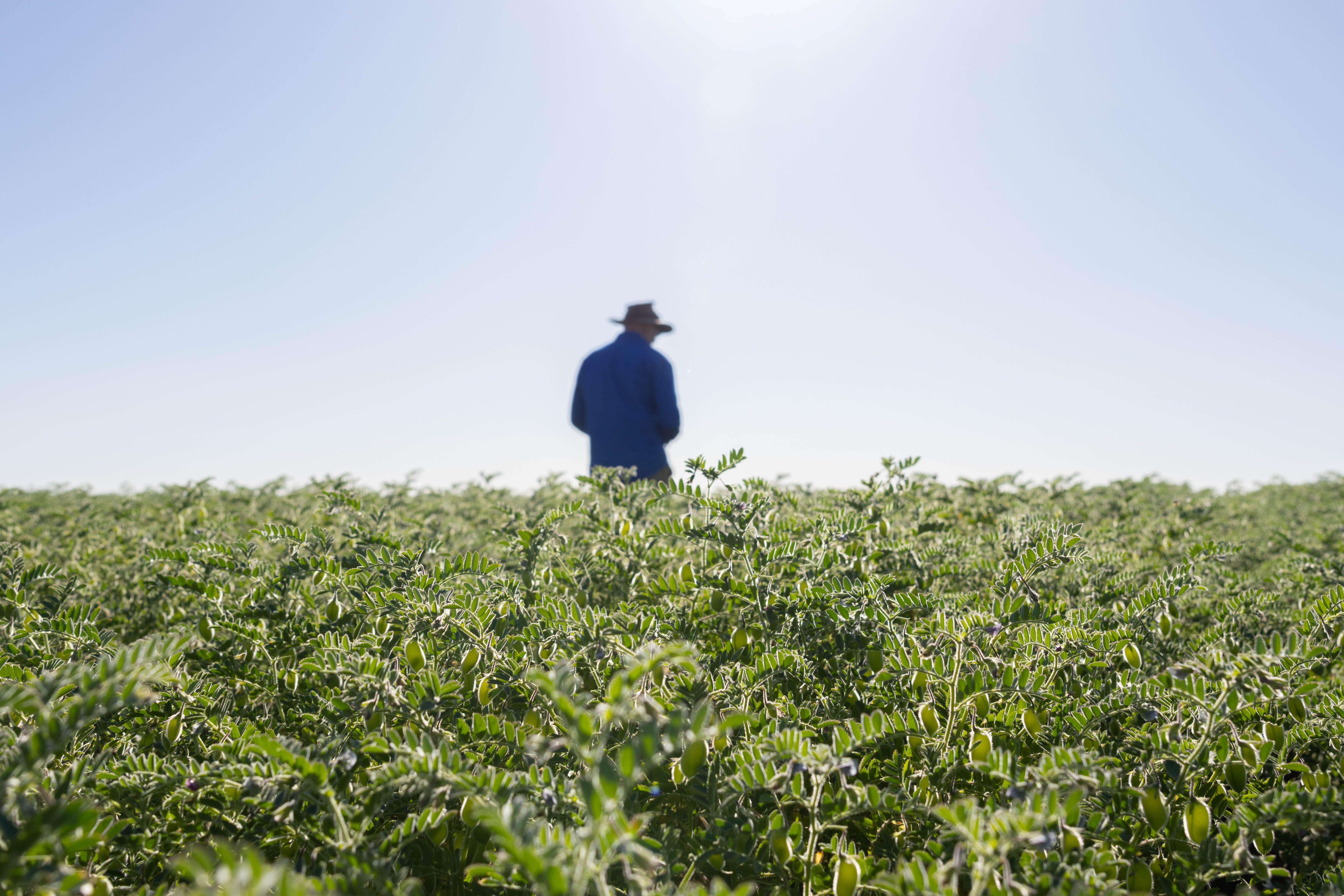
Standing in a wheat field under the vast skies of rural Australia, it would be easy for the rest of the world to slip away. But during last year’s winter harvest, as Rob Houghton worked on his farm in Leeton - a country town five hours west of Sydney -he wasn’t thinking about his fields. His attention was fixed beyond the horizon, on Sudan, where millions of people were starving.
“In my business, yield is king,” Rob says. “But I’ve always had a knot in my gut that there are a lot of people in the world who haven’t got enough to eat.”
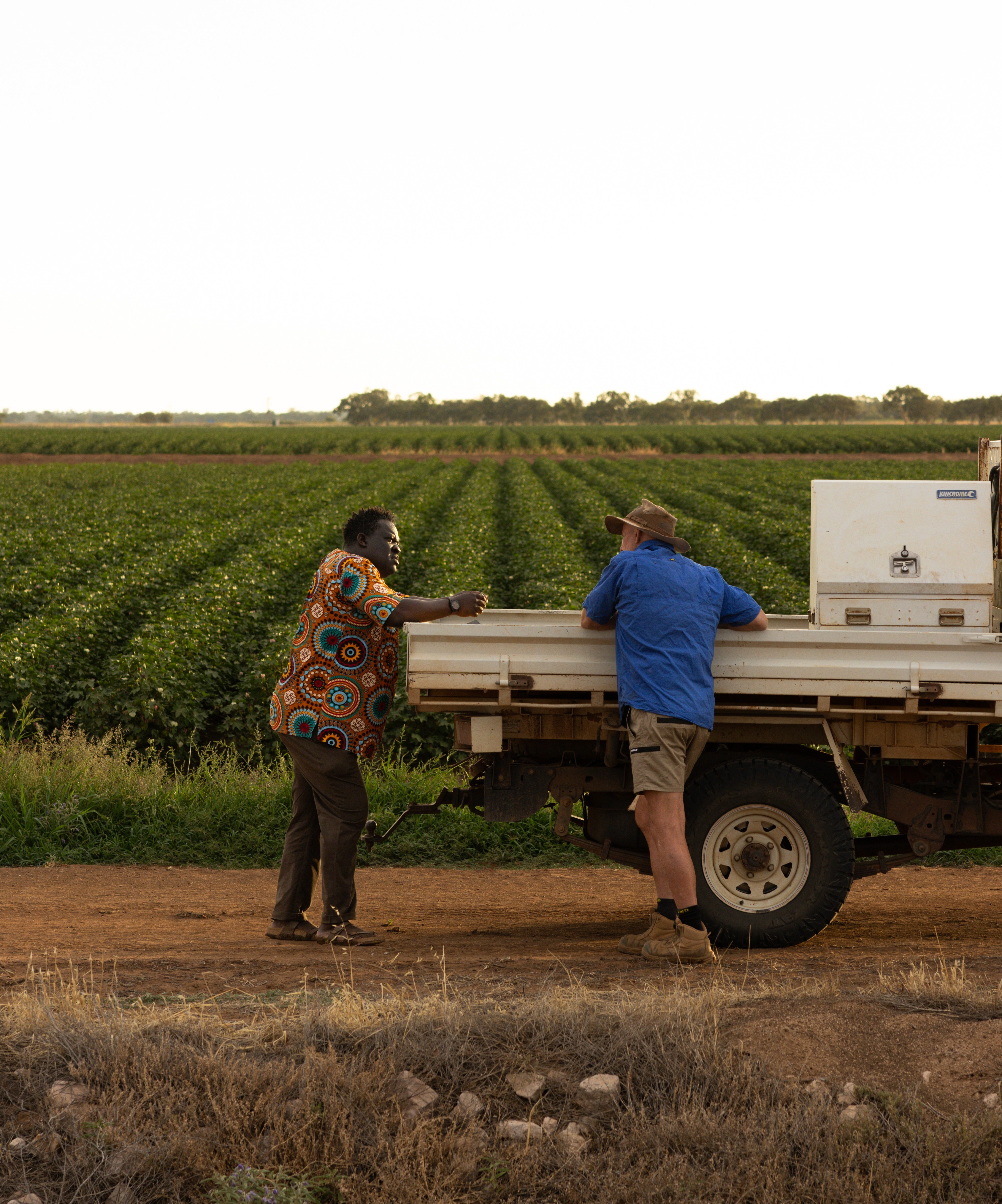
Rob has spent his life producing food. His family came to the Riverina in the 1930s as part of a soldier settlement scheme, and today the property produces chickpeas, popcorn, cereal crops and cotton. Farming, he says, has always been about feeding people. That’s why he and a small group of friends have decided to ship 500 tonnes of wheat to Sudan.
From mung beans to mates
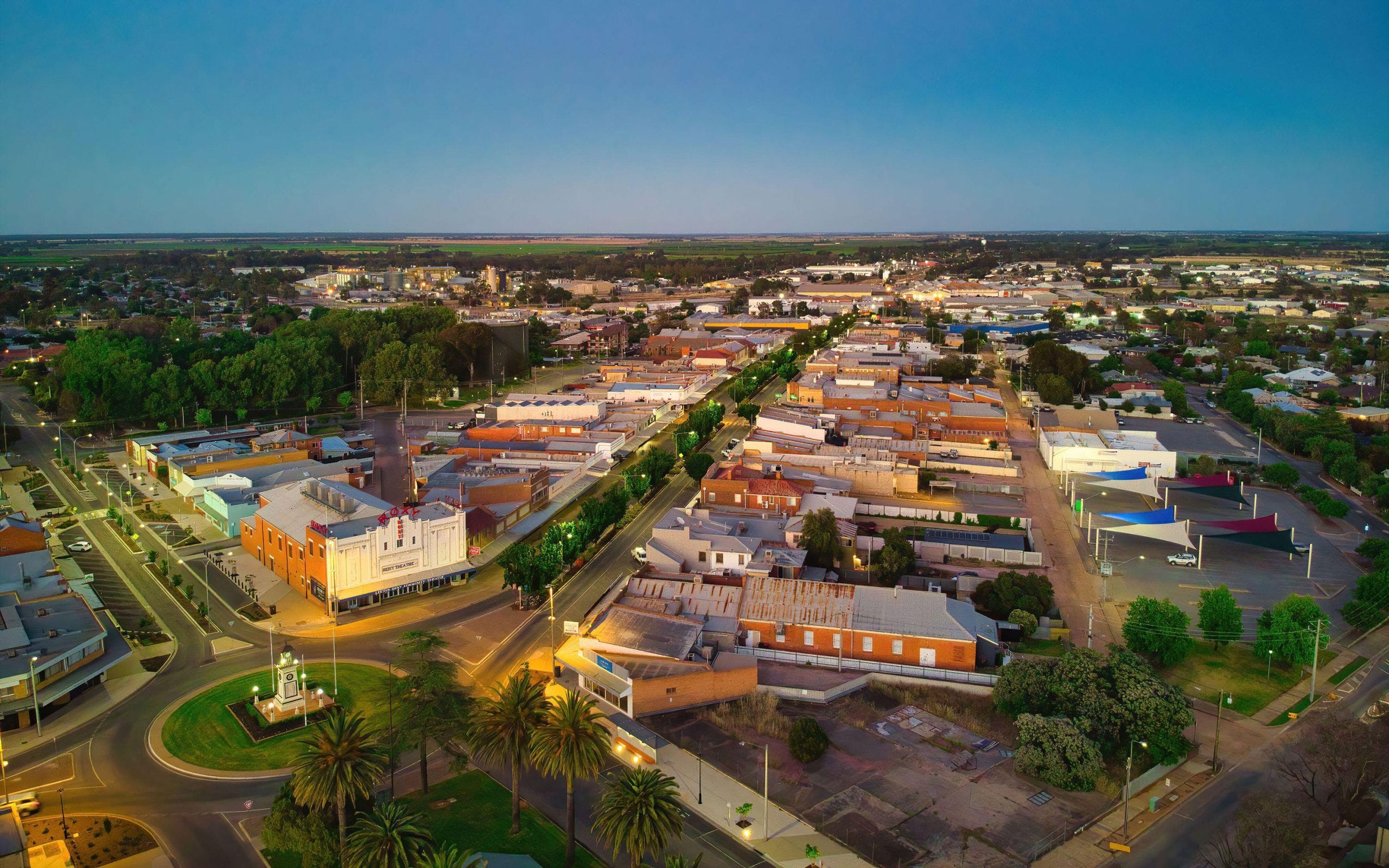
Leeton sits in the heart of the Riverina, on Wiradjuri country, in Australia's food bowl. Water from the Murrumbidgee River flows through thousands of kilometres of channels to feed the region's thirsty farms. They produce grain, rice and cotton, and over a quarter of the fruit and vegetables grown in New South Wales. The town itself is a quintessential slice of rural Australia, flat and sunbaked, with Art Deco buildings, tree-lined streets and rusty water towers.
Leeton has been shaped by immigration since Italian settlers arrived after World War Two. When Ken Dachi moved there in 2019, Leeton was home to around 11,000 people from more than 30 countries. That number has since grown, driven by programs bringing new residents for work in manufacturing and trades. “It’s like the United Nations of small towns,” Ken says. “There’s a footprint from every continent on the planet. The cultural diversity is astonishing.”
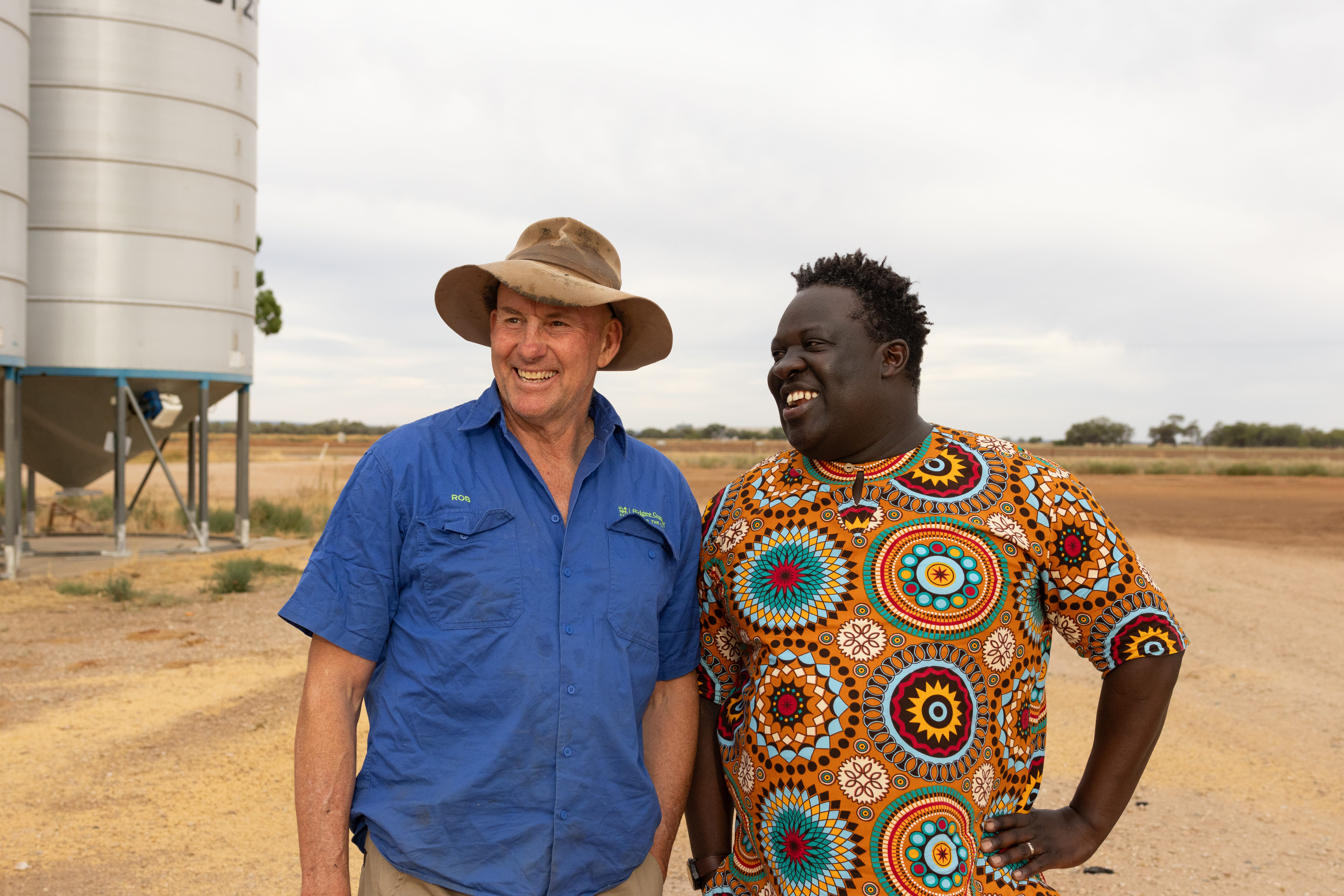
Ken and his wife Sekai, originally from Kenya and Zimbabwe, moved to Leeton from the United Kingdom, where Ken had spent years working in international development. It didn’t take long for word to spread around the tight-knit community, and he was approached by the local council to advise on multicultural affairs. But it was the farmers who really caught his attention. He was curious about how producers in the area were using technology to improve productivity, and Rob Houghton was one of the most inventive.
“We hit it off from day one,” Ken recalls. “And to make matters sweeter, he was growing mung beans, which are a delicacy in East Africa.” Their friendship grew over curries and Friday lunches at Rob’s farm where they started having long conversations about food systems and what Australian agriculture could do beyond its own borders.
The numbers don’t add up
When I jump on a call with Rob and Ken in late January 2026, it’s early afternoon and already uncomfortably hot. In Leeton, the temperature has soared to 46 degrees (114.8°F) - the kind of Australian heat that shuts down paddocks and silences machinery.
“You can’t run equipment over 40 degrees, so everyone’s knocked off for the day,” Rob explains. “That’s our hardship story - but at least we’re not starving.” The chat bounces back and forth between big global issues and the self-deprecating banter you’re likely to overhear at the bar of any country pub.
The tone of their conversations shifted in July 2025, when Ken started telling Rob about the deepening crisis in Sudan, exacerbated by the sudden disappearance of USAID. The cuts weren’t only American. Australia’s foreign aid has been falling for a decade, and now sits at just 0.18% of gross national income, ranking it 28th out of 32 wealthy nations.
For Rob, those numbers didn’t make sense. According to the Australian Government’s Department of Agriculture, Fisheries and Forestry, national winter crop production for 2025/26 is projected to reach 62 million tonnes, the third largest harvest on record. Meanwhile, famine - the most extreme form of food crisis - has been declared in four different parts of Sudan, alongside widespread malnutrition and collapsing medical care.
Australian silos were full. Sudanese refugees were starving. Rob’s response was blunt. He told Ken it was up to them. If governments around the world were slashing aid, it was time for ordinary people to step in. “The gut-wrenching thought was that these people, who were so reliant on overseas help, had it pulled from them overnight. They didn’t have another option,” Rob says. “That initial discussion with Ken was about creating an option.”
Rob wanted something direct, practical and fast. Sudan was an emergency. Instead of lobbying government and waiting for them to get on board, he urged Ken to help him build a proof of concept to show that the idea could work.
Ken admits he was doubtful. “I remember thinking: we’re not significant. We’re powerless. Surely there are bigger players who can do this work?” But Rob had no patience for bureaucracy or symbolic gestures. He told Ken that they were going to drive this from the ground up.
Ken knew there was no backing out. “That was the moment I realised, this will be the largest and most complicated thing I’ve ever done in my little life.”
Australia is the Sudanese word for wheat
Rob’s idea was simple. Get local farms to donate grain, then ship it to those in need. It didn’t require a ten-point plan, just a handful of people prepared to do something. Ken reached out to his network and within weeks formed a small working group. By August 2025 they had their first meeting and shortly after, secured a partnership with the World Food Programme.
For Ken, it was the confirmation he was looking for. “If you get a pushback from the World Food Programme it means there’s something wrong with your idea,” he explains. “The process of building a network of partnerships, especially with those who are experienced in this space, is crucial to making this work.”
One of the first calls he made was to Patricia Garcia, who’d spent years working in conflict zones, including Darfur during the 2003 genocide. She knows how aid systems work. She also knows Sudan.
“The first time I arrived in Khartoum” she told me, “the taxi driver asked where I was from. When I said Australia, he replied, ‘Your country has the best wheat in the world.’ Later, in Darfur, people told me they called wheat flour ‘Australia.’”
Sudan is the world’s largest humanitarian crisis. More than 21 million people - almost half of the population - are facing acute food insecurity, and 13 million have been forced from their homes, most of them women and children. Many have survived sexual violence; nearly all have been displaced multiple times. Despite the scale of devastation, the situation is largely underreported.
“If people knew as much about what’s happening in Sudan as they did about Gaza or Ukraine, there would be a lot more assistance,” Patricia says.
Most displaced families are gathering near border areas, particularly between Sudan and Chad, where aid can still reach them. Getting food into camps like Zamzam in North Darfur is difficult, but possible. Access depends on daily negotiations with armed groups. Some days trucks pass. Other days they’re turned back.
“We need to get the wheat in there to save lives,” Patricia says. “There are people eating dirt and animal fodder just to survive.”
Patricia knows the importance of working with local residents who can navigate the routes and the realities of access. “This isn’t about outsiders coming in,” she says. “It’s about trusting the people who are already there, trying to get food to the survivors.”
From Leeton to Zamzam
One metric tonne of wheat can feed around 90 people for a month. A 500-tonne shipment would provide food for approximately 45,000 people: a meaningful intervention in a crisis where survival is measured day by day.
The wheat will be shipped as whole grain and milled into flour in Sudan to meet national standards. Getting it there involves a 12,000 kilometre relay race. The grain will be loaded in approximately 20 shipping containers in Port Melbourne and travel to a transshipment hub in Asia before being transferred to a vessel bound for the Middle East. From there, it gets loaded onto a smaller feeder vessel for the final leg.
Rob has been calling fellow producers across the Riverina, asking them to set aside a portion of their crop. The response has been steady. Together, they expect to source the full 500 tonnes from local contributions alone.
“It’s a really easy sell. Every farmer I’ve spoken to is happy to set aside a truckload of wheat,” Rob says. “You’d be surprised how many people want to make a difference beyond making money.”
But when the team laid out the numbers for transport, shipping, milling and distribution, the wheat turned out to represent only 10% of the total cost. Getting all 500 tonnes to Sudan will cost approximately $1.3 million: $275,000 for transportation from individual farms to Port Melbourne, and $1.1 million to ship it through to the camps.
Rob admits the process has been an eye-opener. “I naively thought that once we donated the grain, it’d be a no-brainer. It’s been a rude awakening to learn how much it costs, especially shipping into a war zone.”
Once again, rather than waiting for government, the group decided to get a head start and raise the money themselves.
The first donor to step forward was Paul Hines, an old school friend of Rob’s and the founder of an insurance brokerage based in Sydney. After hearing the outline of the project, Paul committed $100,000.
“I was watching what was happening in Gaza and felt completely helpless,” he says. “When Rob called about Grain of Hope, I thought, well, this is something we can actually do.”
With the first donation secured, the group has established a fundraising pathway through Myriad Australia, opening the project to additional philanthropic and public support, and to test the model for future endeavours.
The responsibility to have a crack
Steph Wurst, a producer and mother of three on Kangaroo Island, rounds out their core team. She joined after Ken laid out his vision during an Australian Rural Leadership Program they’d done together. She knows what they’re up against. “This was never going to be easy but that’s why it hasn’t been done before,” she says. On her own island, she fought for years to secure government funding for a childcare centre. It got built. She’s used to long odds.
With 100 tonnes of wheat already secured and cleared to World Food Programme standards, the team is moving ahead with the first shipment, while they continue fundraising for the full 500 tonnes.
If the first shipment works, they want to make it standard practice: a donation option at every grain delivery site on the eastern and western seaboards of Australia, so producers can send surplus wherever it’s needed most.
“Our world has so many complex challenges and so often we feel, as individuals, that we can’t contribute on a nationwide or global scale,” Steph says. “But it’s so important to stop and reflect on how we drive change. You can always make a difference.”
There’s no tidy ending to the story. The wheat hasn’t shipped yet. The fundraising isn’t complete. Grain of Hope is six people, seven months in, trying to build something that has no template and no guarantee of working. The logistics could stall. The access routes could close. The money might not come together in time. But the grain is committed, the partnerships are in place, and the team is already thinking about how to build a continuous cycle of shipments.
Ken hopes that laying the groundwork will help bring the Australian government on board, a partnership that will open up crucial diplomatic channels. “There is so much need out there, and the traditional mechanisms for providing aid are being pulled apart,” he says. “This is a hybrid approach, using both food and money.”
Whatever the future holds, Ken believes that Grain of Hope will remain a stand-alone organisation. “We want this to outlive us,” he says. “We’re building a legacy for Australian farmers.”
No one involved believes 500 tonnes of wheat will end famine. But it may challenge something just as entrenched: the assumption that distance equals helplessness, and that someone else will step up.
Rob is blunt. “We’re not going to solve the world’s problems,” he says. “But that doesn’t mean we shouldn’t get involved.”
He leans back in his kitchen chair, Ken beside him. “We have a responsibility to at least have a crack.”
For more information on this story, email amy@fixthenews.com or dachi@consultant.com.
"If governments around the world were slashing aid, it was time for ordinary people to step in." This story and these words give me the hope that we, the ordinary people, can still make a difference in the world...
I love this article. Thanks for sharing the story so beautifully. I donated through the myriad link you shared in the article.
https://myriadaustralia.org/services/donate/grain-of-hope/?utm_source=substack&utm_medium=email