FTN 308: Five wins on poverty. The Maya Forest. Quantum internet. A reverse Rose Garden. America's non-existent crime wave.
Hidden stories of progress from around the world.
Hi everyone, our latest guest on the podcast is Paulie Stewart, one of Australia’s wildest (and we mean wildest) frontmen from 1980s Melbourne punk legends, The Painters and Dockers. When we connected with Paulie through the Alma Nuns, one of our giving partners, we were curious to know how these two very unlikely forces came together to help kids with disabilities in Timor Leste. The story blew us away. From walking on the wild side, to almost crossing over to the other side, this is a conversation about full circles, second chances and punk magic.
Also, some exciting news! We’re opening up the podcast to listeners and all readers of this newsletter. Any topics you’d like to hear us speak more about, or any burning questions you might have - nothing is off the table, ask us anything! Just hit reply to this email with your question, or even better, leave us a recorded version here. The deadline is next week, 09h00 AEST, Wednesday 27th August.
This issue is sponsored by:
Elle Griffin, author of The Elysian.

We Should Own The Economy—not Bezos or Musk.
Private ownership of the economy created wealth and prosperity but now we need more owners of it. Not just the founders and executives and already rich, but everyone. Become a part-owner in a book project about creating more owners.
This week’s top stories
Fix the News has been leading a lot with environment and energy recently, so for this edition we’re kicking off with some classic human welfare stories. And what could be more classic than plummeting poverty? With some juicy new stats released and plenty of projects in the works, it’s time for a whistlestop tour of five places where things are getting better…
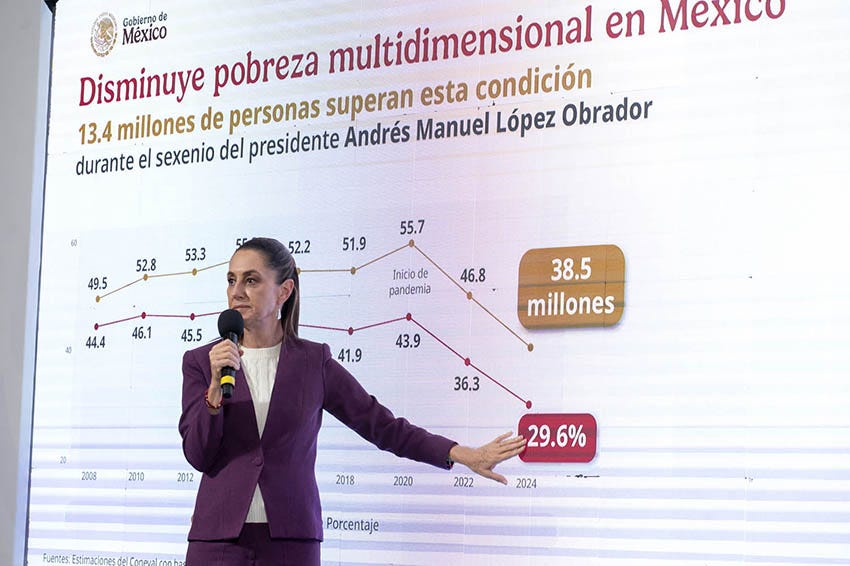
First stop: Mexico has lifted 13.4 million people out of poverty since 2018. The percentage of Mexico’s population living in poverty declined from 41.9% to 29.6% during this period - the most effective poverty reduction in the country’s history. President Claudia Sheinbaum highlighted the new figures this month. “We have to be very proud as Mexicans because this indicator speaks of the essence of our project — humanism.” Mexico News Daily
☝🏽Credit where it’s due: The Guardian seems to have picked this one up.
Second stop: After curbing runaway inflation, Argentina sees extreme poverty rates plummet. In the first half of 2025, extreme poverty fell to 7.4%, down from 18.2% only a year ago. Why? Monthly inflation has fallen below 2% for two consecutive months, compared to over 200% at the end of 2023. Rio Times Online
Third stop: Europe’s quiet success: fewer children left hungry, cold, or excluded. Severe material and social deprivation among children in the EU has dropped from 11.8% in 2015 to 7.9% in 2024, with Romania and Hungary leading the gains. Nutrition has improved too: among low-income children, daily fruit and vegetable intake rose from 87.2% in 2014 to 91.7% in 2021. Behind the progress is the European Child Guarantee, funnelling funds into childcare, housing, food, and healthcare. Eurofound
Fourth stop: Iraq has launched its first Multidimensional Poverty Index, which tracks not only income but also housing, health, education, jobs, and security. The report notes a nearly 50% reduction in the national MPI since 2011, along with a continued decline in income poverty, which fell from 24% in 2022 to 17.5% in 2024. UNDP
Fifth stop: Indonesia is putting community empowerment at the centre of poverty reduction. The national poverty rate slid to 9.03% in March 2025, the lowest in a decade and down from 9.36% a year earlier (that’s 800,000 Indonesians no longer officially poor). The Ministry of Social Affairs attributes this to village-level empowerment: funding micro-enterprises, training women in business, and securing local food stocks. ANTARA

Scientists have established the first quantum satellite link between China and South Africa, spanning 12,900 km: nearly double the previous record. Using single photons to transmit encryption keys, the system makes eavesdropping impossible without detection, and even worked in real time to send encrypted images between Beijing and Stellenbosch. The breakthrough points toward a future global quantum internet and also puts South Africa on the map in cutting-edge quantum science. Phys.org
Courts in the United States push back against Trump administration in environmental rulings. A federal judge in Montana has ruled that the U.S. Fish and Wildlife Service broke the law by denying Endangered Species Act protections to wolves, Trump’s attempt to open areas of the Pacific Remote Islands Marine National Monument off Hawaii to commercial fishing has fallen afoul of a Honolulu judge, and a federal judge has just ruled that Florida must stop construction on Alligator Alcatraz and within 60 days, remove fencing, lighting, and generators.
Mexico, Guatemala and Belize launch tri-national reserve to protect the Maya forest
The countries’ three leaders announced a ‘biocultural corridor’ of the Great Mayan Forest, spanning an astonishing 57,000 km² across southern Mexico, northern Guatemala and Belize. That’s the size of the US state of Iowa - making it the biggest protected area in the Americas after the Amazon. Associated Press
This is one of Earth’s lungs, a living space for thousands of species with an invaluable cultural legacy that we should preserve with our eyes on the future.
Claudia Sheinbaum, President of Mexico

We can now restore memory by recharging the brain’s batteries. French and Canadian researchers have shown that faulty mitochondria (repeat after us: the powerhouse of the cell) directly drive memory loss in dementia. Using a new tool to boost mitochondrial activity in mice, they restored memory performance, proving cause and effect for the first time. The work points to mitochondria as a powerful target for therapies that could slow, or even prevent, neurodegenerative diseases like Alzheimer’s. Science Daily
Related: “What's so special about the human brain?” Researchers are finally getting closer to an answer. Using new tools that map individual brain cells and their connections, they’ve found that our brains aren’t just bigger than those of other primates, they grow more slowly, wire up more densely, and leave more room for experience to shape them. But - this complexity comes at a cost: it may be why humans, unlike other animals, are vulnerable to mental illnesses like schizophrenia and bipolar disorder. Nature
South Africa’s courts have brought Big Oil’s offshore plans to a halt. A high court has blocked Shell and TotalEnergies from drilling off the country’s Wild Coast, citing failures to consult fishing villages and coastal communities. The ruling, hailed as a major victory for fishers, builds on a series of legal victories where judges have prioritised cultural and environmental rights over fossil fuel expansion. The South African
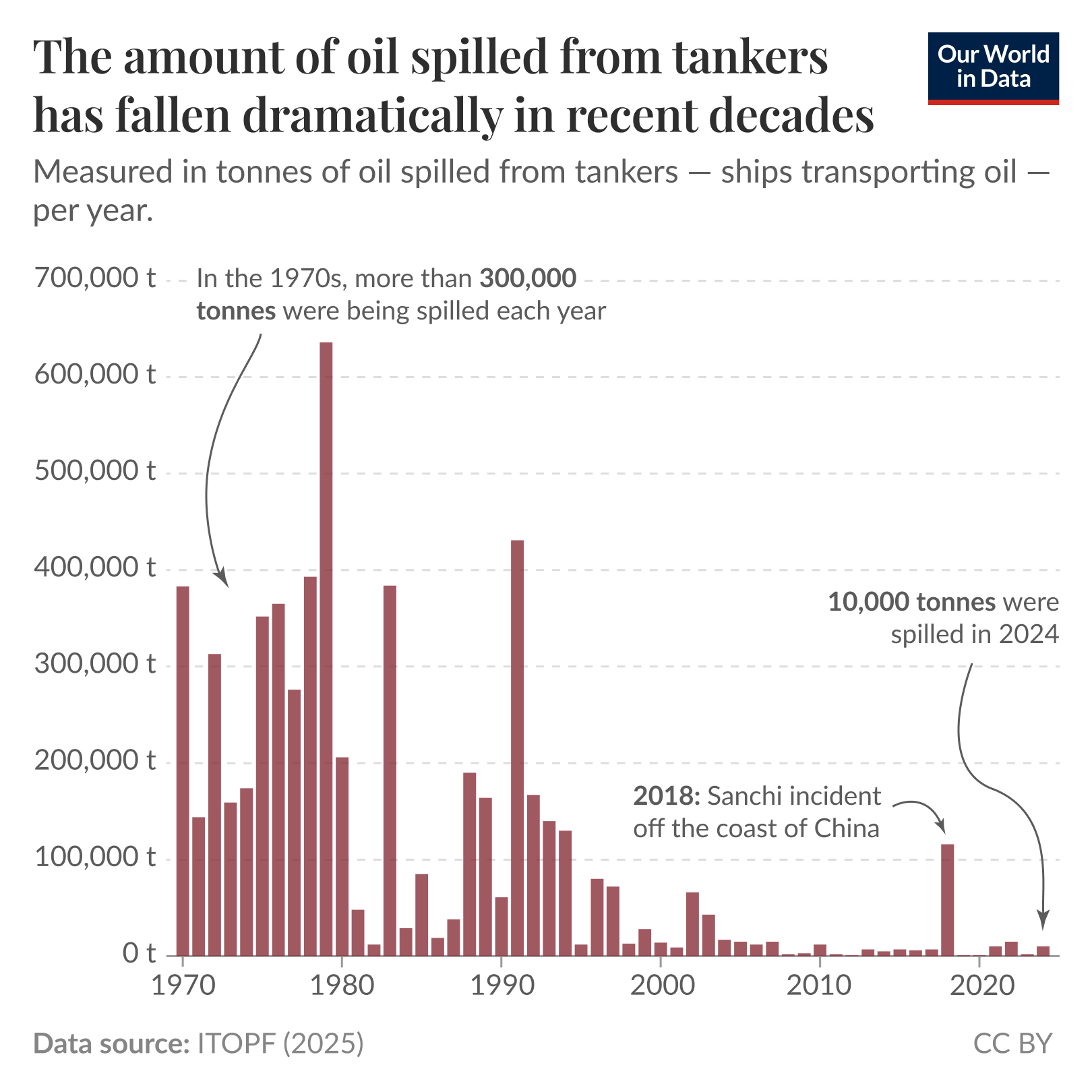
And speaking of: Oil tanker spills have nearly vanished since the 1970s. Half a century ago, spills released an average of 314,000 tonnes of oil into the ocean each year. However, better ship design, stricter regulation, and faster response capacity have turned once-routine disasters into rare events; today, the figure is below 10,000, less than one-thirtieth of its former level. Our World in Data
Cotton farmers are turning to nature’s own pest control. Developed by entomologist Robert Mensah, a simple mix of yeast, sugar, and water lures in ladybirds and lacewings (predator insects that feast on crop pests). The method has since spread from Australia to Benin, Ethiopia, Vietnam and India, protecting farmers’ health while cutting pesticide use. The Guardian
Last week, we noted Wall Street’s big banks were pivoting from fossil fuels to green energy: this week, the playbook continues to shift as hedge funds start shorting oil stocks. Simultaneously, commodity traders are switching their attention from oil, gas and metals to buying, storing and selling energy back into grids, especially in Europe, where capacity is set to rise sevenfold by 2030.
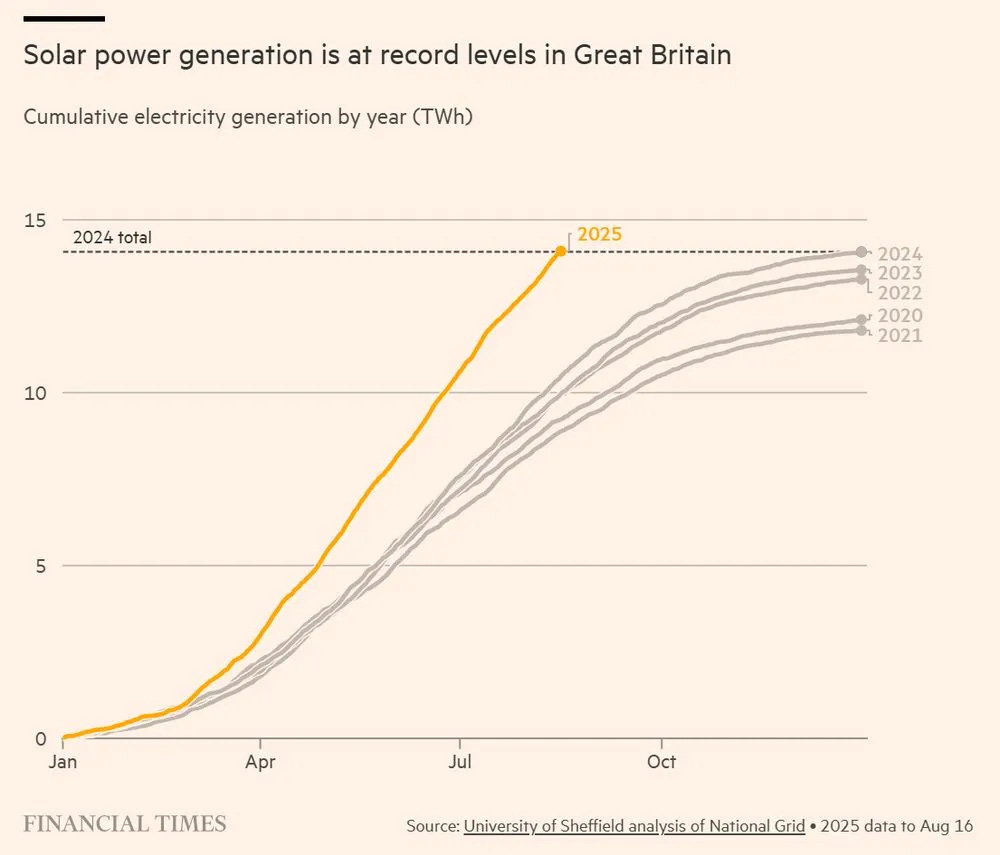
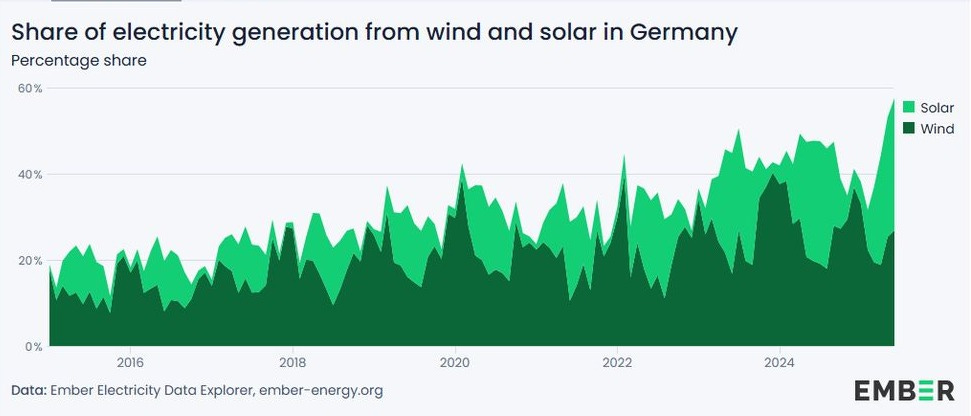
As of today (okay, technically as of mid-August) the United Kingdom has generated more electricity from solar than it did all of last year. Meanwhile, in Germany, wind and solar are generating 57.5% of the electricity, twice as much as they did during the COVID-19 pandemic - and this in the world’s second most important industrial power, and third largest economy.
Million-year-old tools on Sulawesi push back the date of the earliest sea crossings. Apparently ancient hominins crossed deep ocean to reach what’s now Indonesia over a million years ago. Previous to these discoveries we’d thought the first sea crossings were a mere 194,000 years back. Nature
America’s crime wave isn’t happening: The United States is living through its safest stretch in half a century. Murders are down 42% year-on-year (the steepest drop in four decades) while serious violent crime is down 22%. The gap between perception and reality has never been wider. Bloomberg
And finally, Paris just removed the paving in front of its city hall and transformed it into an urban forest.