346: Nightlight. Numbat. Crime watch. Spudcell.
We built a Wright Flyer.
This week’s top stories
Let’s call this the power issue, or at least let’s kick things off there.
Between 2010 and 2024, the percentage of humanity with access to electricity grew from 84% to 92%, even as world population increased by more than a billion. The number of people without electricity fell from around 1.1 billion to 655 million. That is a pretty remarkable achievement, except…
The last stretch is proving the hardest. In sub-Saharan Africa, access to electricity is being outpaced by population growth. A young, growing population is a boost to economies, both locally and globally, but it’s happening in a region where just over half the population has access to electricity. That’s a big problem. Fortunately, as we’ve previously documented, Mission 300 seems to be making serious inroads, getting distributed solar and mini-grids to those places where state infrastructure doesn’t reach.
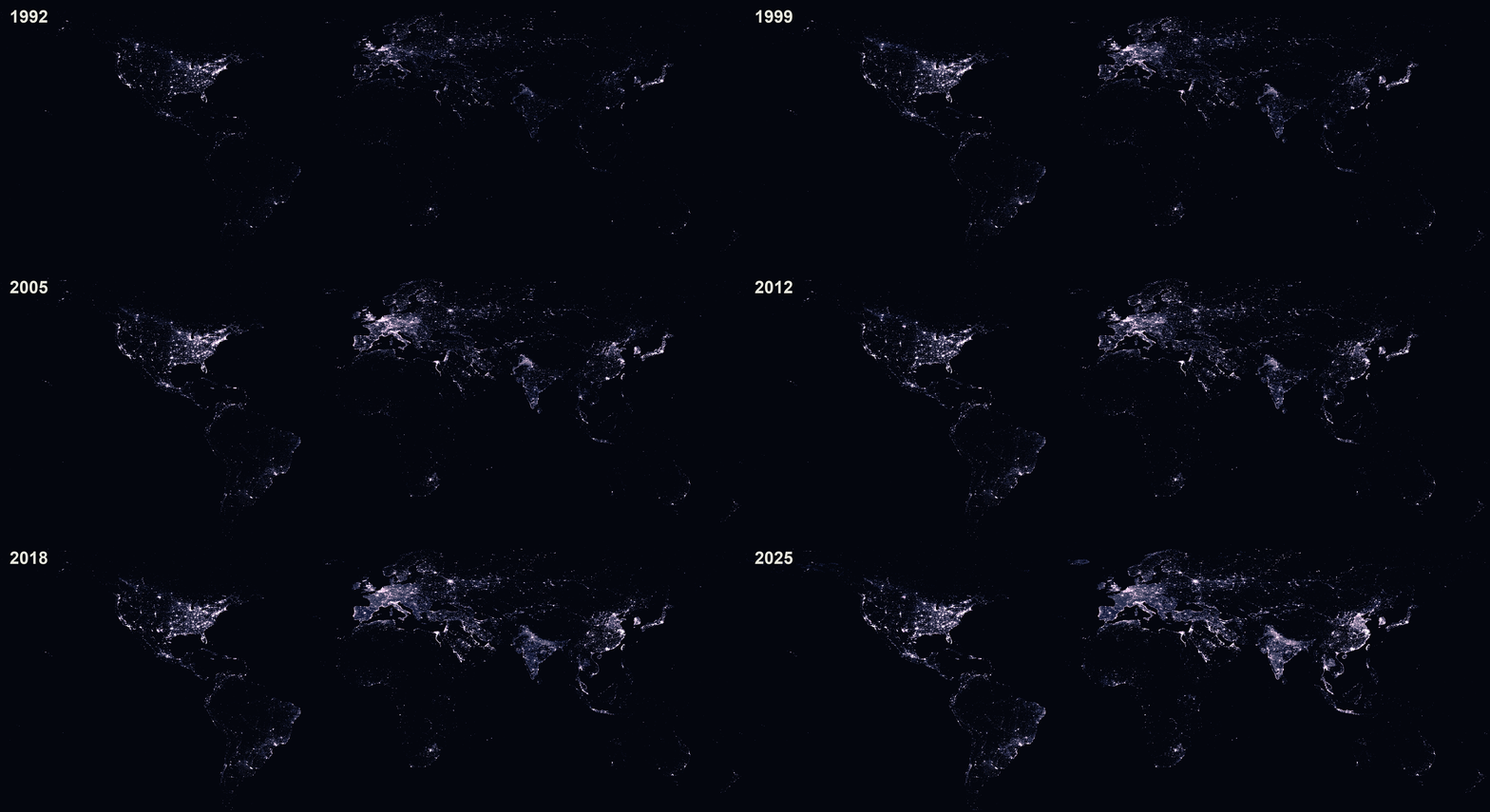
Meanwhile, if you want to see the world’s growing access to electricity, check out the image at the top of this post. It’s probably not the first lights-at-night map you’ve ever seen, but it’s definitely the best. That’s because a bunch of development economists just harmonised three decades of imagery into a single corrected series, stripping out the sensor drift and light “‘blooming’ that blurred the raw data. This new lights-at-night dataset is an excellent, unfakeable proxy for development across the Global South — and it’s open-source, which is how we were able to render it. VoxDev
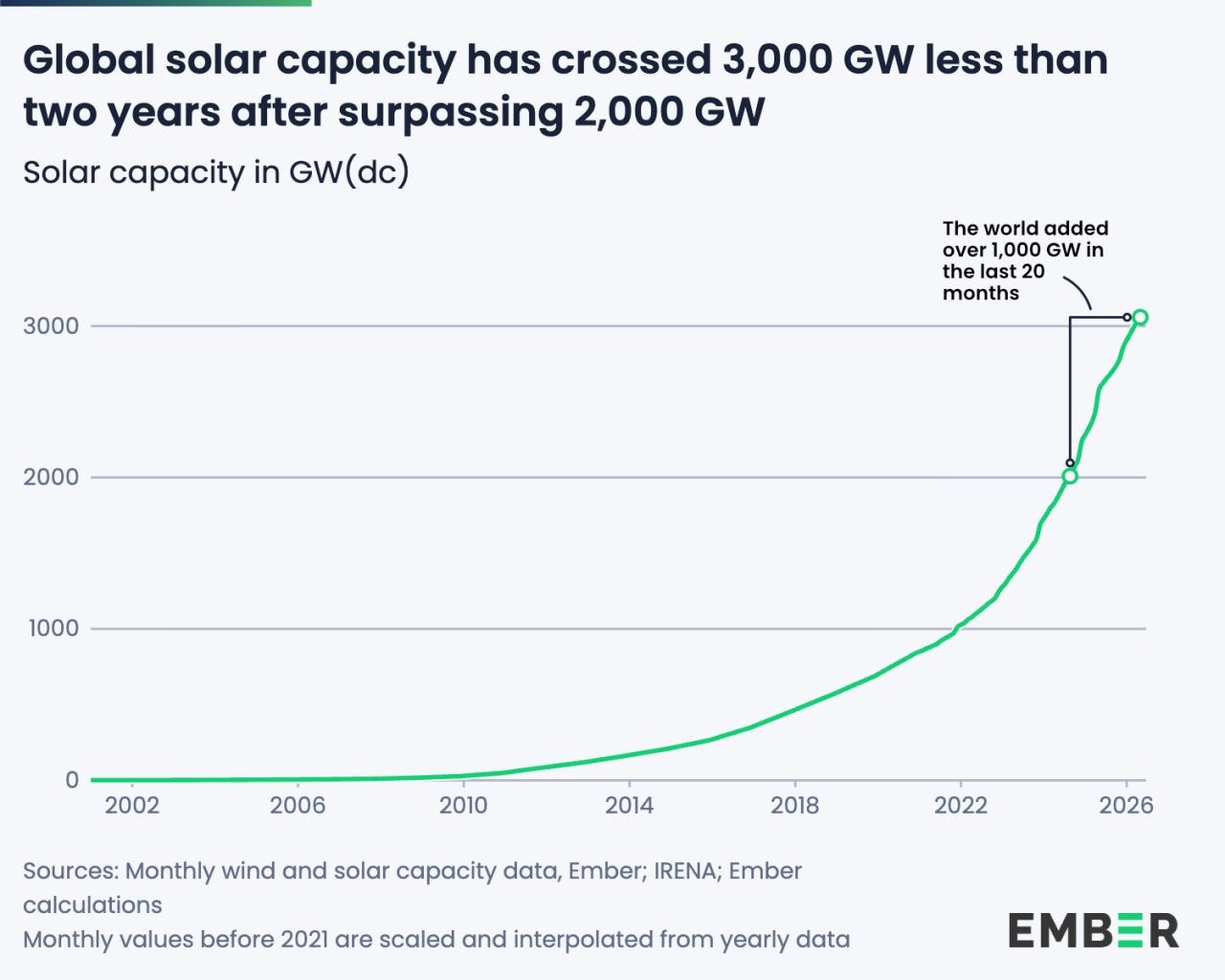
Meanwhile, you know how everyone bangs on about exponential technology graphs all the time? Well here is a classic of the genre, right on schedule. As of April 2026, global solar capacity now exceeds 3 terawatts. The first terawatt took 20 years. The second took 33 months. The third has arrived in 19 months.
Sticking with solar, India is keeping pace with its ambitions to industrialise with sunlight rather than coal. The country added a record 44GW of solar in 2025/26, reaching 154GW in total and overtaking the United States as the world’s second-biggest market for new capacity. To prevent all that nice new clean energy getting wasted, Delhi is spending roughly $100 billion to expand transmission by 2032. OilPrice
Meanwhile, solar has become the EU’s single biggest source of electricity. Panels generated a quarter of the bloc’s electricity in June 2026, more than wind, fossil gas or nuclear, and a shrivelled 8% from coal, just as heatwaves drove air conditioning demand. Spain pulled 34% of its electricity in June from the sun, Germany even more, at 36%. Ember
Planning ahead (it’s not always summer) Switzerland has bolted 5,000 solar panels to an Alpine dam, where they work best in winter. The AlpinSolar plant on the Muttsee dam, about an hour outside Zurich, sits at 2,500m, way above the treeline, where thin air and snow-glare lift output. It generates roughly half its power in the coldest half of the year, around three times what a lowland solar farm manages, and at exactly the time the rest of the country runs short. Ecoportal
Solar is turning up in even stranger places, too. A Chilean salmon farm now draws about 57% of its power from panels laid over the water, cutting roughly 136,000 litres of diesel a year and silencing the generators. With the noise gone, thousands of salmon have gathered in the shade beneath the arrays. Ecoportal
Take a jaunt across South America and you’ll find that Rio’s humpbacks are rebounding now that they’re no longer faced with harpoons Since commercial whaling paused in the 1980s, the South Atlantic humpback population has resurged from around 2,000 to 35,000, near pre-whaling levels, with the giants surfacing in Rio’s postcard Guanabara Bay each winter. AP
More species back from the brink: Australia’s numbat is off the endangered list. The striped, termite-eating marsupial has been downlisted by the IUCN to near-threatened, capping a 40-year recovery. Sustained fox and cat control lifted numbers from about 300 in the late 1970s to around 3,000 today. Mongabay
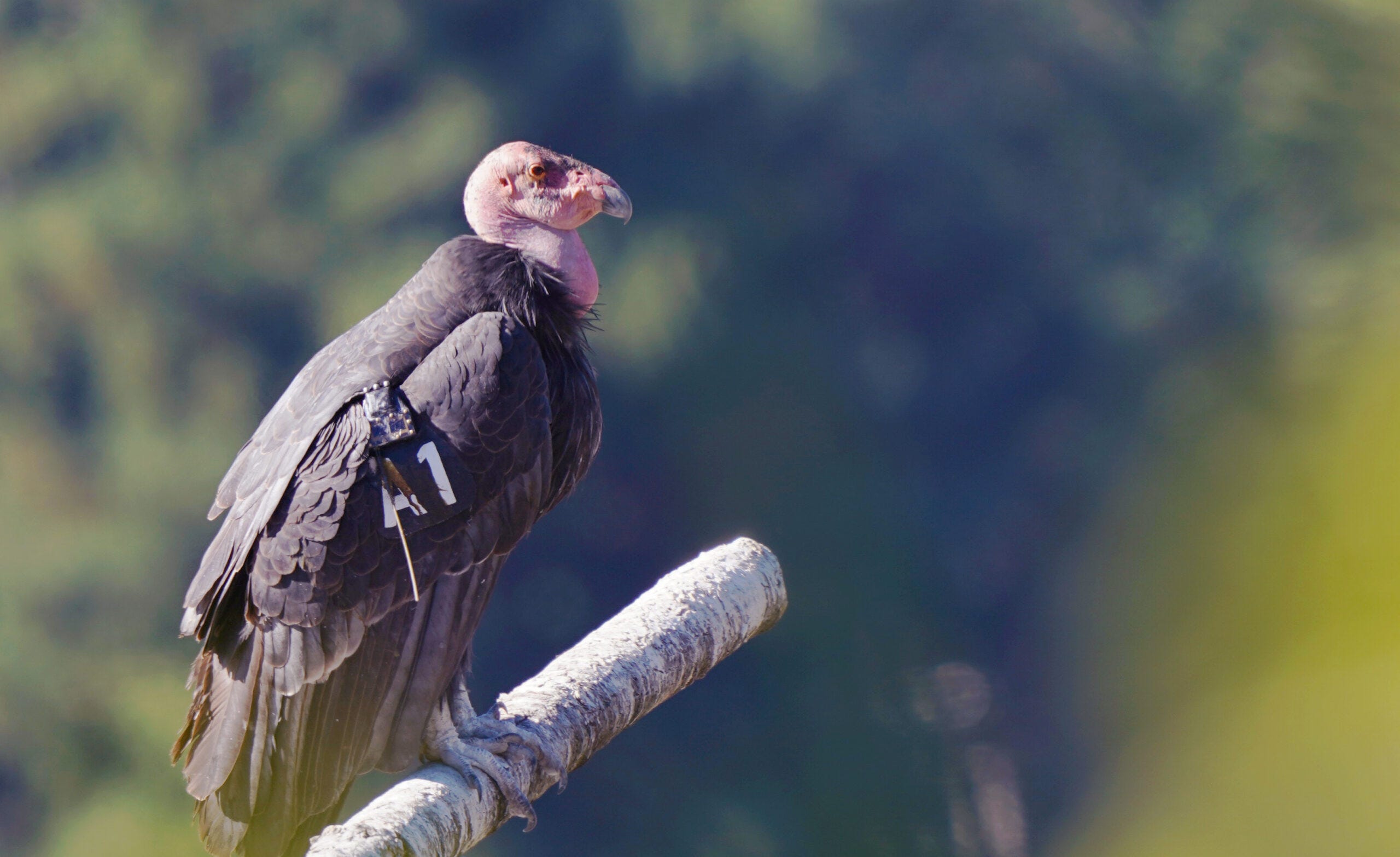
And California condors are nesting in the Pacific Northwest for the first time in a century. A pair reintroduced by the Yurok Tribe, to whom the bird is sacred, appear to be incubating an egg in an old-growth redwood. The species crashed to 22 birds in 1982 and now numbers 607, though lead poisoning still kills more condors than anything else. Mongabay
El Salvador has eliminated trachoma. The WHO validation, reached in just three years through better sanitation, eye screening and clean-water work, makes it the first Central American country to do so, and one of 64 countries worldwide to eliminate a neglected tropical disease. WHO
The UN’s Sustainable Development Goals, treated like failures, have changed billions of lives. The UN’s Sustainable Development Goals, set in 2015, were ambitious: zero hunger by 2030. Gender equality. No more poverty. And since we aren’t on track to meet most of those goals, the news treats them as failures. But part of our job at Fix The News is to hail partial victories and looking at the SDGs in 2026 we’ve done some pretty incredible things?
Internet access from 40% to 74%. About a billion more people with clean drinking water. A billion and a half more with better sanitation. Huge victories against hunger and disease — for all that we’re a long way from eliminating them. We won’t get full gender equality by 2030, nor will we eliminate extreme poverty; the goals were ambitious, maybe impossibly so. But helping billions of people isn’t meaningless. “Let us be judged by results.”
Southeast Asia has flipped from mangrove villain to mangrove hero. The region drove nearly 60% of global mangrove losses up to 2010; since then it has swung to a net gain, supplying about 43% of the world’s recovery. Science
London let its roadsides run wild, and butterflies are starting to return London’s transportation authority has doubled its wildflower verges in two years to 520,000 m², about 100 Trafalgar Squares, and butterfly sightings are up more than 50%.
We’ve built a cell-like object from scratch in the lab, and it grows and divides. A team at the University of Minnesota led by Kate Adamala has assembled non-living biological components inside a lipid membrane and coaxed the resulting blob into replicating its DNA, growing bigger, then pinching itself in two -- the basic moves of a cell cycle, performed by something built molecule by molecule in a lab.
The synthetic cells (nicknamed ‘spudcells’ after Adamala hated ‘Adamala cells’) still need constant deliveries of food and ribosomes to work, can’t meaningfully mutate, and aren’t alive by any definition Adamala herself would accept. But nothing built from scratch has ever come this close before. ‘The modern cell is like a Dreamliner,’ Adamala said. ‘We built a Wright flyer.’ Quanta
The French government is banning all advertising for imported fossil fuels. By year’s end the government will issue a decree banning all advertising for imported oil and gas, activating a 2021 climate law that has sat unused for five years. It forms part of a 22-point plan to cut fossil fuels dependence. Le Monde
The largest digital camera ever built has started filming a ten-year movie of the universe. From a mountaintop in Chile, the Vera C. Rubin Observatory’s 3,200-megapixel camera is now photographing the entire southern sky every few nights, producing roughly ten terabytes of data per night. The goal is an ultra-wide, ultra-high-definition time-lapse of the cosmos: pulsating stars, supernova explosions, asteroid orbits, and clues to dark energy and dark matter.
It’s already working. Even before the survey started, in a six-week optimization run last summer, Rubin discovered over 11,000 previously unknown asteroids, including 33 near-Earth objects. By the time the survey wraps in 2036, the dataset will contain billions of objects with trillions of measurements, all publicly accessible, and of course a lot of gorgeous, watchable “film.” Rubin Observatory
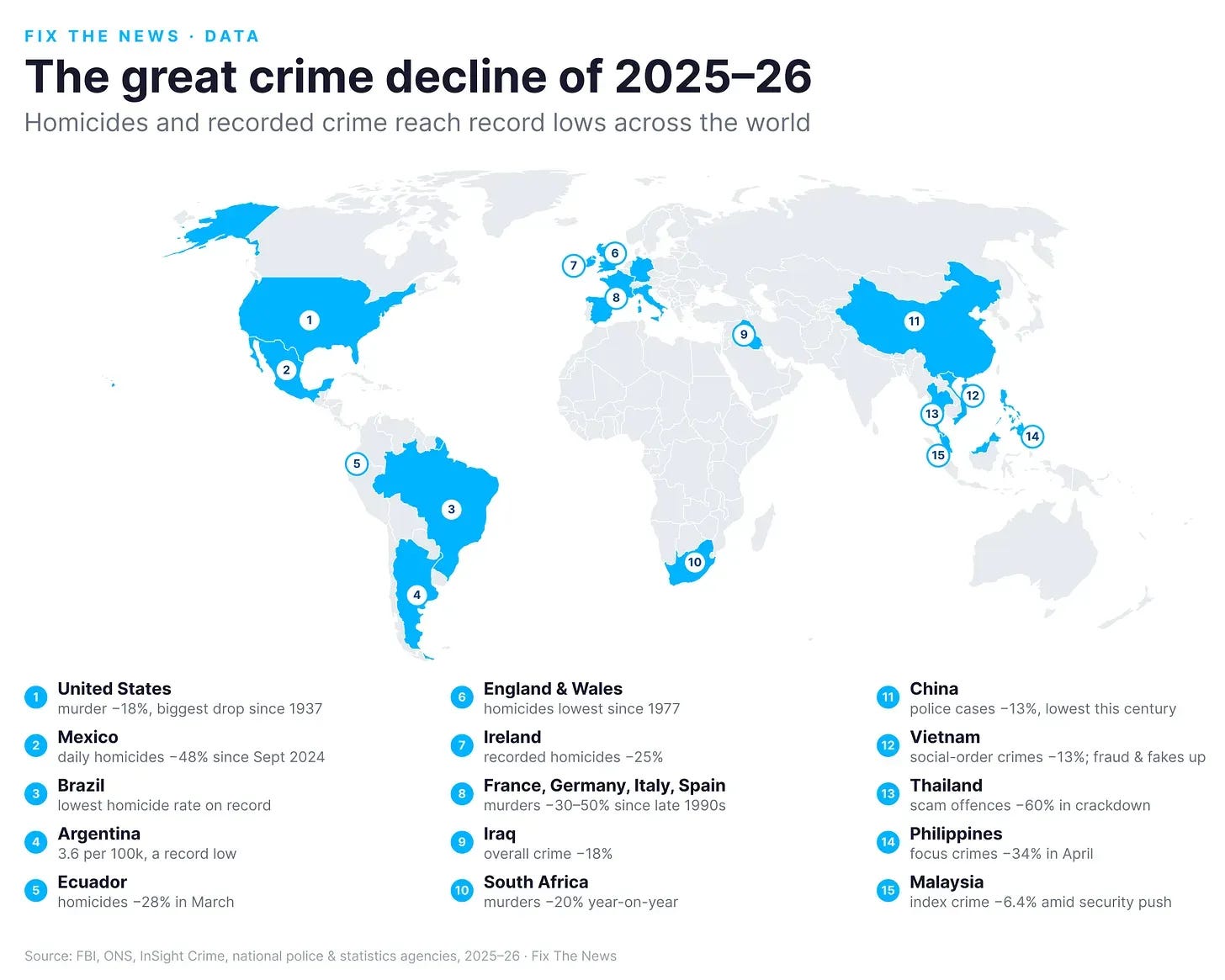
Fix The News crimewatch
United States: murder fell 18% in 2025, the sharpest drop since 1937.
Mexico: daily homicides down 48% since September 2024, 12-year low.
Brazil: just hit lowest homicide rate in its recorded history.
Argentina: 3.6 murders per 100,000 in 2025, lowest rate ever recorded.
Ecuador: homicides down 28% in March after a security crackdown.
Across Latin America and the Caribbean, murders fell over 5% in 2025.
England and Wales: homicides down to their lowest level since 1977.
Ireland: homicides down 25%, mostly fewer fatal road crashes.
France, Germany, Italy, Spain: murder down 30-50% since late 1990s.
Iraq: overall crime down 18% year-on-year.
South Africa: murders down 20%, helped by load-shedding’s end.
Philippines: focus crimes fell 34% in April from a year earlier.
China: police crime cases fell 13% in 2025, lowest this century.
Vietnam: social-order crimes fell 13% nationwide year-on-year.
Thailand: scam offences fell nearly 60% during a national crackdown.
Malaysia: index crime fell 6.4% amid stepped-up security operations.