

336: Awe. Malaria vaccines 👍. Oxyrhynchus. Bandicoot.
Whether it’s the poetry of your scripture or the beauty of the equations.


Hi everyone, Gus here. Two weeks ago I was a guest curator at TED in Vancouver. Over the last six months I’ve been working with their team to create a session based on a simple premise: that some of the most consequential gains being made in the world right now aren’t getting anything close to the attention they deserve.
We are very good at telling stories of doom and destruction. We are far less good at doing the same for progress, repair, and regeneration. This was a chance to bring some of the work we do here at Fix The News to a stage that, better than any other, knows how to tell a story.
We covered a lot of ground! Amy Bowers Cordalis on the restoration of the Klamath, Felix Brooks-Church, who’s been on our podcast, on global food fortification. One of my all-time heroes, Bill McKibben on solar energy, and Saloni Dattani, one of my favourite researchers, on global health. Drew McCartor from Pure Earth, who’ve spent 25 years fighting lead poisoning worldwide, and Rapelang Rabana and Imagine Worldwide, who are bringing education to eastern and southern Africa. Venezuelan opposition leader Leopoldo López, on what freedom really costs, and we even landed an interview with President Vjosa Osmani of Kosovo, who has just ended her term.
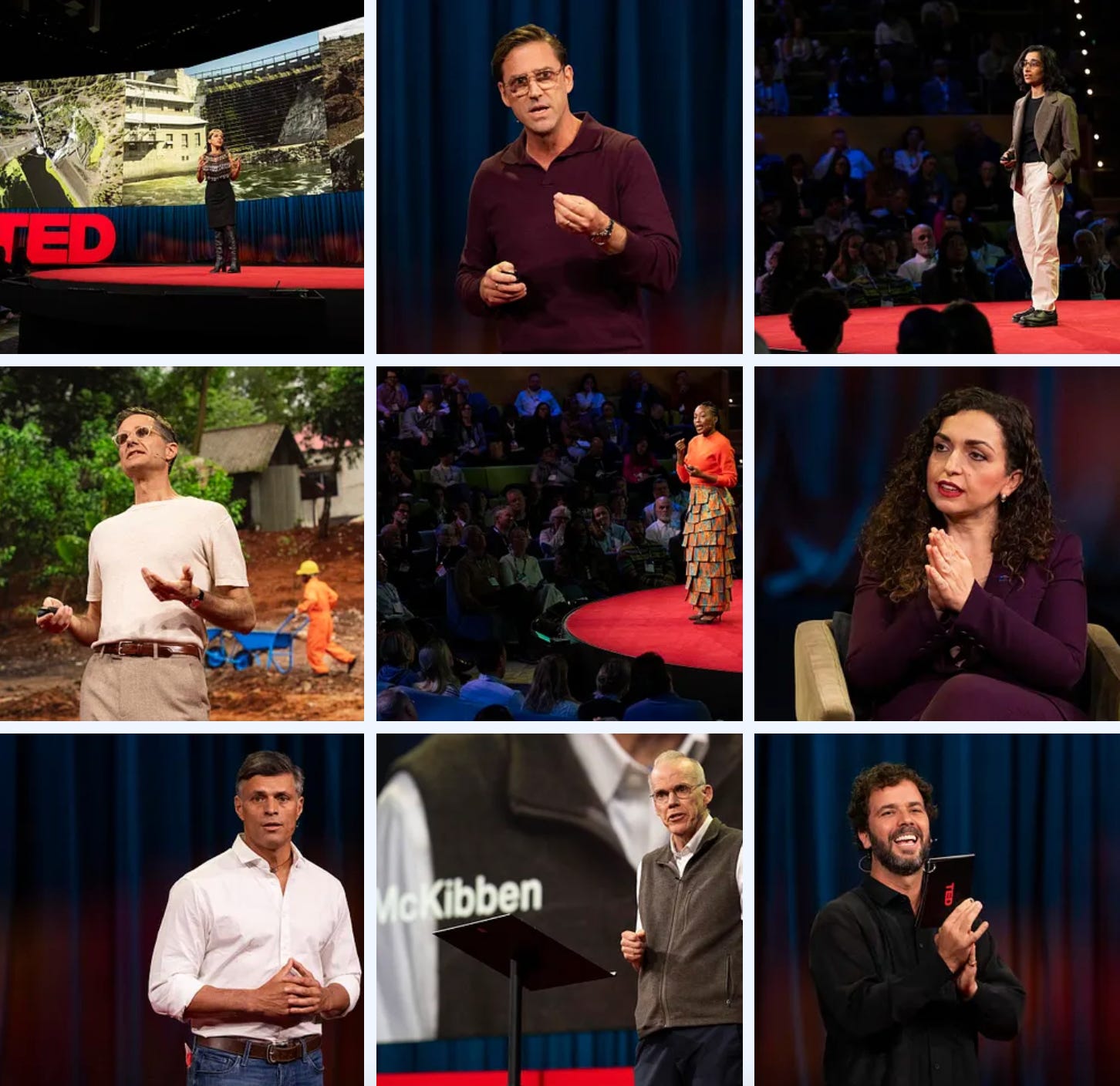
The speakers were remarkable. What was rarer, though, was the feeling of the session itself. TED audiences are used to moments of inspiration and lessons in human ingenuity, but this was something different: a sustained, two hour-long focus on how progress actually happens, why it happens, what keeps it going, and what it requires. A chance to take the mechanics of getting things right as seriously as we usually take the mechanics of what’s going wrong.
Judging from the response, it landed, and in the days that followed, something else became apparent. There’s a familiar observation in solutions journalism: good news happens slowly, bad news happens fast. It’s one of the central claims for why our information environment skews negative, and broadly, it’s correct. But there’s a second asymmetry that gets considerably less attention.
Progress, almost without exception, requires a lot of people working together over a long time. Everyone on that stage was acting as an avatar for a larger collective effort, and what I found so interesting was that several were almost tortured by the fact. Amy Bowers Cordalis kept telling me in the days before her talk: this feels wrong, hundreds of people made this happen, I need to show their faces, I need to tell their stories. But she only had ten minutes.
Felix Brooks-Church is the quintessential archetype of an inventor who changes the world with a machine. But the first people he talked about were others working on food fortification, because he knows the machine doesn’t fix anything without an ecosystem. Bill McKibben, decades in, I think understands at almost a cellular level that real change doesn’t happen without movements: the slow, unglamorous business of organising millions around an issue.
This is all wildly unfair, because on the other side of the ledger many of the world’s most pressing crises trace back to just a handful of people. Specifically, one person in the United States, one in Russia, and one in Israel. Between those three men, you can plausibly account for 60 to 70 percent of the major geopolitical damage of the past few years.
Three men. The structural disparity is staggering. Enormous destructive power accrues to a handful of individuals, while the work of repair requires a vast, distributed, often invisible effort sustained by millions over decades. It is so, so much easier to break than to build.
Like many solutions journalists, I love Margaret Mead’s famous quote about small groups of citizens changing the world, but it’s incomplete. Small groups may start things, but by the time the river runs free, or the disease is eliminated, or the law gets passed, the group isn’t small anymore. It’s made of negotiators and agitators, people that are good with spreadsheets and people who are good with people and people who dig trenches in the rain.
Amy knew this. That’s what was eating at her. And she wasn’t alone. Every speaker on that stage was aware, to varying degrees, that they were standing in for something larger.
I am so grateful to TED for offering these amazing people a platform to tell their extraordinary stories with the craft they deserve. Nobody does it better. But I’m still not sure humanity has a good format for collective stories. We know how to put one person on a stage. We know how to film a reel, or write a headline. We have almost no idea how to tell a story where the protagonist is a thousand people working across twenty years.
I don’t have a fix, but I think it matters to name it. Every time a major breakthrough gets compressed into a press release with a single name, something fundamental about how progress works disappears. Behind each of the faces on that TED stage, and all the stories you’re going to read this week, remember: there are multitudes.
This week’s top stories
We have the first national-level evidence that the malaria vaccines are working. With the exception of COVID-19, malaria vaccines have seen the fastest rollout in history; they are now in routine use across 25 African countries. Anecdotal data has suggested substantial reductions in severe cases and hospital admissions - but now we have the first official figures, from Burkina Faso, one of the world’s ten highest burden countries. Between 2024 and 2025 malaria cases fell by 32% and malaria‑related deaths by 44%. That’s in a single year.
The WHO also just prequalified the first malaria treatment for newborns and infants, and approved three new rapid diagnostic tests to identify a missing strain. Keeping this progress going is not going to be easy - especially in the face of aid cuts and climate change. But this is still incredibly good news, can we just take a moment?
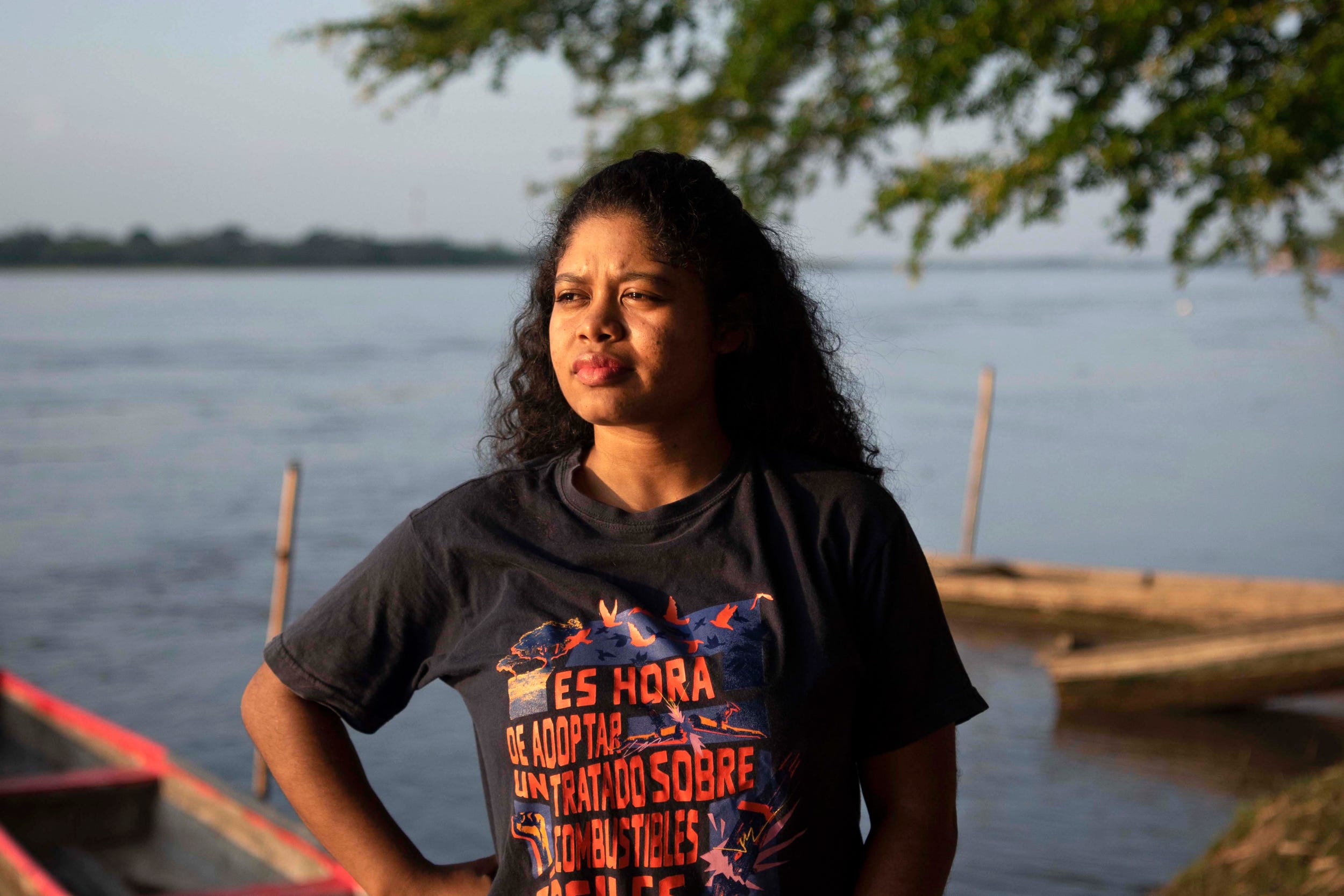
Six environmental activists from around the world have been awarded the Goldman Environmental Prize. For the first time, all six winners are women. One of them is Yuvelis Morales Blanco, who helped stop fracking along Colombia’s Magdalena river. Yuvelis grew up in Puerto Wilches, where “dark spots on the river meant that we were not going to eat.”
In 2019, she co-founded the youth-led group Aguawil, going door-to-door, organising protests and community education and eventually securing a national fracking moratorium. This was all before the age of 24 (and while death threats have forced her into temporary exile in France). Inside Climate News
You can read more about the other Goldman Prize winners here, who collectively protected a rare bat in Nigeria by training communities to prevent wildfires, won a South Korean court ruling requiring stronger climate targets, stopped a UK oil drilling project after a decade of legal challenges, pushed a global mining giant to address toxic waste from an abandoned mine in Papua New Guinea, and helped block the largest proposed open-pit mine in North American history.
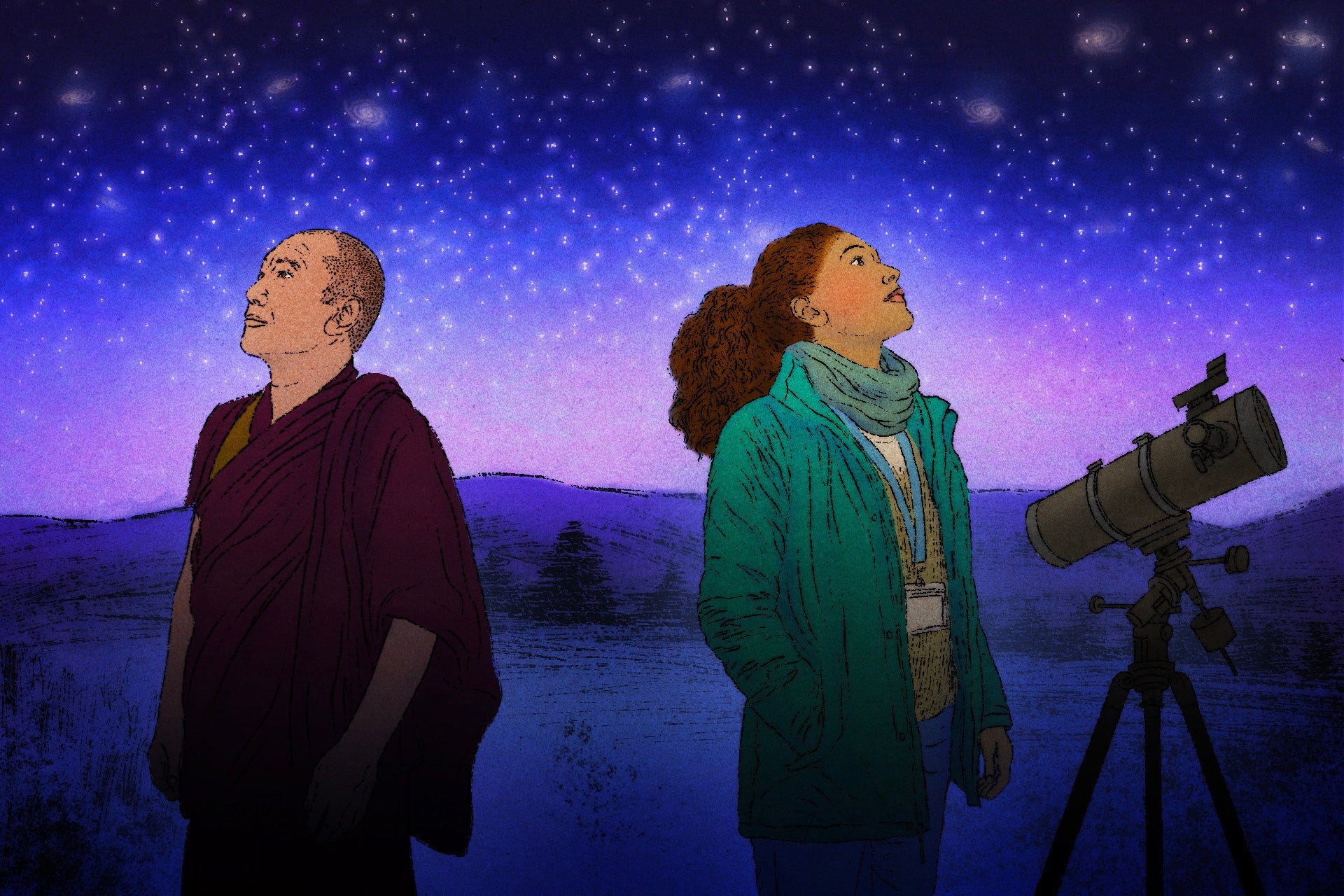
Dark matter is 85% of the universe’s mass, and nobody knows what it is. That turns out to be fertile ground for a conversation between faith and science. A recent feature from the Associated Press has been making the rounds, about how some of the world’s leading dark matter researchers think about the spiritual dimensions of their work, and the answers are more interesting than you’d expect.
Vera Rubin, the astronomer who provided the first robust evidence for dark matter’s existence, embraced her Jewish faith. For Doug Watson, a postdoctoral fellow, the gaze of Lord Krishna seems “eerily similar” to the observer effect in quantum mechanics. And when Ken Freeman, the astrophysicist who provided some of the first hard evidence that spiral galaxies are held together by something invisible, was asked whether his lifelong pull toward dark matter might be the Holy Spirit at work, he didn’t say yes — but he didn’t quite say no either. “I would not paint it that way,” he said, “but it’s a nagging possibility.”
Not every scientist agrees the universe needs a sacred dimension. But when 85% of the cosmos is something we can only feel by pull, perhaps awe as a response is unsurprising?

Telehealth is protecting reproductive rights in the United States. Abortions in the US rose slightly to 1.126 million in 2025, even as cross-state travel fell from 170,000 to 142,000 visits. Telehealth and shield laws have helped keep access open, allowing clinicians in shield states such as New York and Massachusetts to prescribe abortion pills by post to patients in ban states such as Texas and Alabama. Reminder: banning abortion does not lead to fewer abortions. The Guardian
The United Kingdom has ended prosecutions for women who terminate their own pregnancies, as well as approving pardons for women convicted of doing abortions illegally, and expunging the police records of those arrested and investigated over illegal abortions. Research suggests that as many women have been charged in the last 20 years as in the entire 19th century, when judges often treated defendants with greater compassion. The Guardian
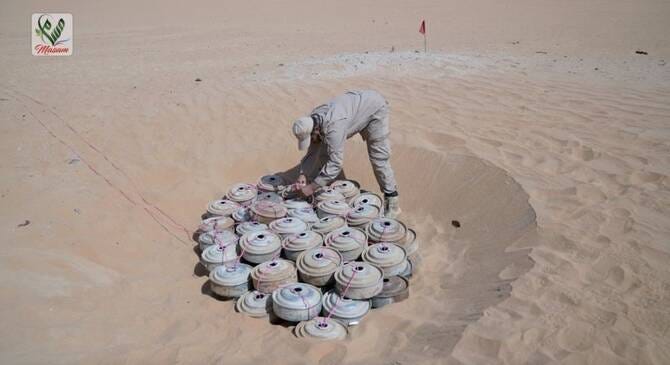
Saudi-backed teams have cleared over 550,000 explosives in Yemen. Since 2018, Saudi aid agency KSrelief’s Masam project has been removing landmines and improvised devices, helping make roads, farms, villages and public facilities safer for civilians. Almost 750 people, including specialists from around the world, are involved in KSrelief’s wider $294 million mine-clearance programme, which also supports work in Iraq and Azerbaijan. Arab News
Algeria has eliminated trachoma as a public-health problem, becoming the 29th country to do so.
Australia has eliminated trachoma as a public health problem, becoming the 30th country to do so.
Countries ditch the UN to create the first fossil-fuel transition roadmap
“Refreshing”, “highly successful” and “groundbreaking.” 57 countries, representing one-third of the global economy, have finished meeting in Santa Marta, Colombia, moving beyond abstract pledges to begin designing national pathways away from coal, oil and gas. The summit created three workstreams on transition planning, subsidy reform and carbon-intensive trade, and is backed by a new, powerful science panel Carbon Brief
China is linking provincial leaders’ promotions directly to climate performance. China says it will grade provincial leaders on emissions peaking, clean energy uptake and fossil fuel limits, with results directly affecting promotions and discipline. The new system ties performance-based governance to decarbonisation, and is likely to turbocharge the country’s already blistering clean energy transition. Bloomberg
The eastern barred bandicoot, once extinct in the wild, is being reintroduced in Australia using a ‘genetic rescue’ approach that mixes mainland and Tasmanian populations. Conservationists aim to establish at least 500 animals across five sites; earlier this week, 100 of them were released onto Australia’s Phillip Island.
Renewables cut European power prices by 24% on average. Wind and solar expansion reduced wholesale electricity prices by an average 24.2% across 19 European countries between 2023 and 2025, weakening the link between power costs and volatile gas markets. Solar alone has saved countries in the bloc over €3 billion since March 2026. Euronews
Mummies with golden tongues, and a piece of Homer tucked inside one of them. That’s what archaeologists just pulled out of a Roman-era tomb at Al-Bahnasa in Egypt, the ancient city once called Oxyrhynchus. The mummies were wrapped in linen patterned with geometric designs, and four of them had metal tongues placed in their mouths — three gold, one copper. The idea was that the dead would need them to speak in the afterlife. But the wildest find was paper, not metal. Inside one mummy’s wrappings, the team found a scrap of papyrus carrying a passage from Book II of Homer’s Iliad — the famous “Catalogue of Ships” that lists every Greek crew sailing to Troy. Smithsonian
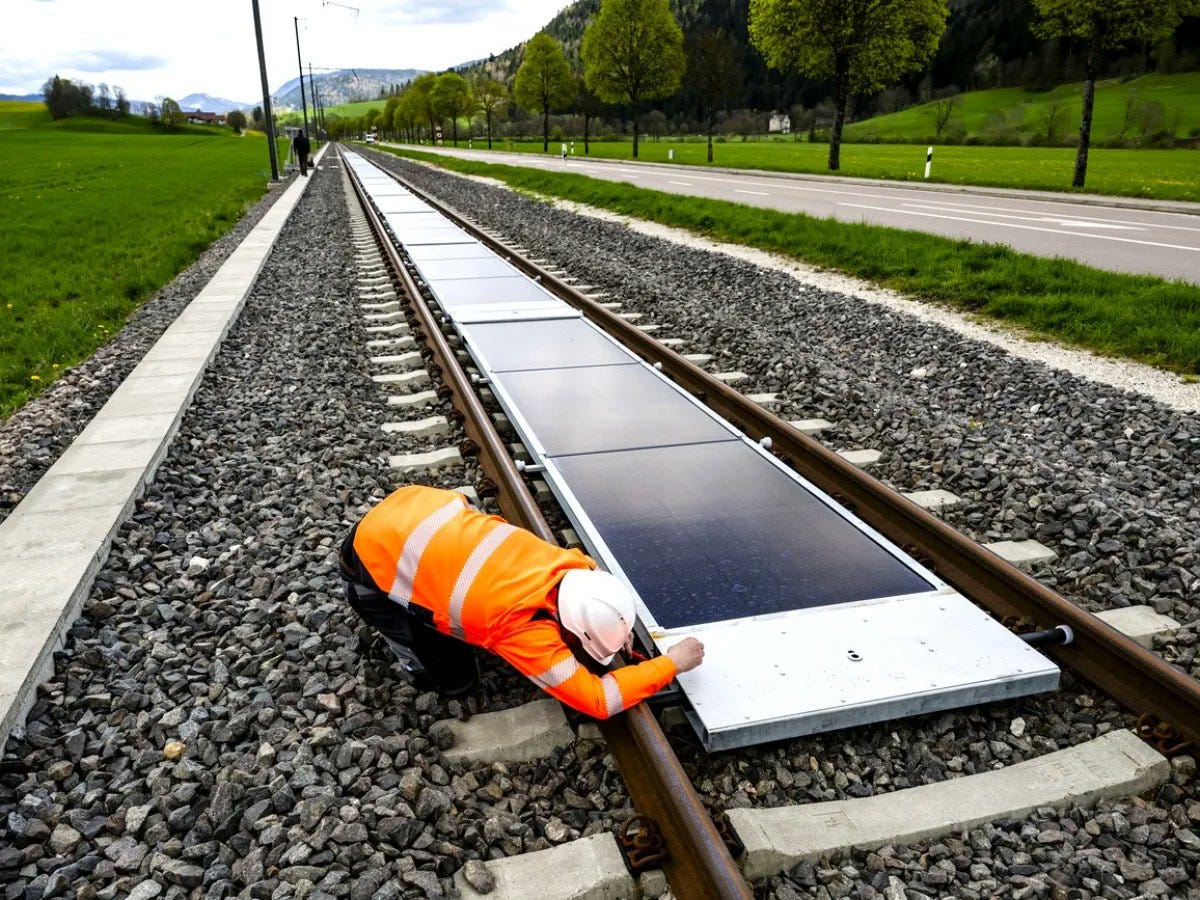
Railway solar project turns unused track space into energy
Switzerland is testing a simple idea: lay removable solar panels between train tracks to generate power from space that normally sits unused. A pilot in Buttes has installed 48 panels over 100 metres, producing about 16,000 kWh a year while trains keep running. If it scales, rail lines could double up as clean energy sources, without taking up extra land. SNCF
New Zealand midwives win a landmark pay-equity case. In a case brought by the New Zealand College of Midwives, the High Court has ruled that the government unlawfully discriminated against self-employed midwives by underpaying them for years. The decision “found a significant gap between midwives’ pay and the value of their work.” Um… yes. PMN
An Italian court has recognised biodiversity harm in a landmark case after the illegal extraction of over 1,000 rare cacti from Chile, linking a global trafficking network to ecological damage. The ruling allows a conservation group to claim damages for harm to its mission, establishing a new legal pathway to treat biodiversity loss as a civil injury and giving another option for enforcement beyond criminal penalties. The Revelator
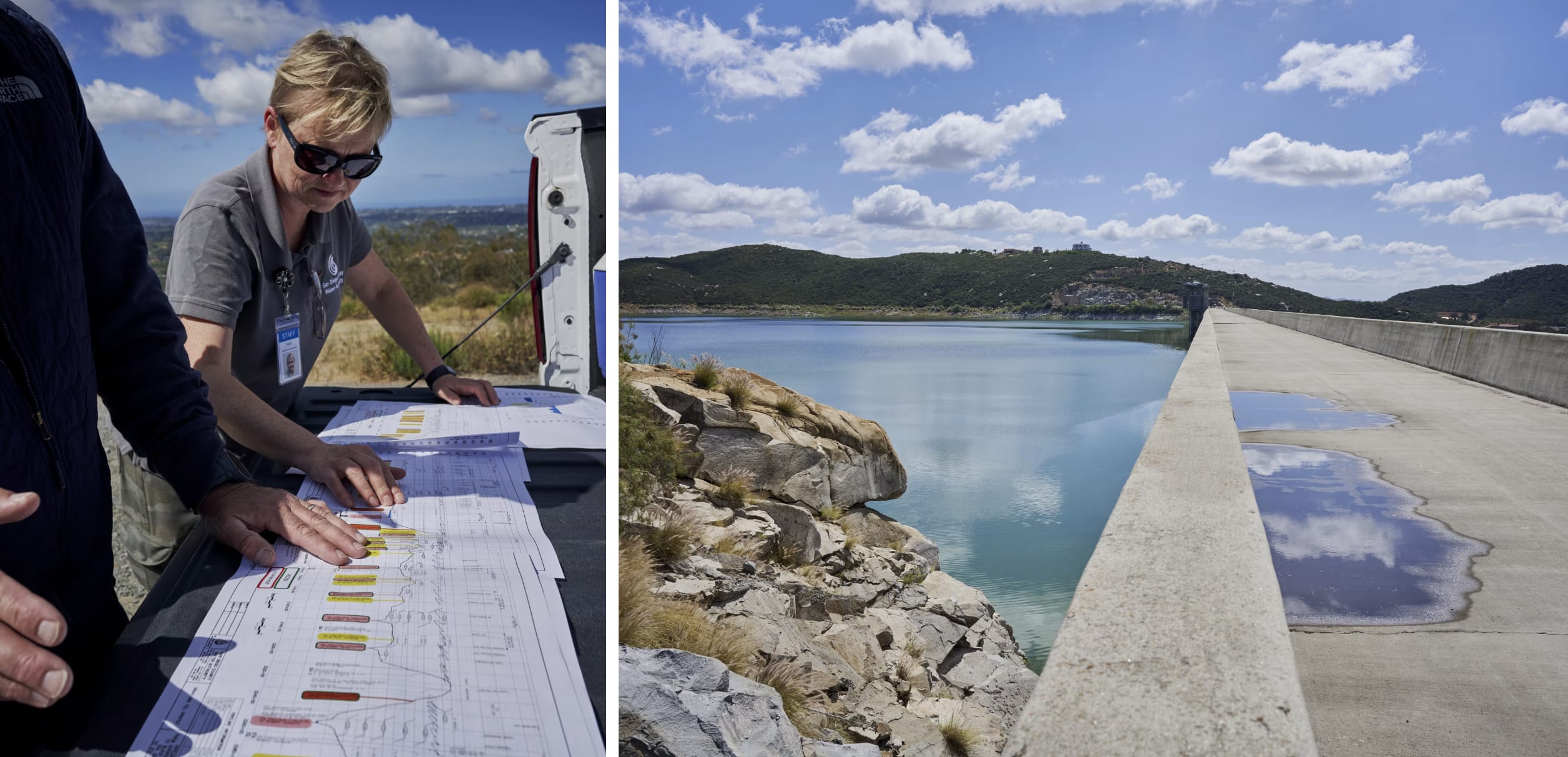
Once a poster child for drought, San Diego now produces surplus water: enough to export to other states, thanks to decades of investment in recycling and desalination. The city is now negotiating deals to supply Arizona and Nevada, easing pressure on the Colorado River. Wall Street Journal
The EU’s top court has struck down Hungary’s five year old anti-LGBTQ ‘propaganda’ law, after a challenge by the European Commission backed by 16 member states and the European Parliament.The court found that “the law is contrary to the very identity of the European Union as a common legal order in a society in which pluralism prevails.” Washington Blade
Sodium-ion batteries are hitting the market at scale. These batteries last longer than their lithium ion counterparts, work in extreme temperatures, and their components can be sourced sustainably, reducing the harm from mining (sodium is 1,000 times more abundant than lithium). They’ve long been the holy grail of battery technology, but while we’ve heard many promises, there’s been little movement. Now China’s CATL has signed a deal to supply 60 GWh of these batteries to energy storage integrator HyperStrong — batteries that can slot into existing systems, making them easy to roll out. Electrek
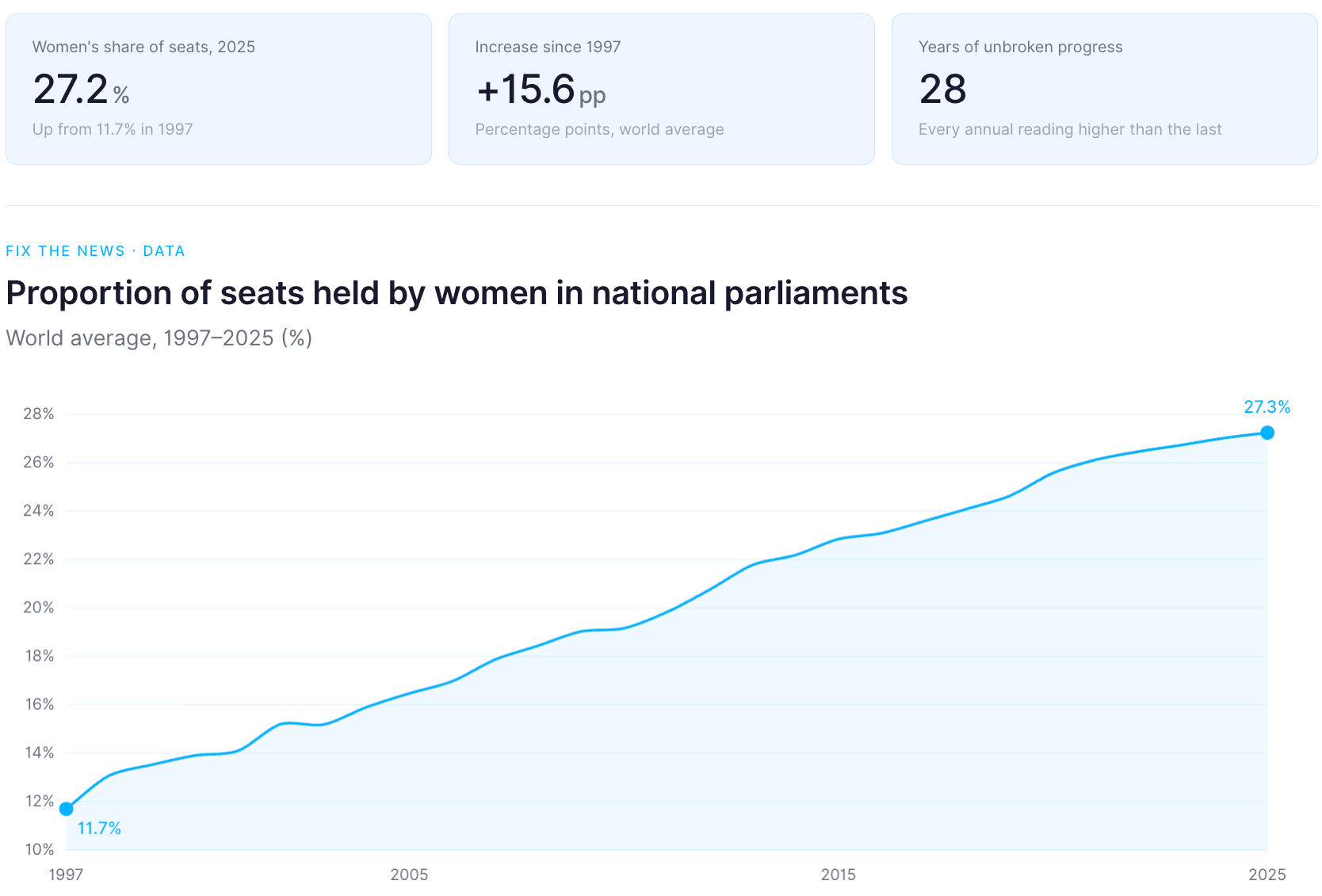
And finally, more than one in four parliamentarians worldwide are now women, up from 11.7% in 1997. It’s been a slow steady climb, one that’s continued through political turbulence, economic shocks and a global pandemic.
For paid subscribers this week:
Digital health systems quietly transform vaccination across 40 countries.
AI-designed drugs reach human trials, moving from code to clinic.
Indoor air pollution deaths fall sharply as cleaner fuels spread.
Kenyan farmers regain the right to share indigenous seeds.
UNESCO sites show wildlife stability despite global declines.
Ecuador’s debt-for-nature deal starts funding Amazon restoration.
The US hits a milestone as clean power overtakes fossil fuels.
A scraggly Australian weed becomes a rapid-response drug factory.
A teenager’s teabag hack removes 90% of arsenic from water.