

333: School. Toponium. Yes we can end TB. Whale birth. Ampurta.
"We will prove to the world that we can move faster."
This week’s top stories
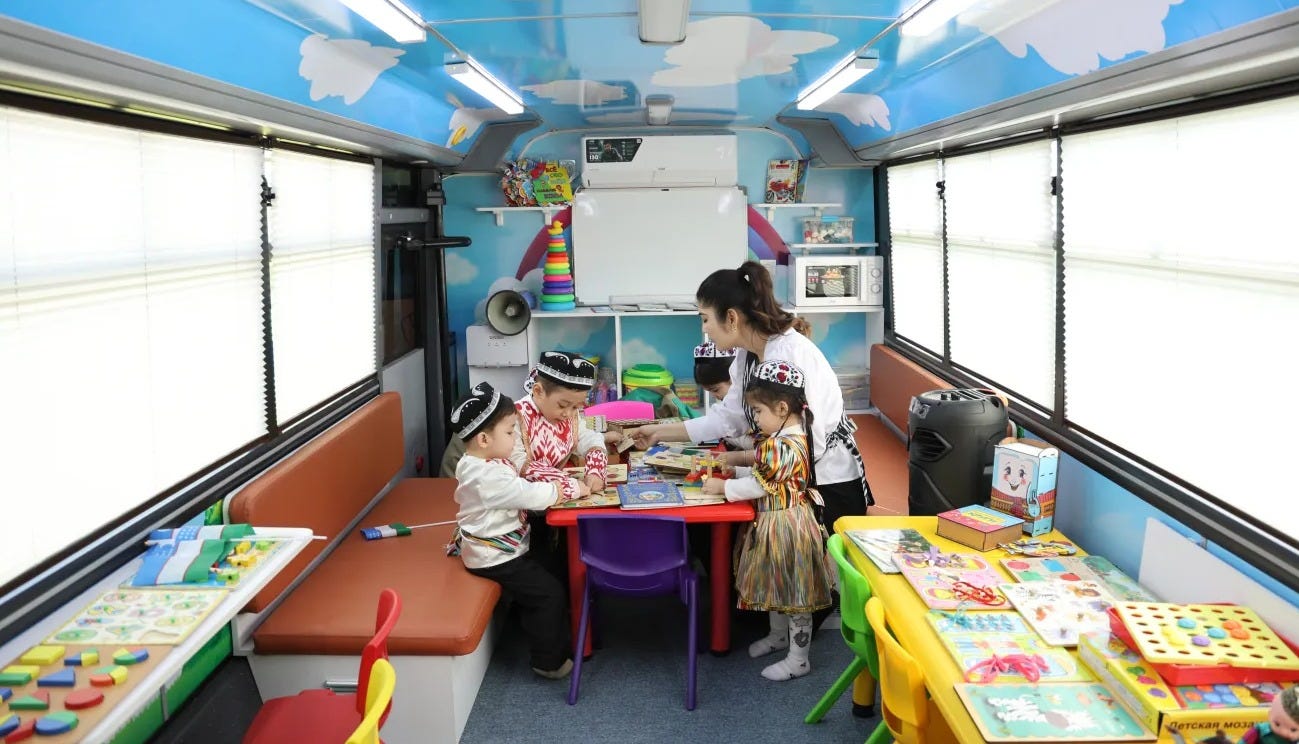
UNESCO’s new Global Education Monitoring Report reveals a dramatic expansion in global education since 2000. But just about every piece of reporting has focused on one statistic: the 273 million children, adolescents and youth currently excluded from education. While it’s true that progress has stalled on that front, zooming out gives a different perspective: school completion is rising at every level, and higher education participation has more than doubled in a generation. The first quarter of the 21st century has been the most expansive era for schooling in human history.
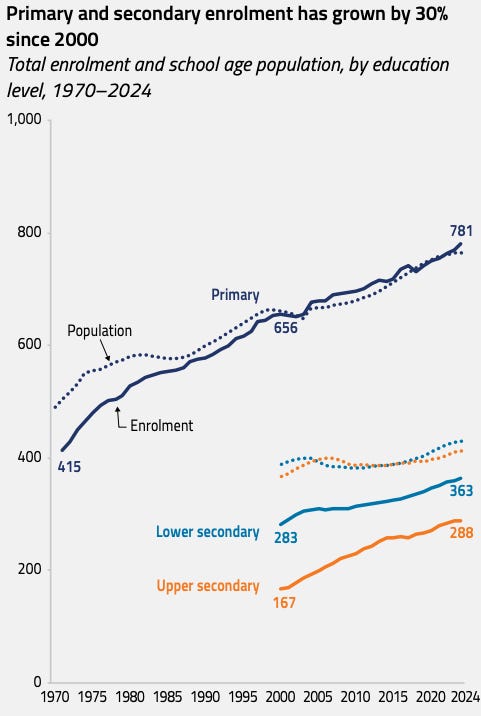
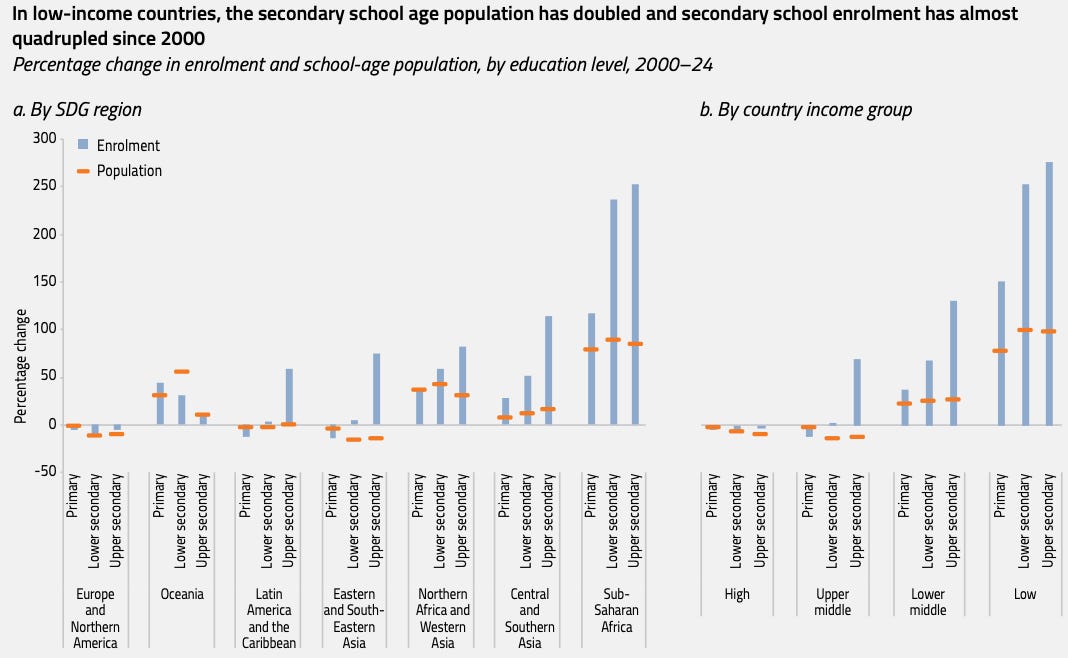
Here are some more stats buried in the report that haven’t appeared in the news media (and yes, we’ve checked).
Since 2000, global primary and secondary enrollment has grown by 30%, reaching about 1.4 billion learners in 2024 — equivalent to 25 additional children enrolling in school every minute for the last 25 years.
Completion rates have improved at every stage since 2000: primary completion rose from 77% to 88%, lower secondary from 60% to 78%, and upper secondary from 37% to 61%.
Gender gaps in primary and secondary education have largely closed. Take Nepal, where girls have caught up with, and in some areas surpassed, boys.
In 14 African countries, making education compulsory, not just free, has added more than a year of schooling for both girls and boys, while child labour laws have increased the gains further.
And finally, congratulations to the countries who have cut out-of-school rates by 80% or more since the year 2000: Madagascar and Togo among young children, Morocco and Viet Nam among adolescents, and Georgia and Türkiye among youth. Côte d’Ivoire halved out-of-school rates across all three age groups over the same period!
Antarctic humpback whales have recovered to nearly pre-whaling levels, a remarkable reversal in the same ocean that saw more than two million whales killed in the 20th century. Humpbacks have been the fastest to rebound since commercial whaling was banned in 1986, with multiple groups of more than 100 whales recorded near the South Orkney Islands. “It’s breathtaking to see blows stretch from horizon to horizon, just as the first explorers to the region described over a century ago”. The Guardian
At first, the researchers on the boats didn’t understand what they were witnessing in the waves below. A group of 11 sperm whales huddled together at the surface, strangely still and taking occasional shallow dives.
After about an hour, the animals seemed to start thrashing, and a plume of blood reddened the water. The researchers feared trouble, maybe a shark attack. But it was something else.
Suddenly, a much smaller, 12th whale appeared, lifted to the surface by the others so it could breathe.
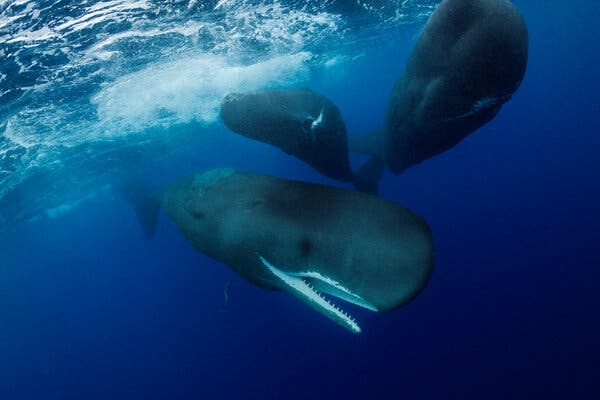
The first ever footage of a sperm whale birth — and it’s magical. Thanks to drone technology, scientists were able to film and analyse a remarkably social sperm whale birth, in which a calf delivered by a whale named Rounder was immediately lifted to the surface by a coordinated group that included her mother Lady Oracle, her sister Aurora, an unrelated young female Ariel, and even an adolescent male, Allan.
During the 34-minute labour off Dominica in July 2023, 11 whales surrounded Rounder, oriented themselves towards her during delivery and then towards the newborn, which was rarely left untouched and was usually in contact with at least 2 whales at once. Half the attending whales were not related to the mother, making the event especially striking as evidence that birth assistance in sperm whales may rely not just on kinship but on broader social reciprocity. The New York Times 🎁
Could Japan, Botswana and Poland be the next to legalise same-sex marriage?
Japan’s marriage equality fight is heading to the Supreme Court, putting legal recognition for same-sex couples before all 15 justices for the first time. A ruling is expected in early 2027. Japan remains the only G7 country that does not legally recognise same-sex couples, despite several lower-court rulings in recent years that found the denial of marriage benefits unconstitutional. Washington Blade
In Botswana, a High Court case scheduled to be heard in July 2026 similarly argues that, after several rulings protecting LGBTQ+ association, gender identity and same-sex intimacy, equal marriage is the next logical test of whether constitutional guarantees of dignity, liberty and equality apply in full. Washington Blade
Meanwhile, following a March 20th ruling by Poland’s Supreme Administrative Court, Poland must recognise same-sex marriages under EU law. That’s right, Poland’s highest court has ruled that authorities must recognise same-sex marriages legally performed in other EU countries, following a binding decision from the European Court of Justice. The judgment forces administrative compliance in a country with no domestic recognition, creating new legal rights for cross-border couples. Washington Blade
How far have LGBTQ rights come in Poland? Travel back in time to 2005, when Pride parades were banned in Warsaw, and the guy who banned them — Mayor Lech Kaczyński — then ran on an anti-gay stance to become Poland’s President. Kaczyński’s far-right Law & Justice party took power again in 2015, but the electorate soured on them in 2023, when a coalition of three liberal parties won 54% of the vote following the highest turnout in a Polish election since 1919. A record number of women and young people voted, many of whom said they did so to oppose Law & Justice’s platform on women’s and LGBTQ+ rights.

Iran shock speeds the shift from fossil fuels to electrification. The data is starting to come in: the Iran war is acting as an accelerant for clean energy. As oil and gas volatility pushes up costs, households from Britain to India and Pakistan are turning to EVs, solar, heat pumps and induction stoves as a hedge. These shifts will not stay local: when major economies accelerate the transition, others follow, creating spillover effects that outlast the crisis. Bloomberg / PV Magazine / CleanTechnica
Indonesia’s President, Prabowo Subianto, on the 11th March 2026:
We will build 100 gigawatts of solar panels as quickly as possible. That is my directive and my decision, and we will prove to the world that we can move faster. This situation pushes us to accelerate the energy transition.
The Philippines’ Energy Secretary Sharon Garin, on the 21st March 2026:
It’s time for us to think about electrifying everything, being less dependent on fuel. We have many plans in place and some are being implemented right now.
This year’s World TB Day theme, “Yes! We can End TB!”, landed with enthusiasm, yes (!), but also with some real evidence behind it. New vaccines and portable diagnostics are starting to close the gaps in prevention and detection.
With the existing TB vaccine protecting infants and young children against severe disease only, new candidates advancing through clinical trials are showing promising signs of effectiveness in adolescents and adults. Gavi says these vaccines could save millions of lives and deliver up to $400 billion in economic benefits, and planning is already under way for roughly 120 million doses a year in the first five years of rollout.
At the same time, WHO has endorsed portable molecular tests that can be used in primary care settings rather than only hospitals and labs, along with tongue swabs, which are easier than traditional sputum tests because they do not require patients to cough up mucus from the lungs. These make it easier and cheaper to diagnose TB closer to where patients live, even as international aid cuts threaten progress. Think Global Health
More than nine million vaccine doses for measles, polio and other preventable diseases were delivered to children in humanitarian settings across the Horn of Africa in 2025. Coordinated outreach and mobile campaigns overcame access barriers, showing large-scale immunisation remains feasible even in the world’s most dangerous places. IRC
A century of (don’t get creeped out) hair samples shows how sharply lead exposure fell after modern environmental rules took hold in the United States. A PNAS study found that current lead concentrations in hair from Utah’s Wasatch Front are almost 100 times lower than before the Environmental Protection Agency was established, documenting a long-run collapse after regulation of leaded petrol and other major sources.

Construction has started on the China-Kyrgyzstan-Uzbekistan railway line, which could redraw Central Asia’s economic map. The line has a long history. First proposed in the 1990s after the collapse of the Soviet Union, it finally got financed in December 2025, which means construction is now underway. The project is expected to be completed in 2030, and Kyrgyzstan’s President Japarov says it will transform the country from a “dead-end” to a “transit power.” It will also reduce China’s dependence on Russian transit routes and create a shorter, faster southern corridor for freight between China, Europe and the Middle East, directly eroding Moscow’s influence as the primary Eurasian trade conduit. The Diplomat
Saudi Arabia has restored 10,000 km² of degraded land and planted over 159 million trees under its Green Initiative, shifting from pledges to large-scale ecological delivery. The programme targets desertification, dust storms and biodiversity loss, and marks one of the largest coordinated restoration efforts in the world’s arid regions. Arab News
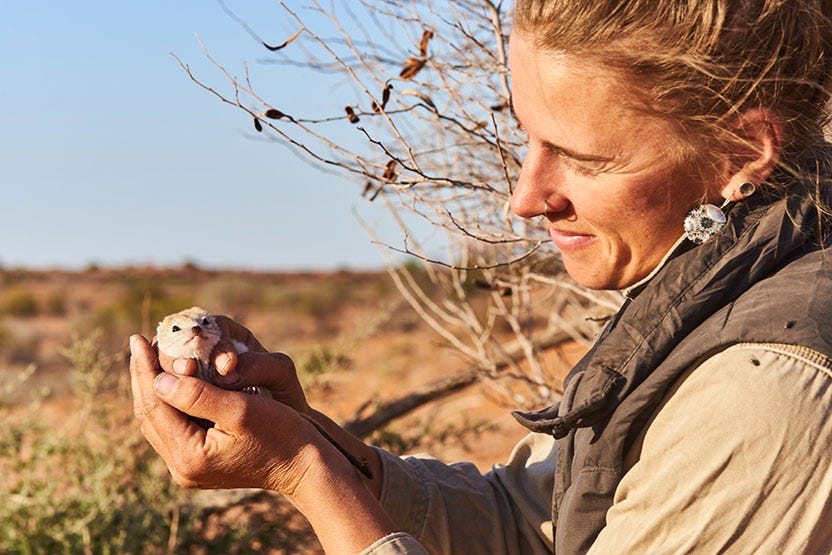
Australia’s ampurta is making a big comeback. The tiny desert marsupial was once thought close to extinction after farming and the introduction of foxes and rabbits devastated its habitat in the 19th and 20th centuries. But between 2015 and 2021 it expanded its range by 48,000 km² — roughly the size of Denmark — to 238,441 km², thanks in part to its resilience in extreme conditions and also to reduced invasive rabbit numbers.
For conservationists, the lesson is a hopeful one: “In other parts of the world where we’re cutting down forests or destroying wetlands … as long as we can bring that habitat back, we can [help] species to bounce back.” Mongabay
Egypt fossil discovery reshapes origins of modern apes
Fossils from northern Egypt dated to 17–18 million years ago identify a new ape species, Masripithecus moghraensis, likely close to the common ancestor of all living apes. The find shifts the centre of early ape evolution from East to North Africa, suggesting a different migration pathway into Eurasia and exposing gaps in a fossil record long biased toward a single region. Smithsonian
Physicists spot impossible particle called toponium, made of top quarks
Scientists at CERN have found strong evidence for “toponium,” a particle formed when a top quark briefly sticks to its antimatter twin. This wasn’t supposed to happen because top quarks decay almost instantly, but new AI tools revealed rare low-speed pairs that behave like a bound state. The signal reached five-sigma confidence (99.99994%), the gold standard for a physics discovery, filling a key gap in the Standard Model showing how the strong force binds matter. Phys.org
And finally, Artemis II, NASA’s most daring mission in generations, has launched to the Moon, marking the first time since 1972 that humans will have left lower Earth orbit. The ten-day flight will be packed with milestones: two of the crew, NASA’s Christina Koch and Victor Glover, will become the first woman and first person of colour respectively to fly into cislunar space.