

332: Stardust. Deep sea mining 🚫. Child mortality. Mexico 💖🌈
At the backbone of the world, where the water begins.
This week’s top stories
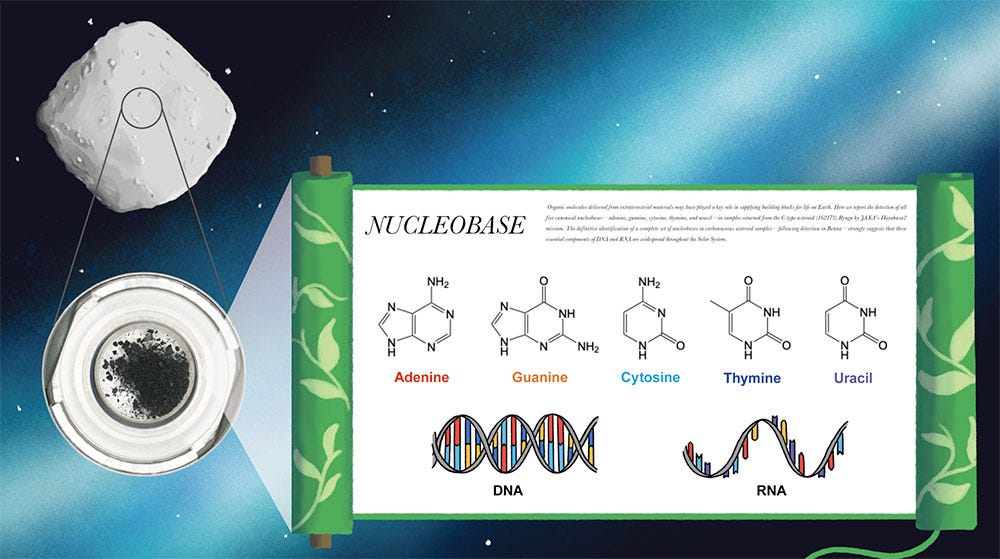
All of the chemical components of DNA have now been discovered on a second asteroid. RNA and DNA are built from five chemical bases: adenine, guanine, cytosine, thymine, and uracil. A Japanese team has now identified all of those in rocks picked up from the surface of the asteroid Ryugu. The discovery corroborates the results from a 2023 NASA mission that returned samples from the asteroid Bennu that also contained all five nucleobases. Finding all five nucleobases of life on multiple asteroids dramatically increases the chance that life was seeded by materials brought to Earth by ancient space rocks. We really might be made of stardust. 404 Media
Child mortality down 60% in two generations, as low-cost tools save millions. Since 1990, global under-five deaths have fallen from 13 million to 4.9 million a year, one of the largest public health gains in human history. Vaccines, oral rehydration, bed nets and safer births have been at the heart of this, with deaths from diarrhoea down 75% and malaria by 63%. Although progress has slowed in the last decade, the tools to prevent most remaining deaths exist. The gap is now political will rather than innovation. UNICEF
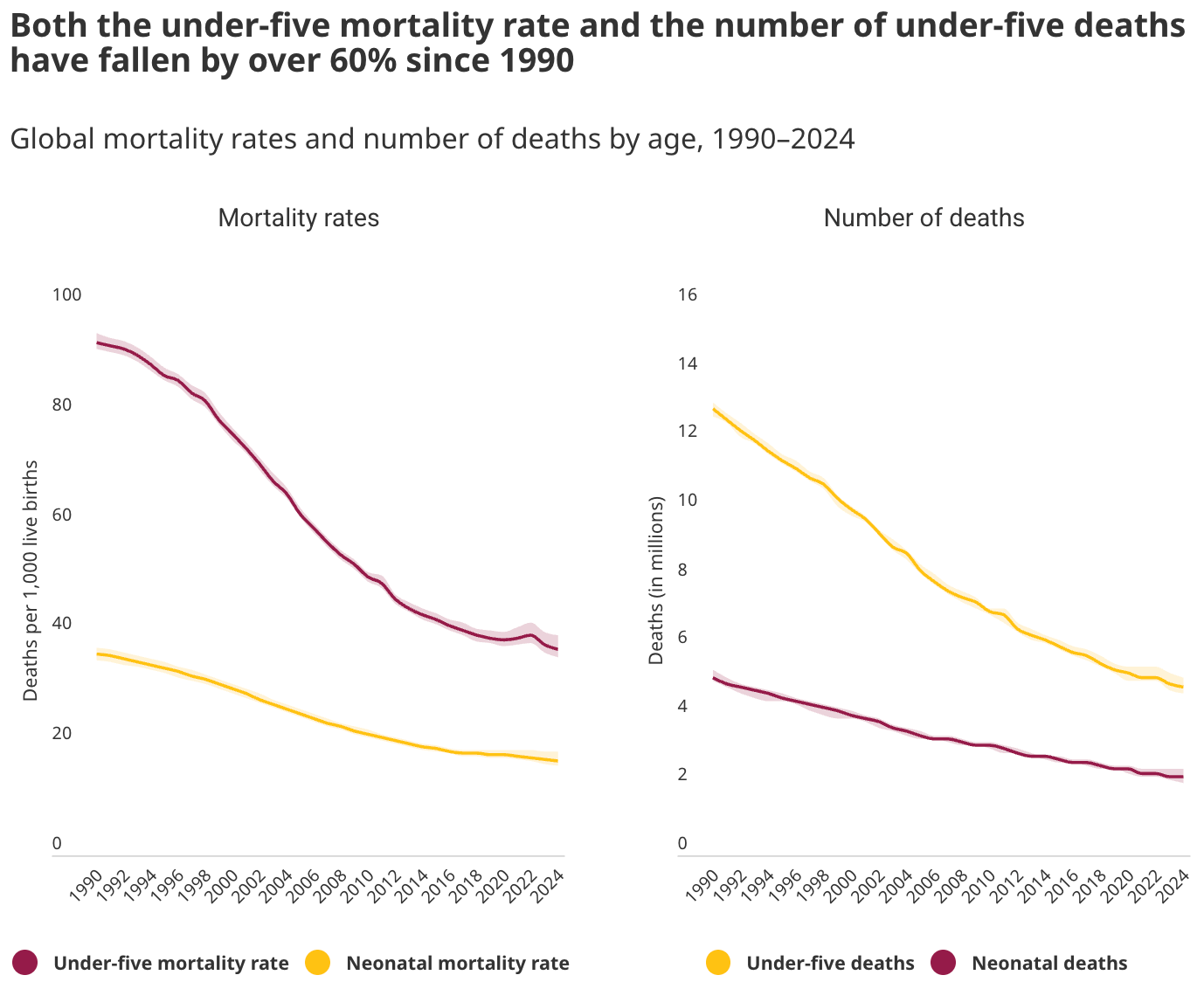
Special mention here goes to India, which has been one of the largest contributors to this progress. Expanded immunisation, maternal care and disease control have cut its under-five mortality rate by 79% since 1990. To put this another way:
A child born in India today is five times less likely to die before their fifth birthday than a child born in 1990.
India is also really starting to come to the party on climate and energy. Emissions growth has slowed to a trickle, and the country is now capable of making 210 GW of solar modules a year. That positions India as a major global solar production hub, which is crucial because… drumroll please… India’s government just announced plans to quadruple solar capacity and triple wind power by 2035, signalling a major acceleration in its energy transition. It’s likely to hit that target well ahead of schedule, too.
If we’re giving props to India, then we need to do the same for China, which just passed a sweeping new Environmental Code. Approved at the National People’s Congress, the move “demonstrates a kind of special attention and priority given to ecological and environmental protection.” Beyond serving as a political signal, it addresses a problem: there has been a spate of environmental legislation in recent decades, but some of those directives overlap and conflict with each other. The revised package replaces 10 existing laws and covers everything from water and soil pollution to ecological conservation and species protection. Bloomberg 🎁
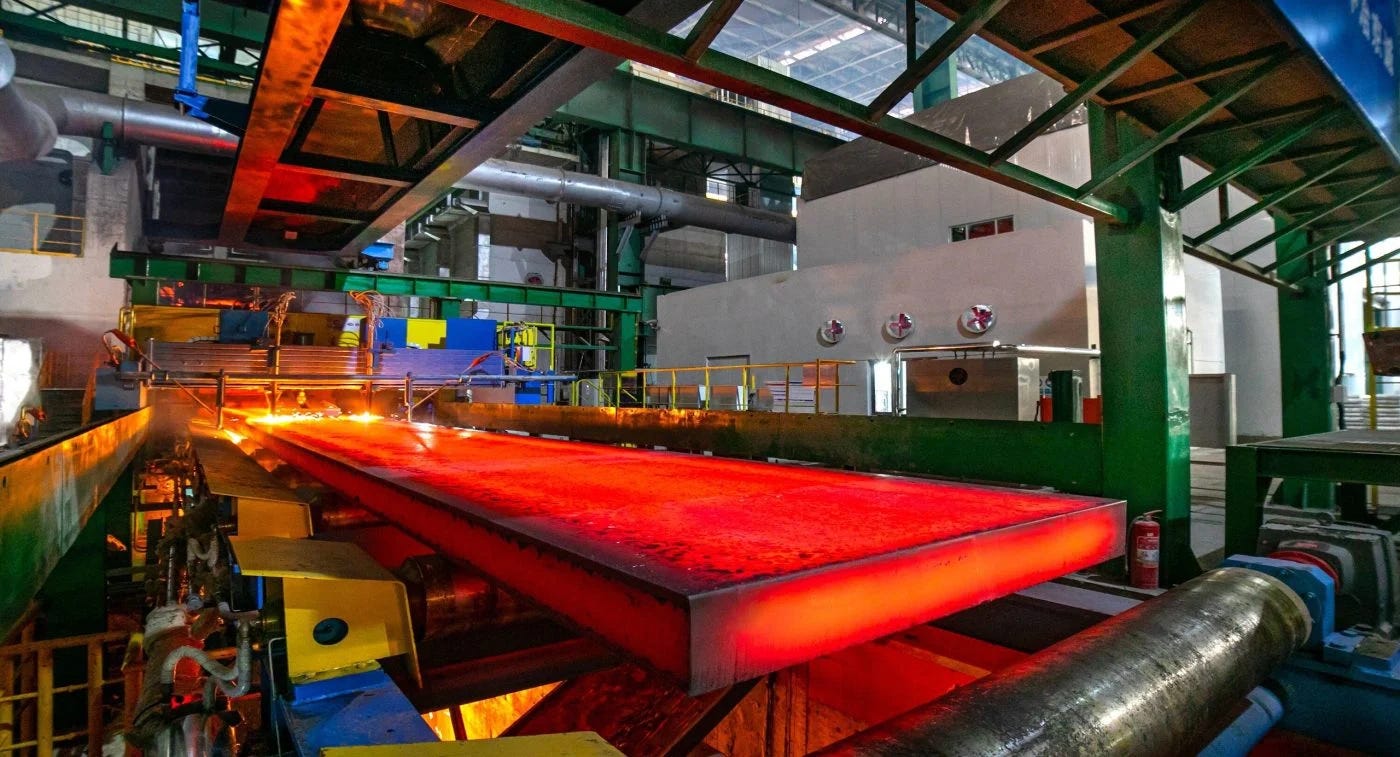
Perhaps relatedly, China is cleaning up its steel industry: More than 80% of producers have now adopted ultra-low emissions processes, following a nationwide policy push. Upgrades have already reduced emissions by 34 million tonnes (equivalent to permanently shutting down eight coal-fired power plants). Reminder: steel production is responsible for 7% of the world’s emissions, and China manufactures more than half of that. Mysteel
Climate policies work faster and more effectively than most people think. An analysis of 40 nations finds climate policies do reduce emissions. The strongest effects come from “packages” combining carbon pricing, subsidies and regulations, rather than single measures. Nature Climate Change
Brazil has a new climate policy centred on ending deforestation. Brazil, like India, has just updated its national climate plan to 2035, but this one places forest protection at the core, aiming to eliminate deforestation by 2030 as the country’s primary emissions source. Land-use change accounts for nearly half of national emissions. Bloomberg 🎁
Kyrgyzstan builds nationwide system to support abuse survivors. Over the last few decades the central Asian country has built a national response to domestic violence, including legal protections, crisis centres and hotlines, backed by civil society and international partners. A landmark law was introduced in 2003 and strengthened in 2017, while frontline organisations now win nearly 90% of court cases they support, reflecting growing institutional capacity and access to justice for survivors. UN News
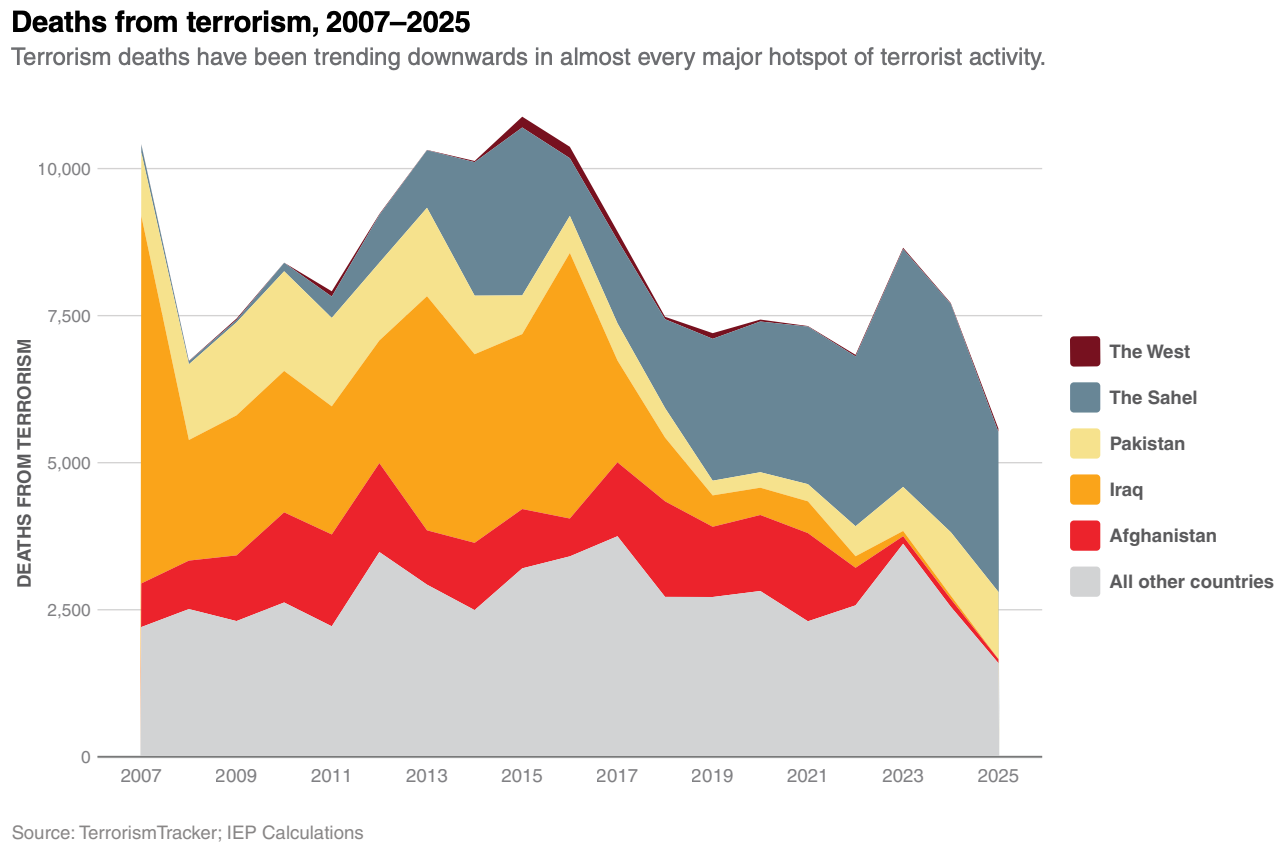
Global terrorism deaths fall to their lowest in two decades. Terrorism deaths have continued their long-term downward trend driven by reduced activity in Iraq, Syria and Nigeria. While fatalities in Western countries rose, they remain a small share of the global total. Vision of Humanity
Philippines cuts child labour cases by almost 40% in two years. Child labour cases in the Philippines fell from 828,000 in 2022 to 509,000 in 2024, driven by coordinated government action and community programmes. Over 319,000 children were removed from labour, while livelihood support reached 47,000 families to tackle root causes. The Philippine Star
Luxembourg will become the second European country after France to protect abortion in its constitution. On the 3rd March, the Chamber of Deputies backed a constitutional amendment stating that “the freedom to resort to voluntary termination of pregnancy is guaranteed”, with 48 votes in favour, six against and two abstentions. ConstitutionNet
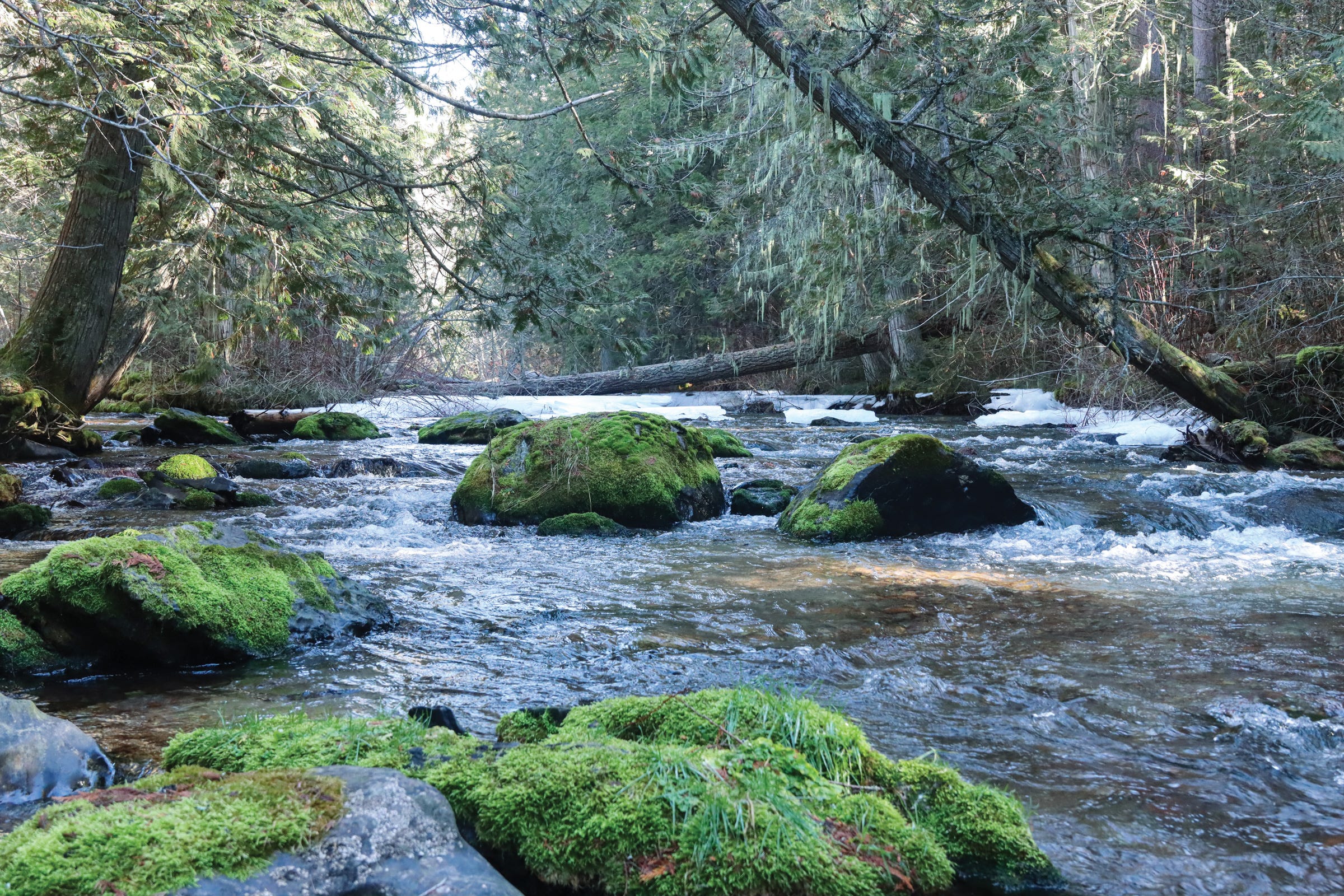
Montana tribes use sovereignty to restore rivers at scale. The Jocko River is home to the United States’ last migratory bull trout population, sacred to the Salish and Kootenai Tribes. For decades, wrongheaded policies designed to make the water as ‘useful’ as possible mangled the river, cutting it off from its natural meanders and endangering the bull trout. Now the Confederated Salish and Kootenai Tribes are using a landmark water rights compact, effective since 2021, to restore waterways like the Jocko, bringing back the bull trout and showing how Indigenous sovereignty can align ecological recovery with long-term water security. High Country News
Monarch butterfly population in Mexico rebounds. Mexico’s overwintering monarch population grew 64% this winter, with butterflies covering their largest area of forest since 2018. The recovery remains fragile, but suggests there’s been a positive impact from conservation efforts in the butterflies’ core habitat, where forest loss has fallen from nearly 500 hectares in 2003–04 to just under 3 hectares in 2024–25. The Guardian
Mexico expands LGBTQ+ protections across 28 federal laws. Mexico’s Senate has unanimously approved reforms embedding protections for sexual orientation and gender identity across numerous federal laws governing health, education, employment and justice. The changes extend anti-discrimination principles throughout the country’s legal system, affecting a population where more than 5% identify as LGBTQ+. Infobae
A £1m prize goes to an AI that prompts people with dementia — and slows their decline. The idea behind “Wispy” is simple: people with dementia can maintain their independence far longer if they have a facilitator standing by 24/7 to prompt them during moments of confusion. For most people, that’s effectively impossible, but an AI can be there all day and night, and create audio and visual cues to make moments of confusion less likely. Wispy’s creator, CrossSense, hopes to roll it out onto augmented reality glasses in 2027 and smartphones sometime this year. Studies (not yet peer-reviewed!) show that those with dementia not only “remember” better while wearing the Wispy-integrated glasses, but retain many of the benefits even after they take the glasses off. The Guardian

Deep-sea mining halted as global moratorium gains support. International negotiations have again resulted in a no to deep-sea mining, with no code adopted and no projects authorised. A growing coalition of 40 countries now backs a moratorium, while regulators have launched a probe into a key contractor. It appears humanity is coalescing around the conclusion that this is a bad idea. Oceanographic
Women’s representation in African parliaments is steadily rising. Women now hold at least 20% of parliamentary seats in 31 African countries, with standout cases like Rwanda exceeding 60% and recent reforms pushing representation above 25% in countries such as Sierra Leone and Benin. Higher representation is linked to gains in girls’ education and gender equality, demonstrating that political inclusion can translate into broader social progress. Deutsche Welle
And finally, we’ve already covered Ukraine’s rewilding of the Danube, but this beautifully filmed (and short, just 15 minutes!) documentary by Emmanuel Rondeau really brings it home. Next time you find yourself lost in the infinite scroll, why don’t you give your thumb and your sanity a rest and watch this instead? Rewilding Europe