

324: D̶u̶n̶e̶ Wind. Middle Class Mexico. Psychiatric biomarkers? Canadian farmers 💪. Porsche.
We can afford that!


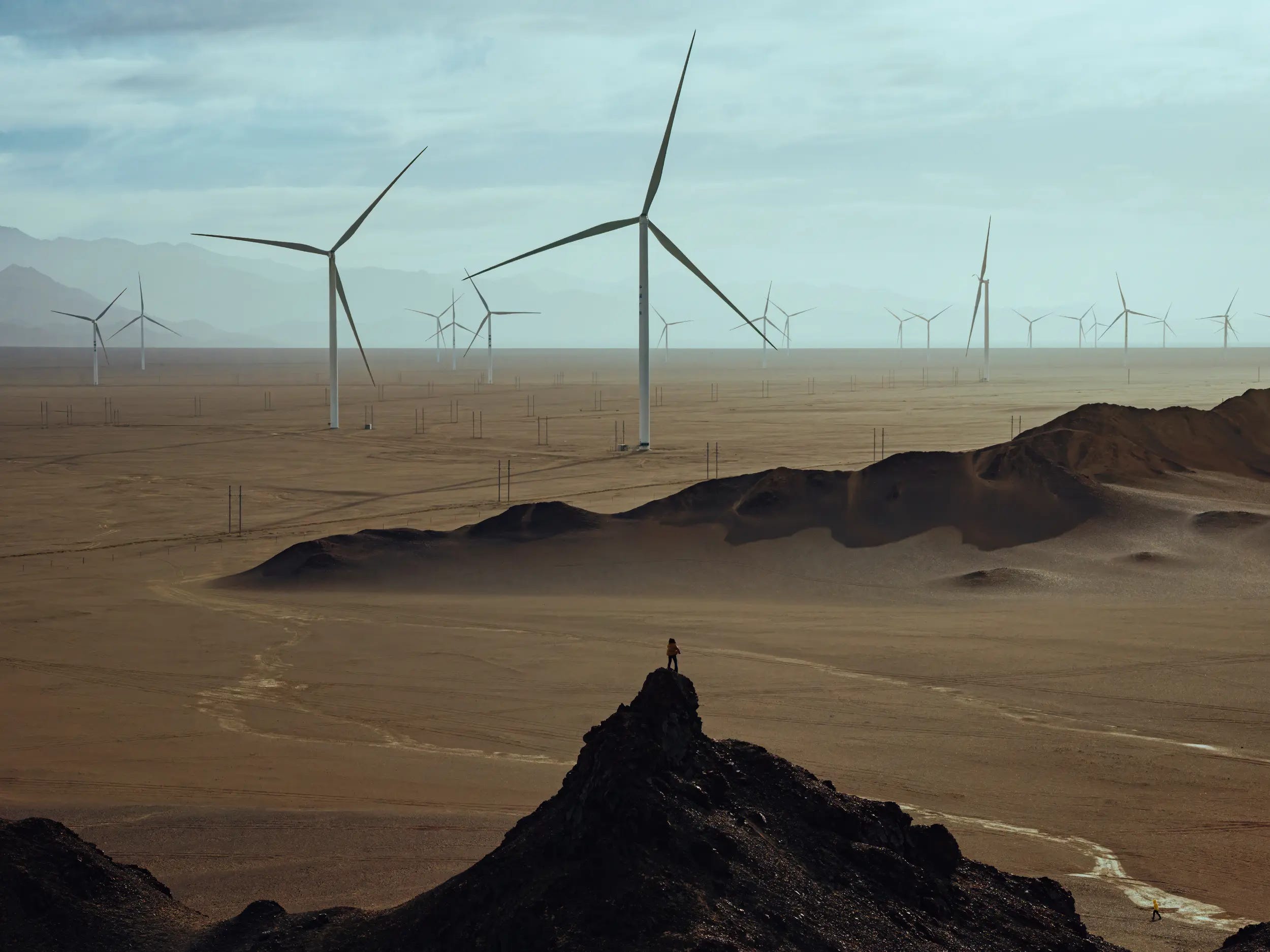
Do you know someone who’s changing the climate story for the better? Nominations are open for the Gulbenkian Prize for Humanity 2026 - a €1 million award that shines a spotlight on individuals, groups and organisations that are turning bold climate vision into measurable change. They’re looking for more nominations (they didn’t get a lot through this year) and we figured there would be plenty of readers who might be interested. Past winners include Greta Thunberg, the Antarctic Southern Ocean Coalition, and the Covenant of Mayors for Climate and Energy. Entries close Friday 30th January 2026.
This week’s top stories
For the first time in history, more people in Mexico are categorized as middle class than as living in poverty. Income poverty has declined from 35.5% of the population in 2018 to 21.7% in 2024, according to World Bank data. Over the same period, the middle class expanded from 27.2% to 39.6%. The shift reflects what President Sheinbaum calls “a moral economy, welfare programs, rights, not assistance programs but rights.” Mexico News Daily

And, for the first time since October 2023, aid partners in Gaza now hold enough food to meet 100% of minimum caloric needs. That compares with late 2025, when families received just 50–75% of required calories. The United Nations is supporting the production of around 170,000 two-kilogram bread bundles daily, but access, security and the risk of Israel suspending NGO operations mean the gains remain fragile. UN News
According to Albert Cheung, the Head of Global Transition Analysis at BloombergNEF, the global energy transition is still accelerating, even as the politics worsen. Global wind and solar installations passed 800 GW last year, triple the pace of 2021, falling battery costs have enabled grid-scale storage just as renewable penetration deepens, and electric vehicles now account for over 25% of global car sales. The drivers of the transition have shifted from moral appeals to energy security and competitiveness. Hard-to-abate sectors still lag, policy uncertainty remains real and 1.5°C is not going to happen. But economics, rising demand and technological capacity are now carrying the transition forward — unevenly, but irreversibly.
Global electric vehicle sales reached 20.7 million in 2025, up 20% year on year, driven by strong growth in Europe and emerging markets, according to Benchmark Mineral Intelligence. Europe overtook China as the fastest-growing major market, while sales outside China, Europe, and North America jumped 48%.
Gregor Macdonald notes that the global consumption of gasoline is starting to flatline…
… and electrified models outsold combustion Porsches in Europe for the first time in 2025.


After 20 years of negotiation, the High Seas Treaty entered into force last week, creating the first legal framework to protect biodiversity across the 64% of the ocean beyond national jurisdiction. Attention now turns to what comes next: setting up a secretariat, agreeing on funding and benefit-sharing rules, launching a scientific body to propose marine protected areas, and negotiating with fisheries bodies and deep-sea mining regulators. Many question marks remain, but, for the first time ever, high seas conservation sits on a legally enforceable framework. Dialogue Earth
🐾 Some nice animal stories for your feed
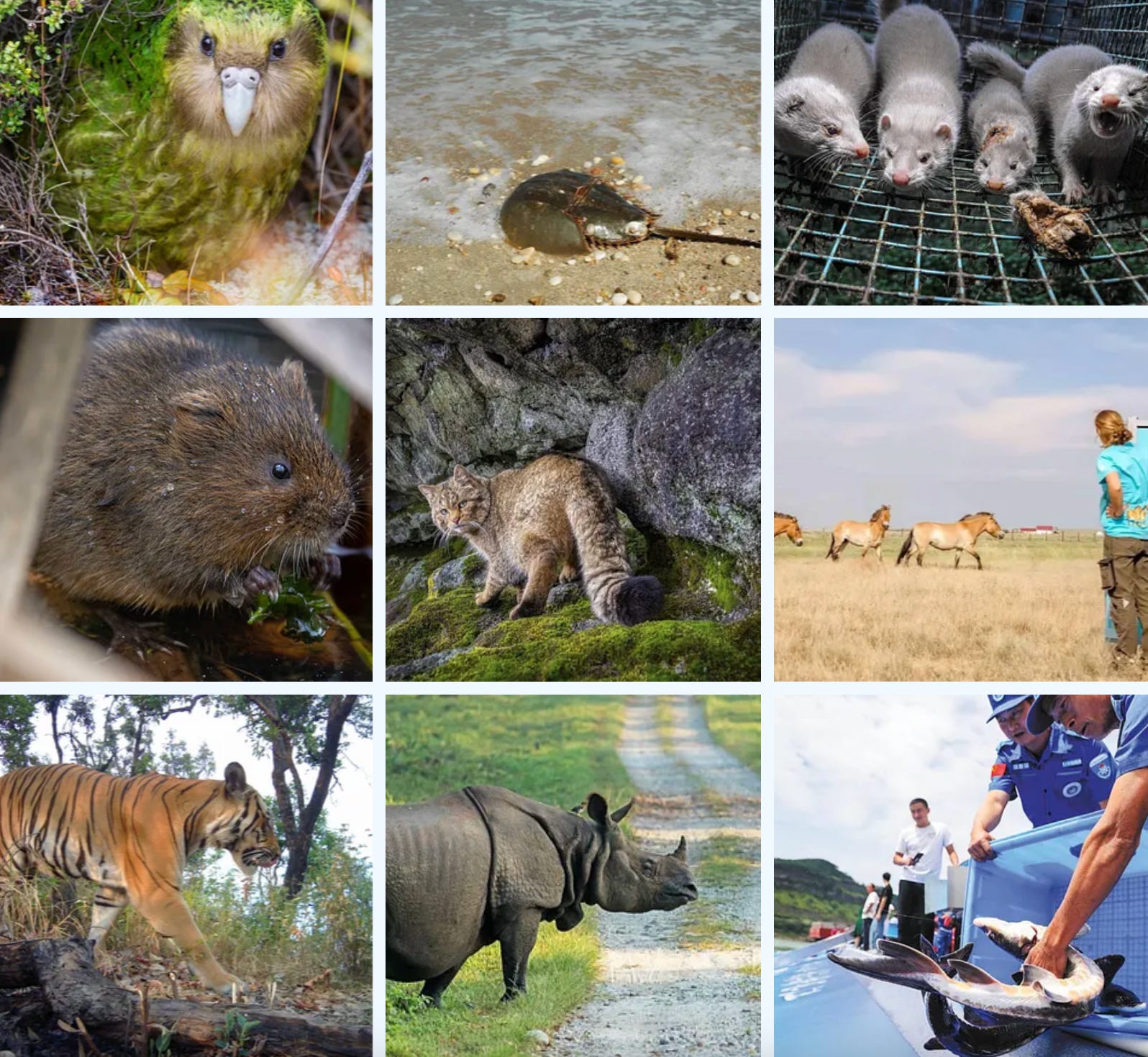
New Zealand’s critically endangered kākāpō have begun breeding for the first time since 2022, triggered by a ‘mega-mast’ fruiting of native rimu trees that provides the energy needed to raise chicks.
New York has passed the Horseshoe Crab Protection Act, setting a timetable to end commercial harvesting of this ancient species by 2029.
Belgium has banned imports of hunting trophies from endangered species, while Germany has banned fur farming (Poland, Europe’s largest producer, banned it last month).
An explosion of water voles! (Petition to make that the new collective noun). Endangered water vole populations across the east of England have surged following sustained eradication of invasive American mink, their main predator.
Some recoveries are quieter. European wildcats, once thought lost from central Europe, are being rediscovered through camera traps, with scientists estimating around 140,000 persist across more than two dozen countries.
Przewalski’s horse, extinct in the wild by the 1960s, now roams again in Mongolia and Kazakhstan following decades of captive breeding led by the Prague Zoo.
Global tiger numbers have risen from 3,200 in 2010 to 5,574 by 2023, with Thailand now supporting up to 223 tigers after two decades of protection.
In India’s Assam state, no rhinos were poached in 2025, only the second such year since records began.
And in China, the Yangtze sturgeon, absent from the wild since 2000, is back, following two decades of captive breeding and releases led by Zhou Liang.
Psychiatry is finally finding an objective way to spot mental illness. Depressed people speak differently: compared to their pre-depressed selves, they pause more and speak less, and their voices lack variation in pitch. This is devilishly difficult for a psychiatrist to detect, but for an AI on your phone, it’s easy… and for mental health professionals, it might be the holy grail. Psychiatry has, since its inception, tried to mimic the diagnostic precision of more physical forms of medicine, but it hasn’t. And how could it? Psychiatrists have little to work with besides patients’ descriptions of their own internality, which can be fuzzy, never mind fraught.
Now we’re within reach of something better. A rush of startups in the United States are using AI and wearables to try and identify biomarkers associated with various mental illnesses. The hope is to eventually allow for diagnostic data to supplement patient self-reports, improve psychiatric precision, or enable those who can’t go to a psychiatrist get a diagnosis. New Scientist
No-till farming helps Canada post record grain exports. Canadian farmers are harvesting record spring wheat and canola crops, driven largely by widespread no-till and zero-till farming that locks in soil moisture and cuts erosion. Longer term, yields are up 77% for wheat and nearly double for canola since the mid-1990s. As the world’s largest canola exporter and a top five wheat producer, Canada’s gains are easing global food supply pressures even as climate volatility intensifies. Reuters
“We were sitting with our calculator saying ‘we can afford that!’” A manufacturer in Bangladesh will launch a generic version of the cystic fibrosis drug Trikafta in spring 2026, cutting annual costs from about $370,000 to as little as $12,750 for adults and $6,375 for children. The breakthrough follows years of campaigning by parents, challenging monopoly pricing that left three-quarters of the world’s 190,000 CF patients without access. The Guardian
Since 2015 India, the world’s most populous country, has cut malaria incidence by 80%, tuberculosis by 21%, and maternal mortality from 130 to 88 per 100,000 live births. Infant and under-five deaths have also fallen sharply, with the government emphasising that sustained primary-care and treatment scale-up remain a priority going forward. Times of India
Poland moves to recognise same-sex couples. Poland’s government has approved a bill introducing “cohabitation contracts” for couples living together regardless of gender - its first nationwide legal recognition of queer relationships. The bill, which covers health, housing and tax rights, stops short of marriage, but activists say it’s the only one with a real shot of passing in the current parliament. Reuters

Really good news: American lawmakers have agreed to a $50 billion compromise foreign assistance budget for 2026, restoring funding for Gavi and the International Development Association while preserving over $9.4 billion for global health, $5.4 billion for humanitarian aid and $691.5 million for global education. As one education advocate put it, the funding is “relatively good, considering everything.” Devex
And finally, Dylan Matthews revisits the core argument of a book project he was working on that collapsed because editors struggled to believe it: that since the 1970s, the US social safety net has expanded and absolute poverty has fallen a lot.
The overall point that the safety net has grown, and that living standards at the bottom have improved, struck me as so obvious and clear in the data that I hadn’t braced myself for the depth of disbelief. I suspect a large part of the issue is that the people I was pitching are mostly liberals and leftists, and an unstated premise of a lot of left-of-center advocacy is that you must paint the world in a maximally negative way so as to inspire people to push for change.