

314: A Stake Through The Cold, Dark Heart of King Coal 🪦♥︎. Western Pacific eliminates rubella. The world feels safer. Robotic ballet.
Hidden stories of progress from around the world.
Our audio documentary about the malaria vaccine is complete! All three episodes, now available wherever you get your podcasts. We are very proud - we poured a lot of love into this, it’s our first ever big piece of original reporting.
Episode One | Episode Two | Episode Three
This week’s top stories
Last week was Climate Week, and we didn’t put out an edition. So now there’s a backlog of excellent news, especially climate news, to get to you.
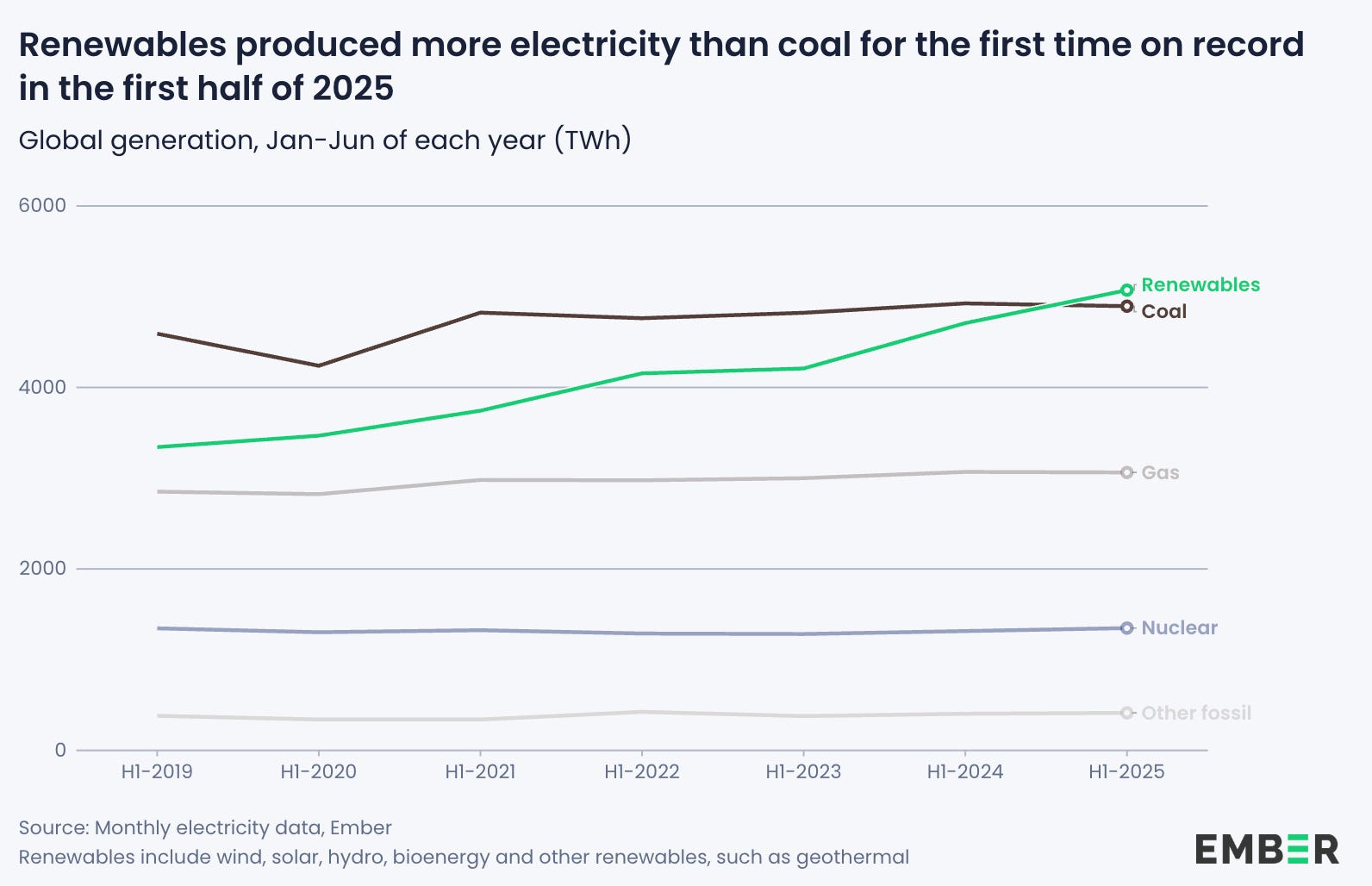
First, a moment we’ve been waiting for since we launched this newsletter: According to Ember’s 2025 mid-year report, renewables have produced more power than coal globally for the first time - a historic first. How? Solar output jumped 31% from last year and wind added another 7.7%. Coal fell, led by declines in China and India - the only two countries still commissioning significant numbers of new coal plants. Ember
A decade after the Paris Agreement, global greenhouse gas emissions are barely rising, up just 0.3% a year since 2015, compared with 1.7% before.
Australia might get its first ever day without coal sooner than anyone predicted, and analysts say 100% renewables is no longer theoretical. The country’s ageing coal fleet is being rapidly replaced by wind, solar and batteries, and the market operator says 90% of coal could be gone by 2035.
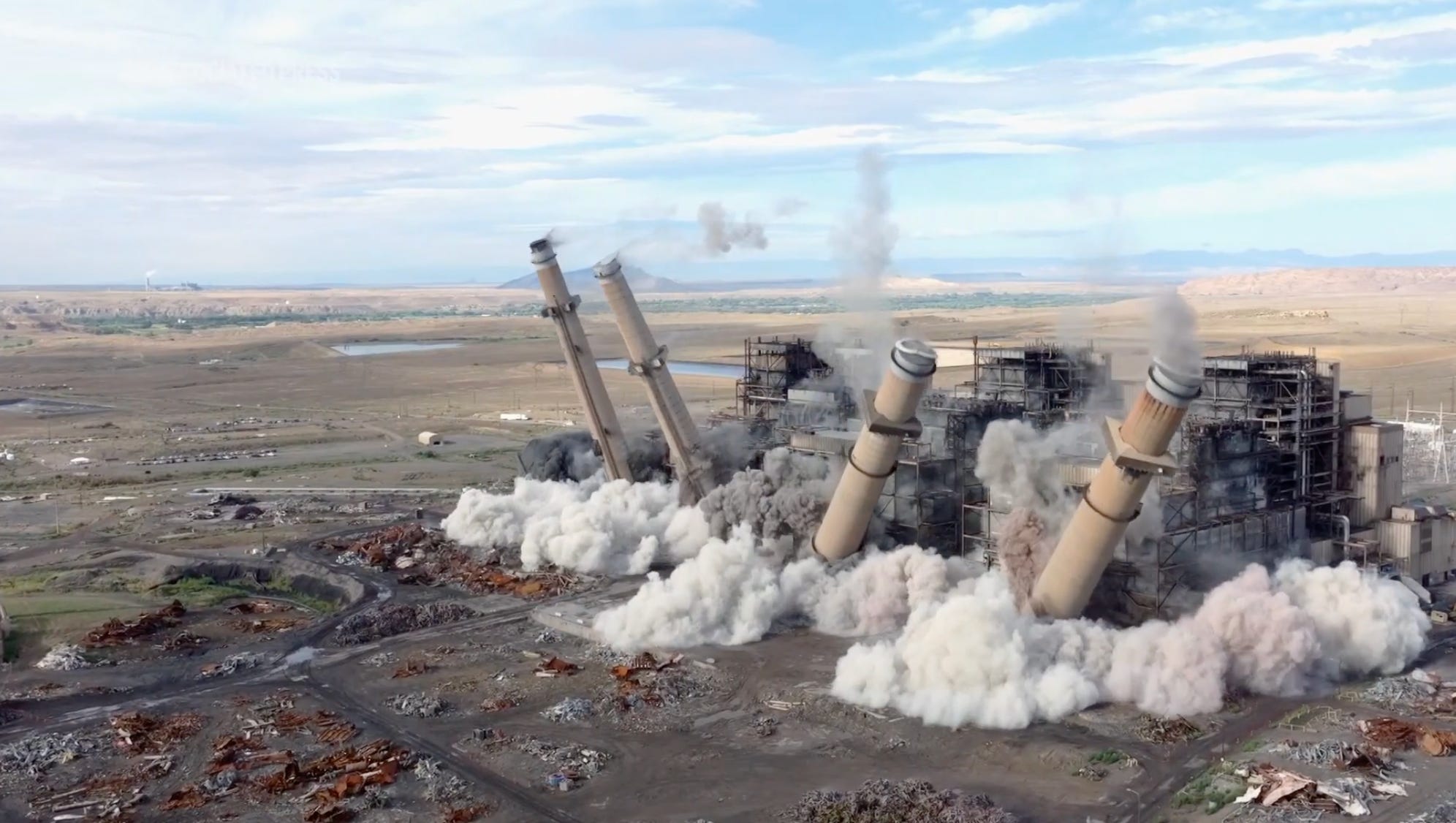
In the United States, new coal mines are fetching almost nothing at auction, with the Trump administration’s latest bid selling for less than a penny a ton, and New England just closed its last coal plant three years ahead of schedule.
India races ahead with record solar surge, installing 17.5 GW between April and August 2025 - more than double last year’s pace. The boom, driven by cheap modules, strong demand and a 143 GW project pipeline, makes it the world’s fastest growing energy market - with demand increasingly being met by power from the sun.
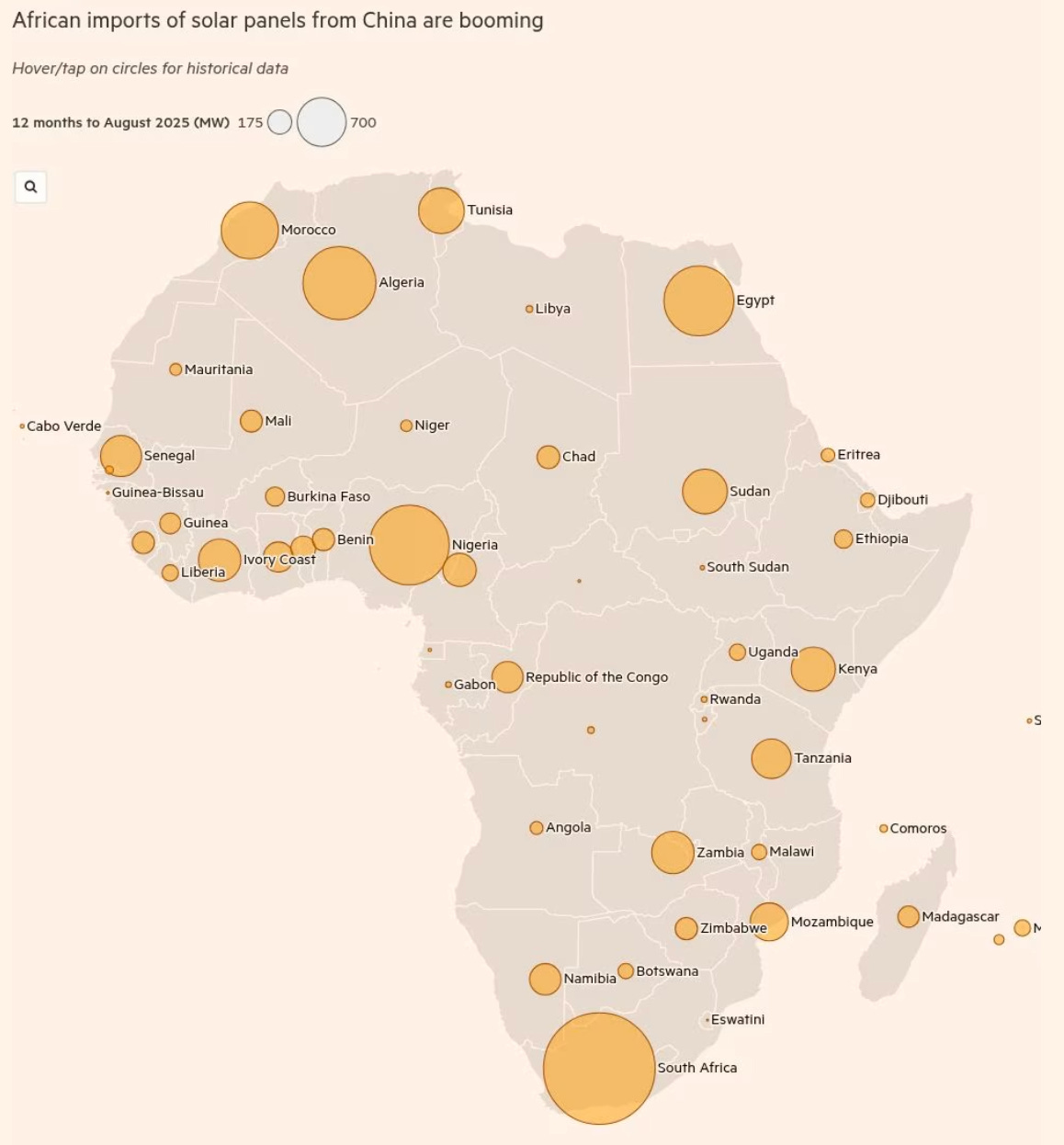
As the energy transition ramps up, a global philanthropic coalition has secured $4.2 billion to expand renewables and energy access across Africa. There’s genuine momentum here - the solar revolution is already lighting up Africa’s biggest oil nation, Nigeria, long plagued by blackouts despite its oil wealth. Imports of Chinese panels have jumped 60% this year, and Nigeria isn’t alone - solar panels are pouring into the continent, improving energy access across the continent, though the challenge of grid reliability remains.
More good news from Africa’s most populous country, as Nigeria launches its largest-ever public health campaign, aiming to immunise around 106 million children against measles, rubella and polio by early 2026. The nationwide drive for the first time combines vaccines and other child health services under one programme, introducing the WHO’s newest measles–rubella vaccine, deploying mobile teams to reach remote areas, and strengthening systems for data, logistics and payment integrity. WHO
Sudan has launched an emergency cholera vaccination campaign across war-ravaged Darfur, aiming to protect more than 1.8 million people amid the region’s humanitarian crisis.
Meanwhile, the entire Western Pacific has been verified free of measles and rubella. The WHO has verified the elimination of both diseases in all Pacific Island countries, alongside rubella elimination in Japan. The achievement follows two decades of coordinated immunisation campaigns, regional surveillance, and high routine vaccine coverage, making the Western Pacific the first WHO region to eliminate rubella entirely.
What is rubella? A short primer from the Cleveland Clinic.
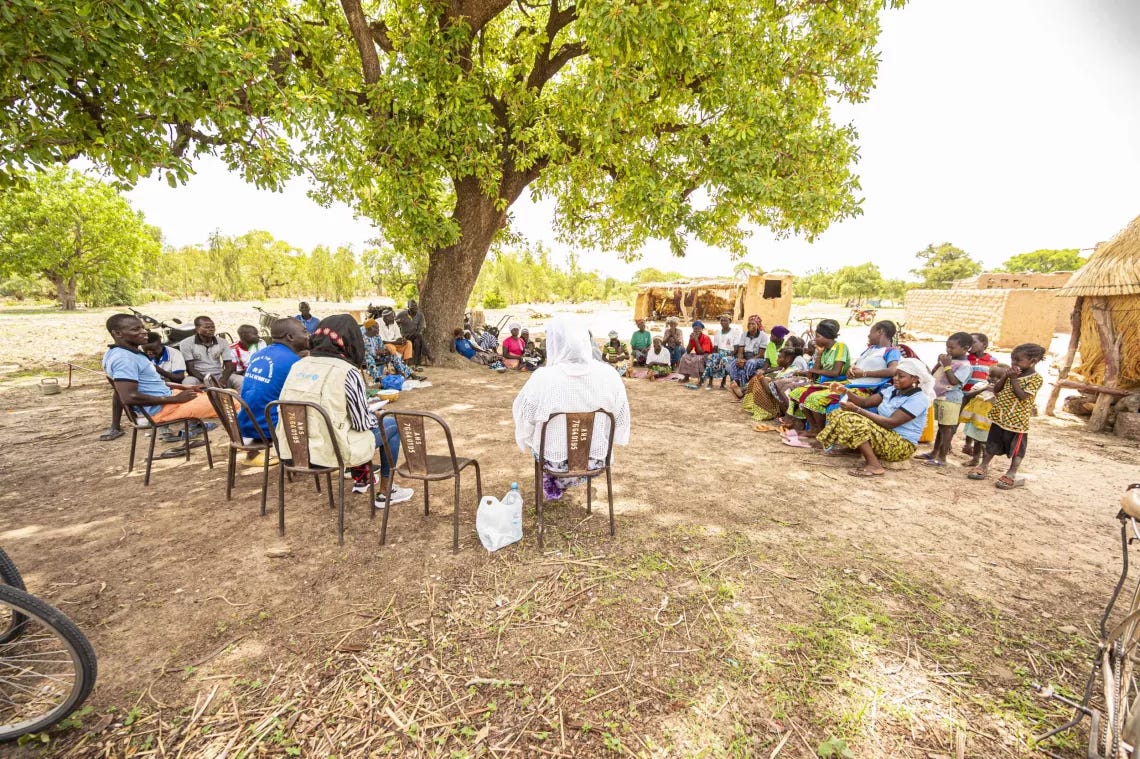
Burkina Faso has raised the legal age of marriage for girls to 18, aligning national law with international human-rights standards. The reform follows years of advocacy that has already yielded results - between 2015 and 2021, the proportion of women aged 20 to 24 who were married before 18 fell from 51.3% to 38.2%. Girls Not Brides
US fire deaths fall two-thirds since 1980
Fires remain a danger in America’s cities, but thanks to decades of safety improvements per-capita civilian fire deaths have dropped by about two-thirds since 1980, total fires by half, and injuries by more than 50%. Smoke alarms, sprinklers, safer furnishings, and “fire-safe” cigarettes have each helped drive the decline. Slow, steady regulation - it’s not sexy, but it saves lives. Vox
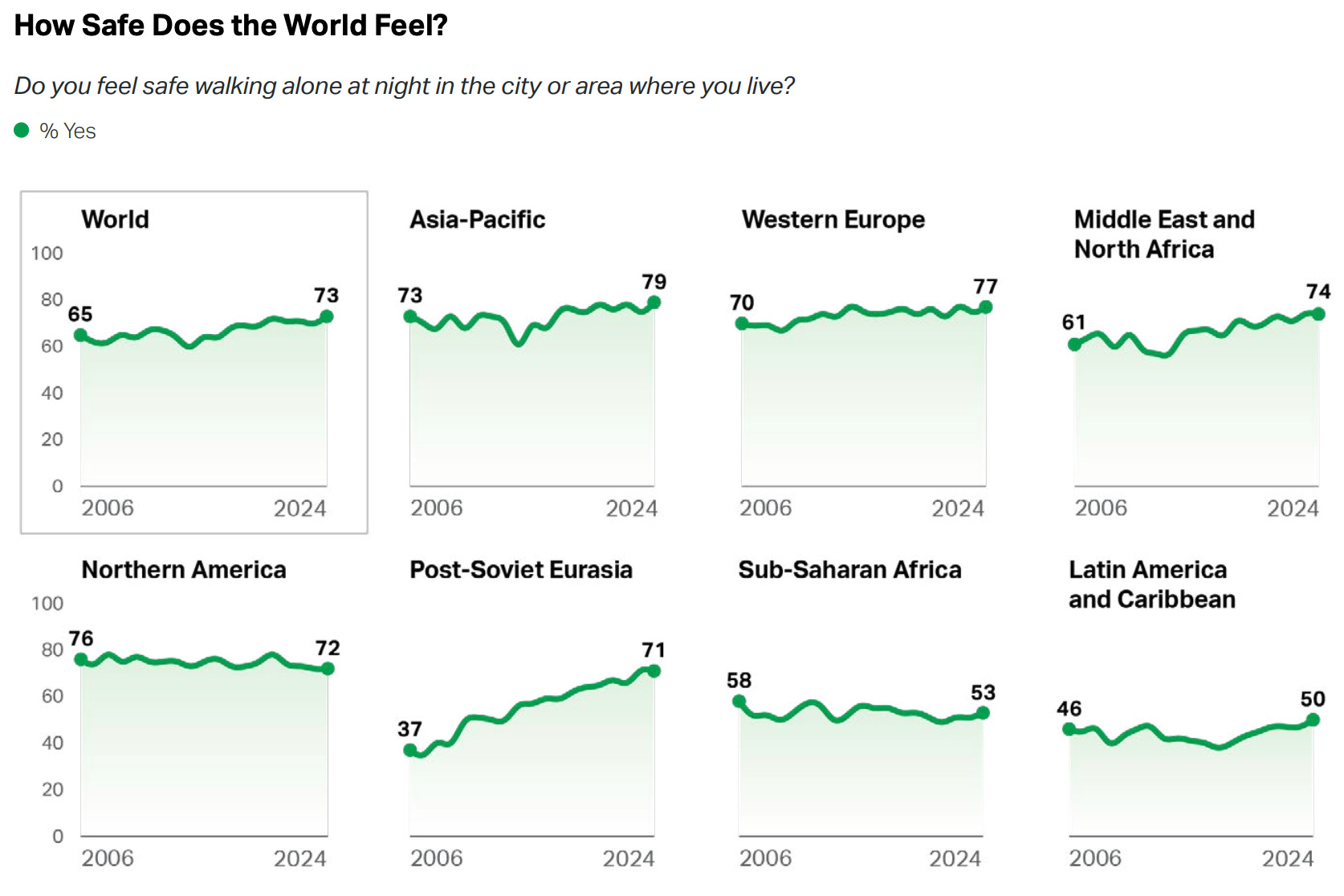
Feelings of global safety reach record high. Gallup’s 2025 Global Safety Report finds that 73% of people feel safe walking alone at night, the highest level recorded since Gallup began asking the question. Global perceptions of safety rose steadily between 2014 and 2020 and then stalled during the COVID-19 pandemic and its aftermath. The rebound in 2024 is driven by gains in the Asia-Pacific, Western Europe, Latin America, Caribbean and sub-Saharan Africa regions.
Yet the fact that perceptions of personal safety are rising, often in regions with deep, long-standing challenges, suggests that progress is still possible. It also highlights the role of local-level security, trust in institutions and leadership, and community resilience, which can strengthen even in the face of broader global unrest.
Some excellent news for the Amazon as Peru protects half its northern Amazon carbon in a new reserve co-managed with Indigenous Kichwa and Bora peoples. The Bajo Putumayo–Yaguas Communal Reserve links protected areas along the Colombian border to safeguard 53% of all carbon in the northern Peruvian Amazon.
Suriname followed with its own announcement at Climate Week. One of the world’s few net-carbon-sink nations pledged to permanently protect 90% of its tropical forests: a national plan will direct climate finance toward Indigenous stewardship to preserve one of the planet’s most forested nations. AP
And, Brazil has committed to the first $1 billion to a global forest fund that’s supporting conservation across the Amazon, Congo and Southeast Asia. The initiative, set to launch at COP30, aims to mobilise both public and private capital for forest-rich nations, building on Brazil’s steep drop in Amazon deforestation since 2023. Reuters
…oh, and did you know? Three years ago, 33 million Brazilians went to bed hungry. Today, Brazil is off the United Nations Hunger Map, largely through political, not technical, choices. Expanded cash transfers, local food procurement from family farmers, and revived food councils reversed years of rising hunger. The model challenges export-led agriculture by proving redistribution and local supply chains can end hunger at scale. IPES
China has tested a helium-lifted turbine capable of generating 1 MW mid-air. Nationwide trials begin next year. South China Morning Post

Vogue has ended the use of fur across all 29 editions — a major cultural turn for luxury fashion. The policy follows years of advocacy from animal-welfare groups and reflects a wider industry pivot toward ethical, innovative materials. World Animal News
Google DeepMind has developed a system that coordinates factory robots to move without collisions. Called RoboBallet, it plans and synchronises multiple machines to build products without collisions, turning days of manual programming into moments. Tested on real robot arms, it could make factories faster, safer and more flexible—an industrial dance directed by code. Ars Technica
Ancient amber reveals South America’s oldest insect fossils. Scientists in Ecuador have found 112-million-year-old insects preserved in amber — the first evidence of Cretaceous insects from South America. Trapped within resin from Cretaceous trees, the flies, beetles and wasps capture life from the lost forests of Gondwana. The amber offers an unprecedented window into southern ecosystems that evolved in parallel with those in the north. SciTechDaily
And let’s end with Jane Goodall’s last message - a fitting close to climate week (though if you’re a paid subscriber, there’s still loads more environment and energy stories to come).
