311: No ordinary pilgrims. Cosmic waves 💫. China energy 🤯. Global child poverty. Rewilding in England. Jaguars!
Hidden stories of progress from around the world.

You’re reading the premium version of Fix The News, a weekly roundup of stories of progress. We give away 30% of subscription fees to charity. Give someone a gift subscription. Get a group subscription for friends, family or your organisation. Listen to our podcast. If you need to unsubscribe, there's a link at the end.
Ok, we know this sounds like a stretch but honestly, the first episode of our malaria vaccine podcast might be the best thing we’ve ever done? One of our core goals was to make sure it wasn’t too ‘worthy’ - we didn’t want it to feel like eating your vegetables. We think we pulled that off, and are very proud of it. Give it a go, and let us know what you think. Episode Two drops this weekend :)
This week’s top stories
“In love there is no fear”: Last week, over 1,000 LGBTQ+ Catholics descended on Rome for the first pilgrimage for gay and trans people to be hosted by the Vatican as part of a Jubilee Holy Year. Organisers credited Pope Francis’ legacy and Pope Leo’s early signals of inclusion for the shift, with masses and vigils marking what participants described as a long-denied recognition of faith and identity. WaPo
Our eyes have known the tears of rejection, of hiding. They have known the tears of shame… Today, however, there are other tears, new tears. They wash away the old ones. And so today these tears are tears of hope.
Reverend Fausto Focosi
In a big win for public health access, the WHO has added 39 medicines to its global essential list, including breakthrough treatments for lung cancer, melanoma, multiple myeloma and type 2 diabetes. Being on the list means countries are more likely to buy the medicine in bulk, copycat versions get made faster, and prices come down quicker. Several of the drugs are already WHO-prequalified, allowing countries to begin large-scale purchasing immediately. WHO
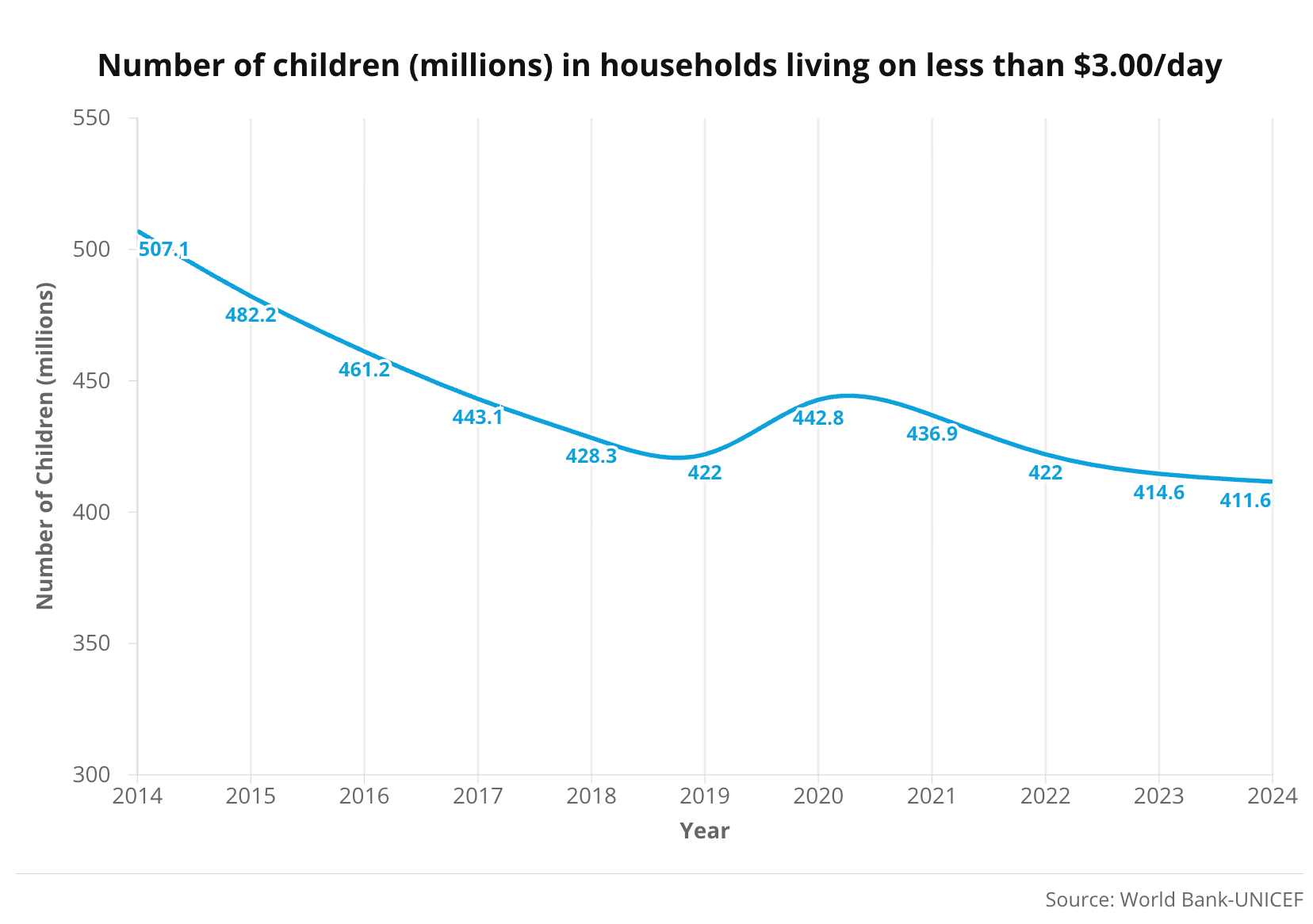
Nearly 100 million fewer children live in extreme poverty than a decade ago. Global child poverty has fallen from 507 million in 2014 to 412 million in 2024, despite population growth and setbacks from COVID-19. South Asia cut extreme child poverty by two-thirds, led by India, while East Asia achieved similar gains. Child poverty is now increasingly limited to sub-Saharan Africa and fragile and conflict-affected places. World Bank
Ebola outbreak in the DRC met with absolutely off-the-charts public health capacity. The DRC just confirmed a new outbreak of Ebola, BUT in under 24 hours, the virus was isolated, sequenced and the sequence data made publicly available. Genuinely incredible to see this kind of resolution and turnaround go from sci-fi to feasible over the course of the last decade. Wow.
And speaking of public health capacity, the mpox emergency is officially over in Africa. After surging in 2022–2023, the virus hasn’t disappeared, but case numbers have plummeted, and outbreaks are increasingly rare. Another reminder that we hear a lot when outbreaks happen, but not so much when they’re over! Reuters
Japan pledges US$550m for African health. At the recent Tokyo International Conference on African Development in Yokohama, Japan committed up to US$550 million over five years to Gavi’s 2026–30 program. Coming on top of the US$9 billion already pledged earlier this year, it puts Gavi’s goal of vaccinating half a billion children by 2030 well within reach. Gavi
That said, while this is a win, it’s still a problem that health outcomes on the African continent rest so much on other countries’ generosity. Which is why we’re relieved to report the next story, even though it’s a bit complex. As you may know, PEPFAR, a US-funded AIDS relief program that’s been responsible for saving millions of lives, is facing serious uncertainty, with renewed pressure from Congress to pare back funding. But this moment could be a turning point, not a collapse. As Congress debates the 2026 budget, a strategic realignment is underway: the House bill calls for a “gradual and responsible” transition toward country-led HIV responses, and African leaders have echoed this push for national ownership of HIV response through the new Accra Initiative.
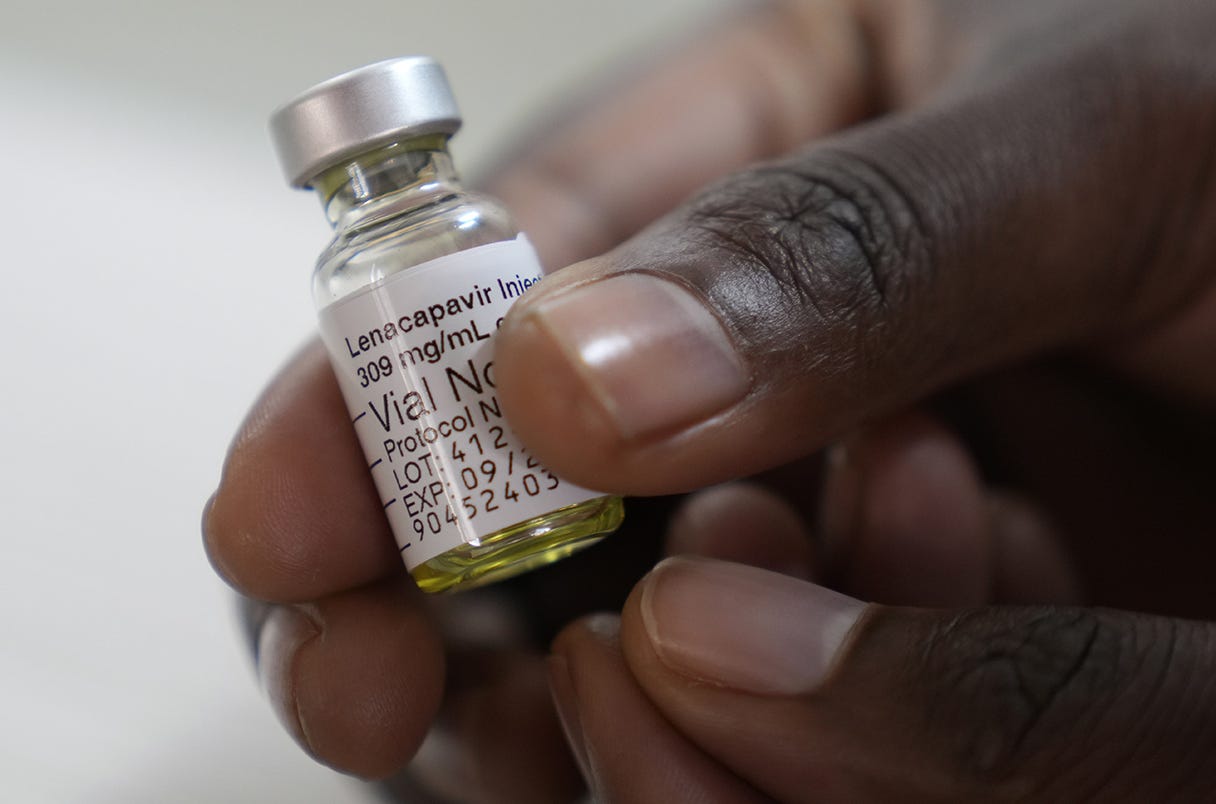
And in related, major good news: the United States will fulfill a Biden-era pledge to fund breakthrough HIV prevention drug, lenacapavir. The twice-yearly injectable could shield millions of people, especially young women in sub-Saharan Africa, from HIV infection. If scaled properly, it could be key in transitioning responsibility for AIDS responses from PEPFAR and similar programs to African national governments. Science
Ireland’s story of progress. From postwar poverty to one of Europe’s most prosperous and progressive societies, Ireland’s transformation over the past 70 years is nothing short of staggering. Life expectancy has climbed from 70 to 83 years; infant mortality has plummeted; and GNI per capita has risen from $2,000 to $60,000. Emigration has flipped to immigration, half the population now holds a university degree, and the country has voted in a gay, mixed-race prime minister - all unimaginable in the deeply conservative, poverty-bound Ireland of the 1950s. Vox
And this week brought another small but symbolic step forward in Ireland: free public transport for all children under nine as part of the country’s broader effort to reduce costs for families and cut emissions by getting more people onto buses and trains. Irish Times
AI tools are uncovering patterns in animal sounds and signals once thought indecipherable. Dolphins in Florida show shared whistles beyond their personal ‘names,’ cuttlefish display repeatable arm signs, and nightingales and parrots reveal speech-like flexibility. A $10 million Coller Dolittle Challenge is spurring teams worldwide to crack interspecies communication, raising the prospect that whales, dolphins or birds could be the first to have their “language” decoded. New Scientist
Plus, after years of advocacy and mounting pressure, the Australian state of New South Wales has confirmed the creation of the Great Koala National Park, adding 1,760 km2 of state forest to existing reserves to form one of the state’s largest protected areas. The move will safeguard more than 12,000 koalas, along with 36,000 greater gliders and over 100 threatened species. Logging will halt immediately within the park’s boundaries.
In Australia’s Gondwana Rainforest, critically endangered red and yellow mountain frogs are being successfully bred and released for the first time. Following years of work by researchers from Australia’s Southern Cross University, seven teensy 3cm-sized frogs have been released into the wild, with more to follow.

England’s rewilding movement is accelerating, says campaigner Ben Goldsmith. Once controversial, beavers are now embraced by many farmers for their role in reducing floods, while white storks and bison are returning in carefully managed projects. A major shift in farm subsidies, which has redirected billions toward restoring wetlands, soils and biodiversity, has also helped drive cultural change, as the country moves from tightly managed landscapes toward living more easily with nature. Mongabay
Jaguars are making a comeback in Mexico. After two decades of conservation efforts, Mexico’s wild jaguar population has increased by over 1,000 animals - up 30% since 2010 - bringing the total to 5,326. It’s one of several wins for the big cats that we’ve reported on recently, in this case made possible by a national strategy that combines protected corridors, camera monitoring, and deep collaboration with Indigenous communities and landowners. The Guardian
AI helps us hear fainter cosmic waves. At LIGO, the Laser Interferometer Gravitational-Wave Observatory, researchers detect gravitational waves using 4 km long laser tunnels and mirrors so sensitive that tiny vibrations can drown out signals. To keep the mirrors steady, engineers use feedback loops, but those loops themselves can add noise. Now DeepMind and Caltech have trained an AI controller to correct the motion of the mirrors without creating extra interference. In real runs at LIGO’s Louisiana site, the AI cut noise by a factor of 30-100, a leap that could help capture hundreds more black-hole and neutron-star collisions each year. Geekwire
A once-dismissed HIV drug may improve brain plasticity, and open up radical new possibilities for trauma and stroke recovery. Maraviroc, originally developed to block a receptor used by HIV to enter cells, is now being trialled as a "neurorehabilitation pill." Early research suggests it may boost brain plasticity after stroke or trauma, essentially keeping the brain's "rewiring window" open longer than usual. This could help patients recover skills and movement long after traditional rehab ends. NYT 🎁
And finally, California’s underwater forests are bouncing back thanks to divers with hammers. Once devastated by warming waters, pollution, and an explosion of ravenous purple sea urchins, California’s kelp forests are now regrowing at scale. The turnaround is thanks to an ambitious restoration effort led by The Bay Foundation: over the last 13 years, divers have spent over 15,000 hours underwater, manually smashing 5.8 million urchins to clear space for kelp to return. This “underwater pothole-filling” has restored acres of coastal seabed, which once again provides food and shelter for a vast array of marine life. The Guardian
Energy & Climate
We’ve said it before, but it bears repeating: climate change is not a global problem, it’s a China problem.
One statistic makes this clear. Since the Paris Agreement entered into force in 2016, China has been responsible for around 90% of the world’s emissions growth. Think about that for a moment. Strip China out of the equation, and global emissions would have already peaked, or at least plateaued, over the last decade. All the drama - the impassioned pleas, the backroom deals, the documentaries, the marches - it kinda… worked?
But while those battles raged, China exploded, pumping out hundreds of millions of tonnes of carbon each year, the equivalent of dropping another five Germanys into the global emissions ledger.
The inconvenient truth is that nothing Greta Thunberg said, nothing Vladimir Putin did, or any of the deals agreed to in Brussels or London or Washington, had any bearing on China’s actions. The world’s climate curve kept on climbing because Beijing decided to keep burning coal and building factories.
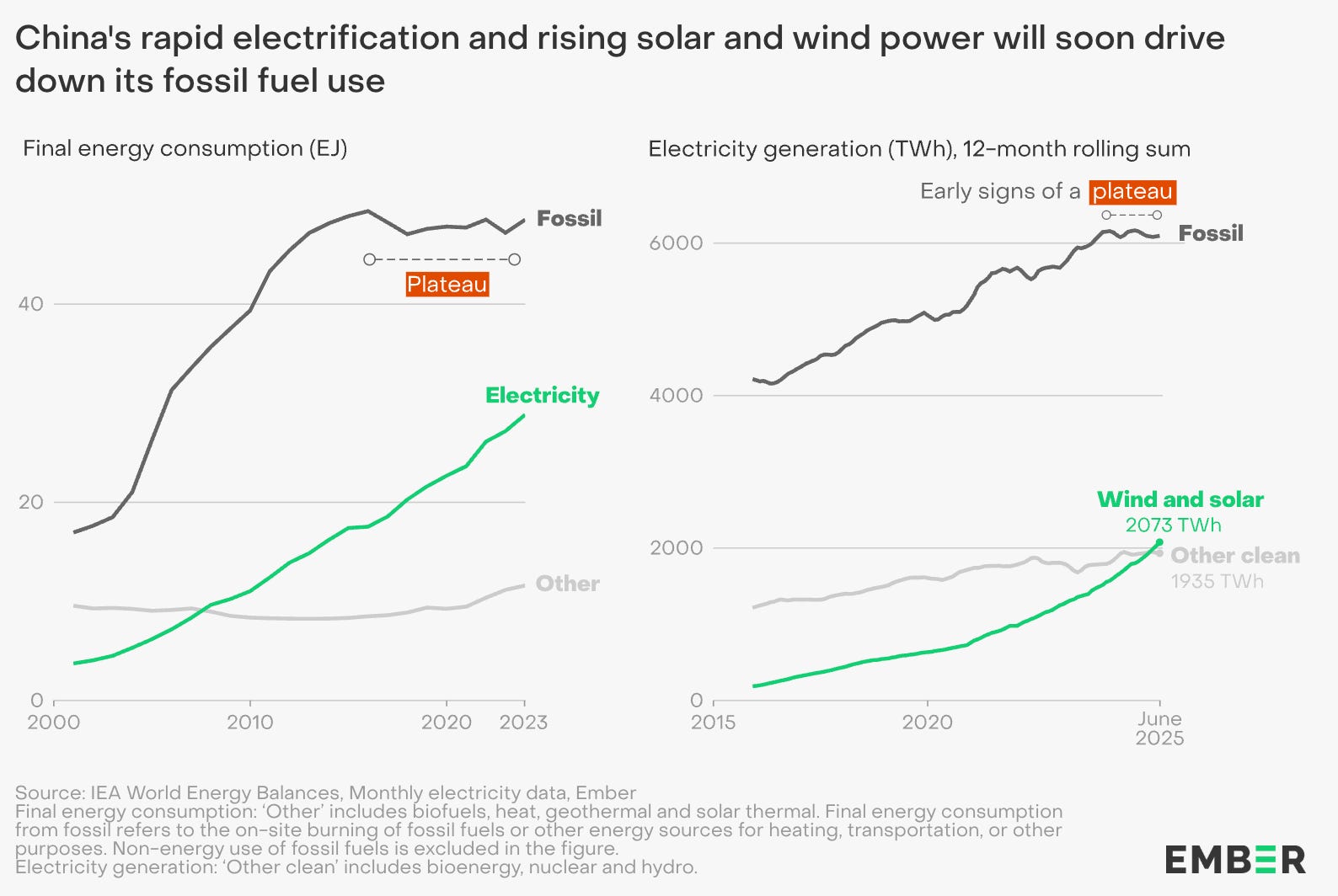
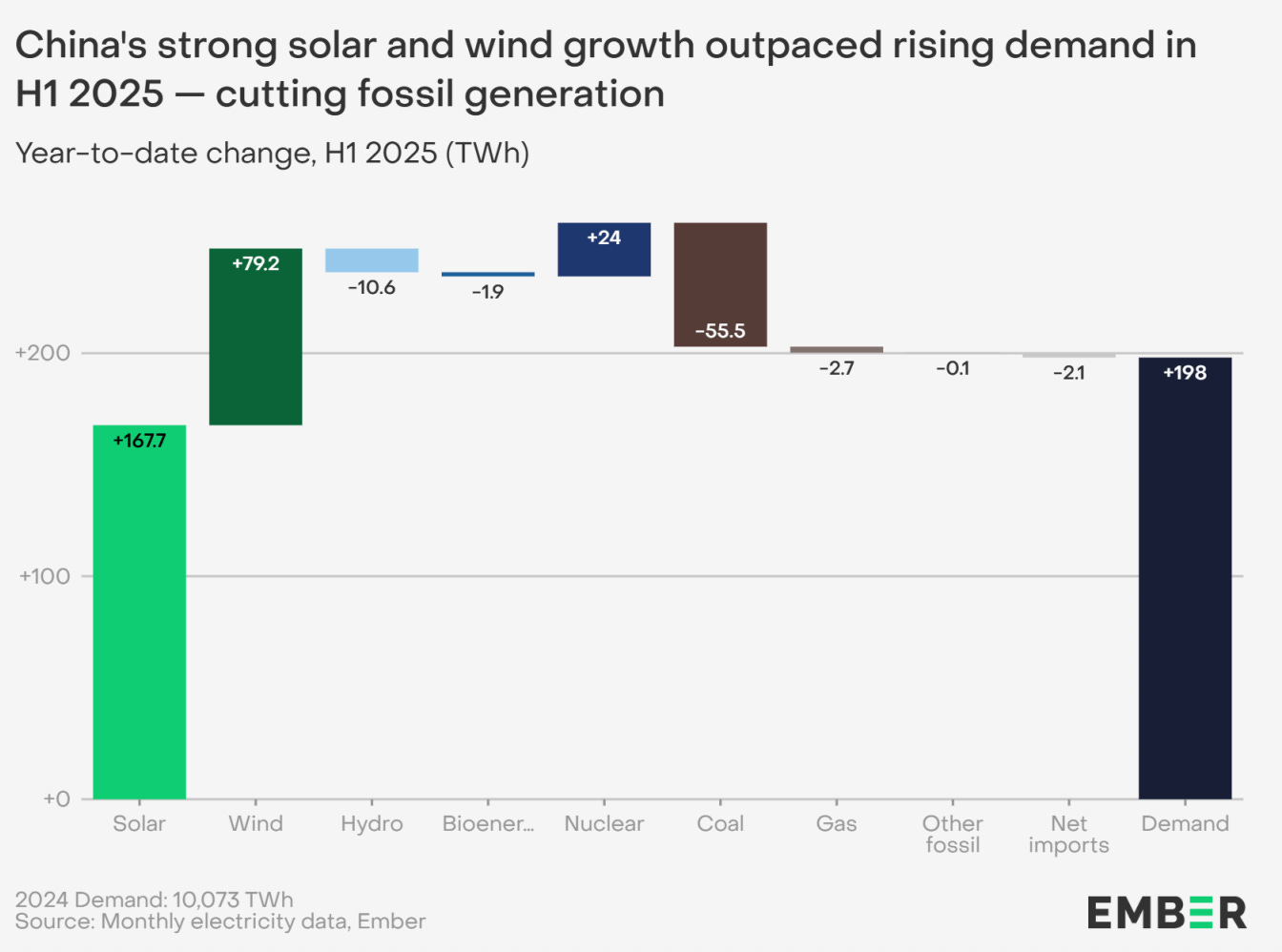
Now it’s changing, and the good news is as big as the bad news. In the background, China has been building a system to replace fossil fuels, and that system is starting to bite. Since the beginning of 2021, wind and solar capacity has soared from 635 GW to almost 1,700 GW, close to a threefold increase. In the first half of this year China added more solar than the United States has in its entire history, forcing fossil generation down by 2%.
Lauri Myllyvirta, one of the world’s leading energy analysts, calls it the tipping point. A country that was adding “two Great Britains worth of electricity demand every year” is now more than meeting that demand with panels, turbines and batteries instead of coal plants.
And it doesn’t stop at China’s borders. Four out of five solar panels, two-thirds of electric cars, almost all the world’s batteries - made in China. That scale has crashed global prices and pulled entire regions into the slipstream.
In sub-Saharan Africa, a solar kit now costs less than a budget smartphone. In Latin America, BYD is selling electric cars for under US$20,000. In Pakistan, Bangladesh, Kenya and Brazil, grids are being rewired in real time by a tidal wave of manufactured sunlight.
This is the structural change we’ve all been waiting for. Emissions are plateauing. Coal is peaking. The export of clean technology by China is doing more to decarbonise emerging economies than any Western climate summit or speech.
Keep this in mind the next time you see a headline about a wildfire, or Trump’s latest fat-fingered flourish, or another European carbon skirmish. The decisive shift is happening in China, and the rest of the world is being towed along behind.
That’s the climate politics story of this decade.
Everything else is an afterthought.
If you’re interested in more, we highly recommend Ember’s new China report, nine months in the making.
A few more ‘afterthoughts’:
In the United States, the world’s largest economy, 77% of new solar this year has been built in states that Trump won in 2024.
Germany, the world’s third largest economy, has already met its 2028 target for reducing coal power.
India, the world’s fourth largest economy, cut fossil electricity by 4% in the first half of 2025, and clean generation is up 20% - more than any other major economy.
Japan, the world's fifth largest economy, cut fossil electricity from 73.1% in June 2018 to 54.8% in June 2025.
Australia has become the world’s third-largest market for big batteries.
Dutch pension giant PFZW just pulled billions from BlackRock and LG in a sustainability push.
In Pakistan, solar has surged from 4% to 14% of the power mix in three years.
In 2025, 37% of all cars sold globally came with a plug.
BYD and the Shenzhen Port Group are building a green shipping corridor.
CATL just launched the Shenxing Pro in Europe - a battery with a 758 km range, a million-km lifespan, and a 478 km fast charge in 10 minutes.
The Media Misery Machine
Two-thirds of the public think crime is a major problem in the United States overall and eight in ten say it is a major problem in large cities. Only about a fifth say crime is a major problem in small towns or rural areas, or in their own community.

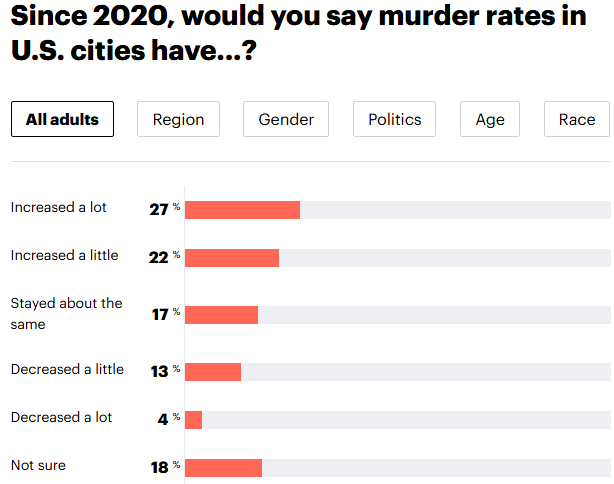
49% of Americans say murder has increased since 2020, compared to 17% who say it has decreased (35% said it has either stayed about the same or they weren’t sure).
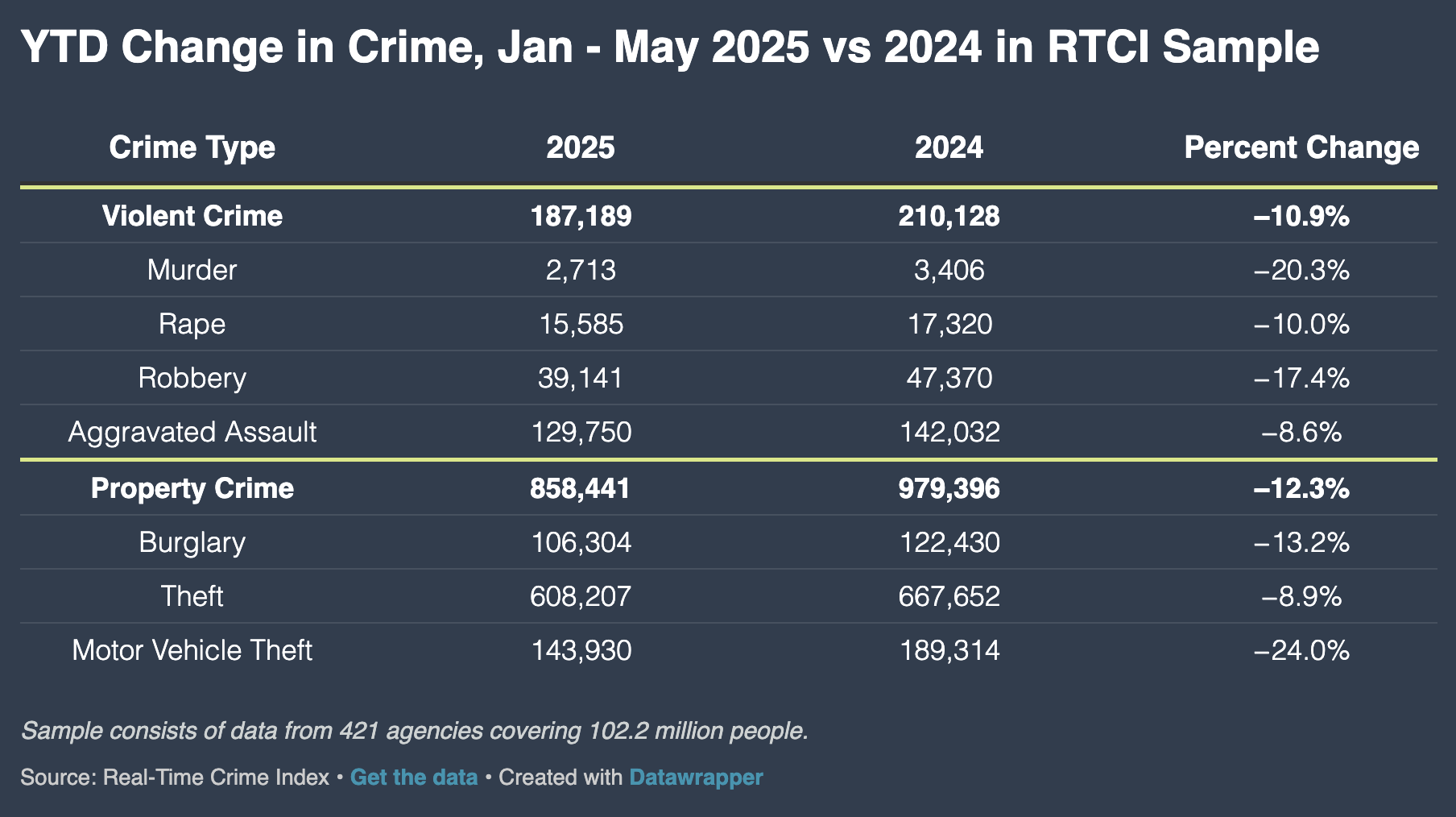
Crime is falling in the United States, led by the largest one-year percentage point decline in murder ever recorded. The decline is fairly uniform across cities/counties and population sizes. In 13 cities with a population of over 1 million people, murder is down 20.1%, violent crime is down 11% and property crime is down 12%.
The final word on crime through midyear is that there is a sizeable decline in every category of crime. The data through May suggests crime may decline at or near record levels in every crime type we have measured since 1960. It’s also plausible that multiple crime types will feature their largest drop ever recorded in 2025.