301: The Fifth Monotreme
Payangko! Plus, the High Seas Treaty inches closer, a ton of new marine protected areas, global child labour is falling, great news on reproductive rights in England and Wales, and for the first time ever - the south pole of the Sun.
This week's top stories
In our last edition we shared the news of two huge new marine protected areas in Samoa and French Polynesia (now the world’s largest). Turns out they weren't alone. In the last fortnight...
Colombia designated a new 8,000 km² marine protected area around the San Andrés archipelago in the Caribbean.
Tanzania announced two new marine protected areas covering 1,300 km2 in the waters around Pemba Island.
Spain will expand protections to cover 25% of its marine waters, including critical habitat for whales, dolphins, and endangered seabirds.
Portugal created a new marine protected area covering nearly 2,700 km² off its southern coast.
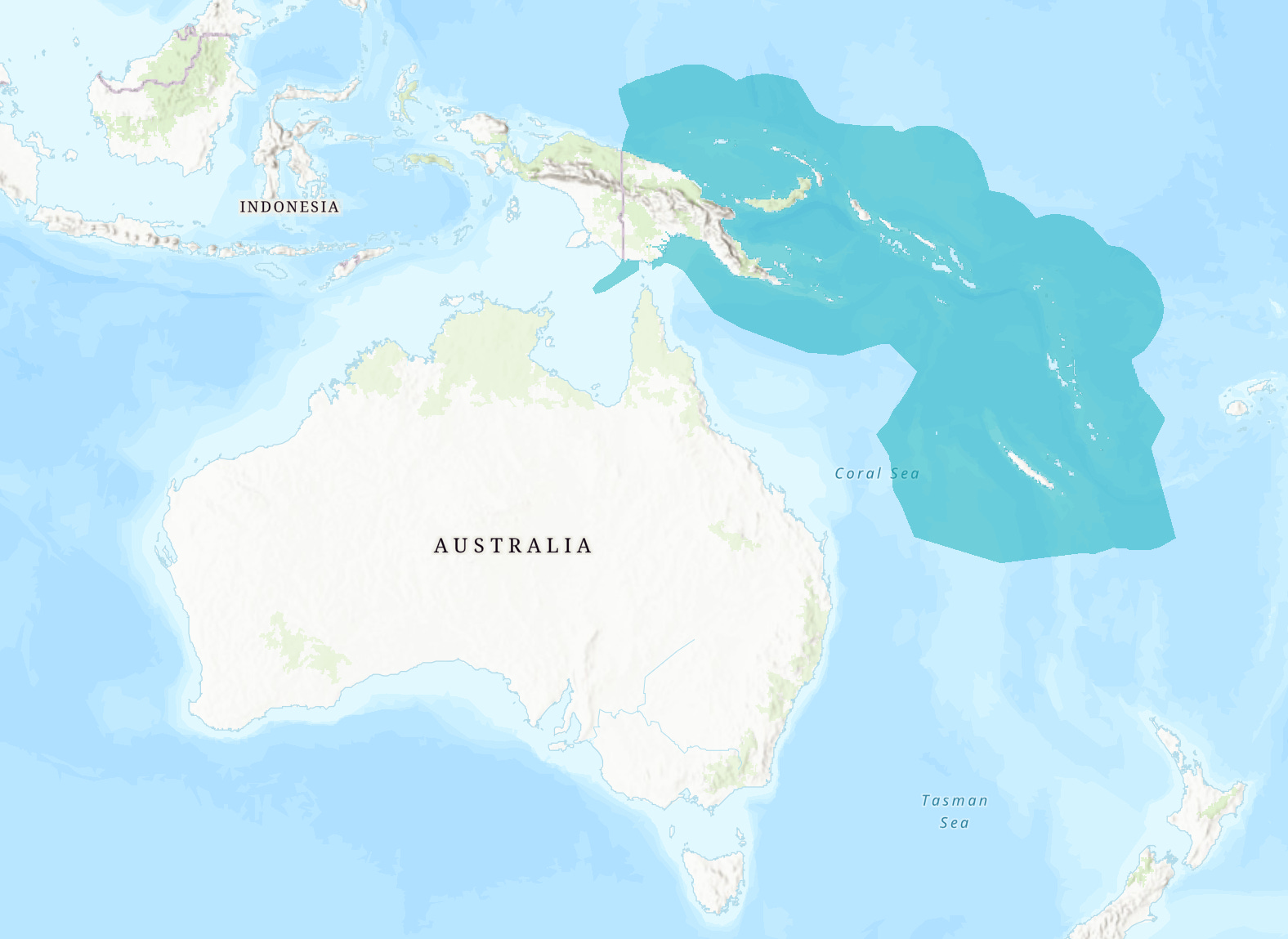
The Solomon Islands, Vanuatu and Papua New Guinea announced plans to create the massive, 6.07 million km² Melanesian Ocean Reserve, covering an area nearly as big as the entire Amazon rainforest.
The Ocean Cleanup has launched a new initiative targeting 30 of the world’s most polluted rivers, aiming to reduce plastic inflow into the ocean by one-third by 2030. The plan is to bring their Interceptors (snazzy belts and boats, read more about them here) to 30 cities with the dirtiest rivers, including Mumbai, Bangkok and Los Angeles. Backed by city governments and philanthropies, the initiative marks a major scale-up in global efforts to tackle marine plastic at its source.
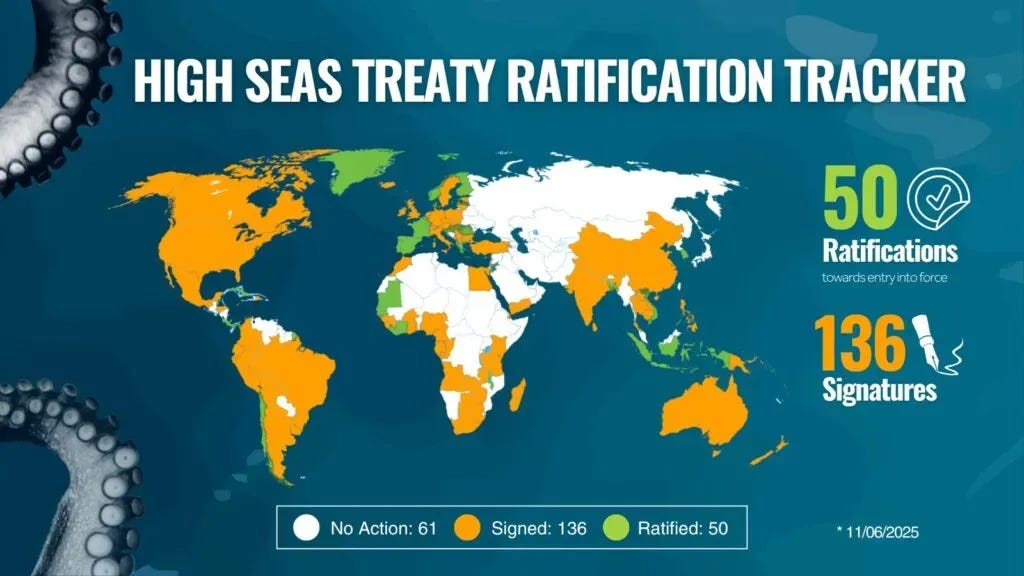
50 countries, plus the European Union, have now ratified the UN’s High Seas Treaty, aimed at protecting international waters that cover nearly half the planet’s surface, and beyond the jurisdiction of any single country. The agreement needs at least 60 countries to ratify it to enter into force. The Conversation
Wait, what’s the difference between signing and ratifying a treaty? The UN’s Dag Hammarskjöld Library defines terms here.
… plus the European Commission announced a €1 billion investment to support ocean conservation, science, and sustainable fishing, Germany launched a €100-million programme to remove underwater munitions from the Baltic and North Seas, New Zealand committed $52 million to strengthen the Pacific’s ocean governance, and a 37-country coalition led by Panama and Canada, launched the High Ambition Coalition for a Quiet Ocean to tackle underwater noise pollution. UNOC
Bolivia’s Congress has advanced legislation to ban child marriage, raising the legal age to 18 without exceptions. The move follows similar reforms in Colombia and would close one of South America’s last remaining legal gaps on child marriage. Latin Times
Speaking of, Colombia has launched a national programme for children orphaned by femicide, offering financial support, counselling, and legal aid to survivors. Thousands of children are expected to benefit, marking one of the world’s first large-scale policy responses to the hidden toll of gender-based killings. Al Jazeera
Oh, and Colombia’s government has entered new negotiations with armed groups in a bid to extend its 'total peace' agenda. Talks include ceasefires, reintegration measures, and rural investment aimed at addressing long-standing grievances. While past efforts have collapsed, officials say public pressure and fatigue with violence are creating a rare window for breakthrough. El Pais 🗄️
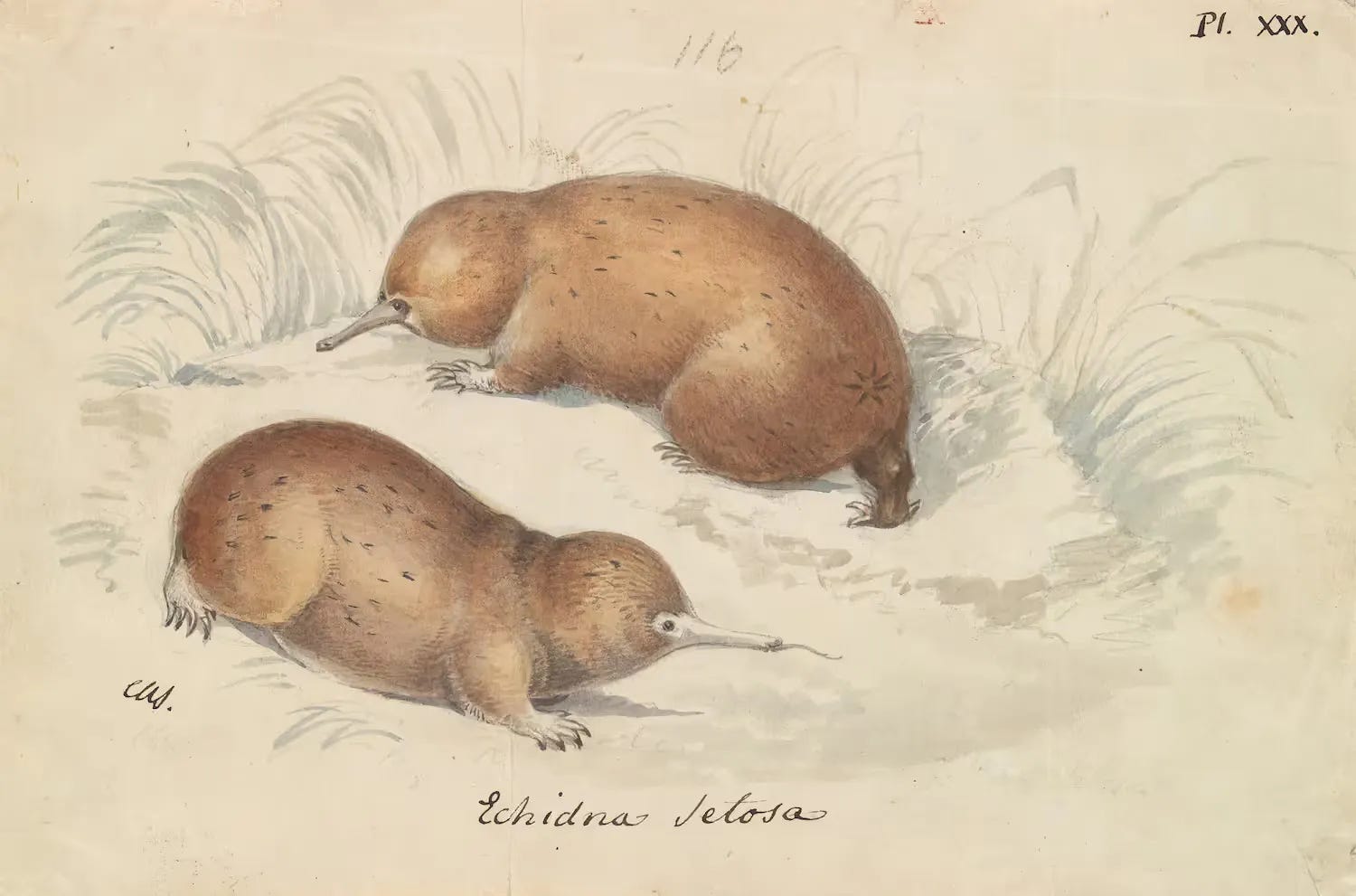
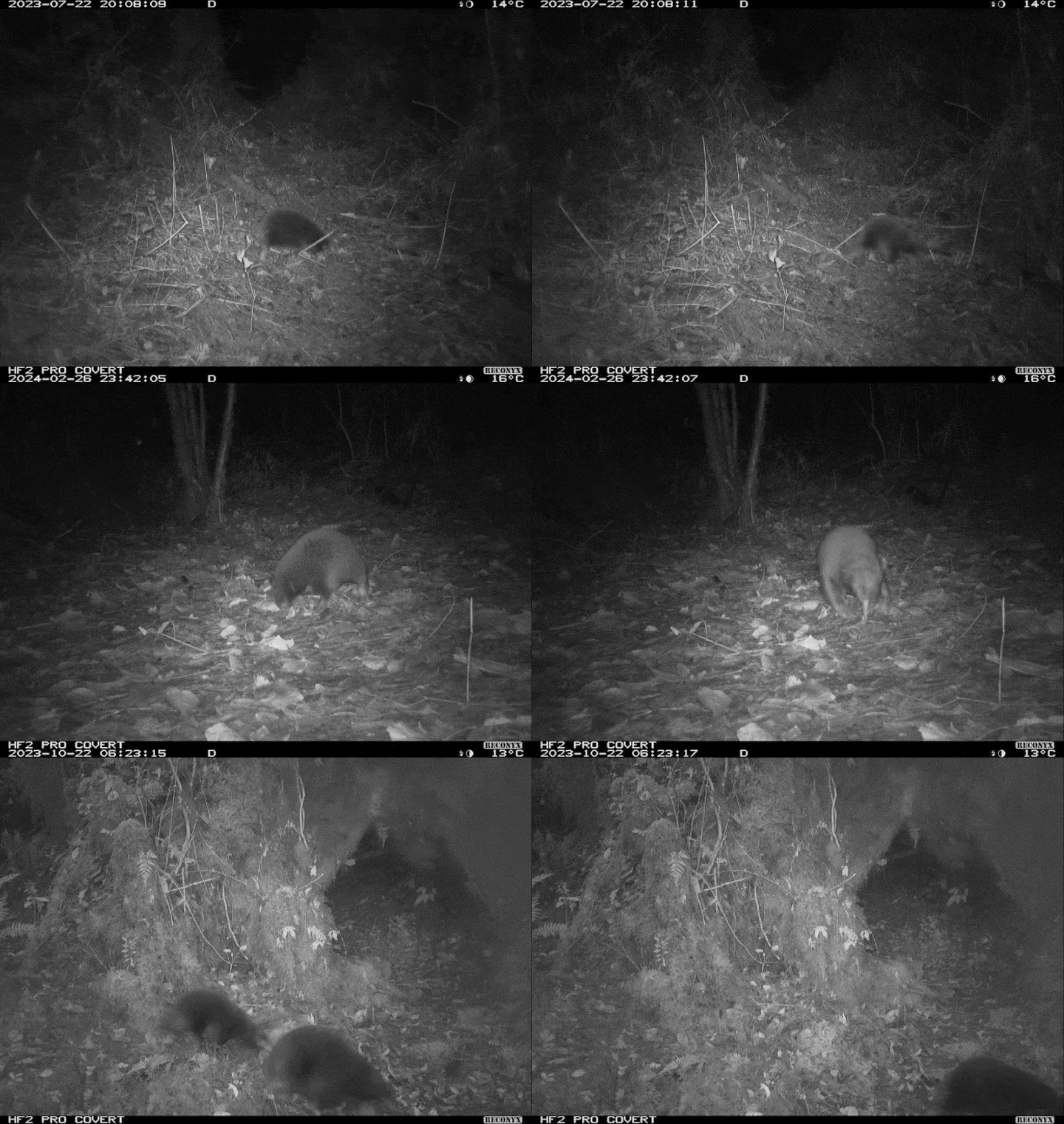
We thought this egg-laying mammal might be extinct. It wasn’t. Clickbait boldface, but excellent news: biologists have confirmed the ‘rediscovery’ of Attenborough’s long-beaked echidna, one of the sole living representatives of the monotreme lineage that diverged from therians (marsupials and placental mammals) approximately 200 million years ago. By combining camera traps with indigenous knowledge, researchers obtained the footage in New Guinea. Cute! Nature
In the Terpera language of Yongsu Sapari and Yongsu Dosoyo, the echidna is called Payangko, and our camera-trap images demonstrate the potential importance of Indigenous and local knowledge in biodiversity research. Our success in capturing the first photographic evidence of the species was built on the Indigenous and local knowledge of communities in the Cyclops, which informed us on echidna behaviour and habitat, where to place camera-traps, how to search for echidna signs and, fundamentally, gave us confidence the species was still extant.
Global EV sales rise 28% in first five months of 2025. Sales rose to 7.2 million units globally between January 2025 and May 2025, driven by surging demand in China and a sharp rebound in Europe. China accounted for 60% of all EVs sold, while Europe posted 15% growth after a subdued 2024. The data suggest EV uptake remains resilient despite subsidy cuts and broader auto market stagnation. Rho Motion
India accelerates battery rollout with massive funding scheme
India has approved ₹5,400 crore (around $650 million) to support 30 GWh of new battery storage, part of its larger clean energy ambitions. The funding covers a huge financing gap and complements a recent decision to waive transmission charges on storage projects until mid-2028. Combined, these moves signal a pivot from coal dependency to grid flexibility.
A man with a severe speech disability has been able to speak expressively using a brain implant that translates neural activity into words almost instantly. The device, implanted in the motor cortex, uses a synthetic voice to speak words within 10 milliseconds of detecting intention - a significant improvement over earlier models which took at least three seconds. The implant also conveys intonation, lets the user emphasise words, and hum and sing. Nature
Researchers have found that we all have a unique 'breathprint', tied not only to our body mass index, but also to patterns of anxiety, depression and autism. For example, those scoring high on depressive traits tended to exhale very swiftly. These unexpected findings could point to a positive future for non-invasive mental health screening. NYT 🎁
MPs vote to decriminalise abortion for women in England and Wales
Parliament has backed a landmark amendment removing criminal penalties for women ending their own pregnancies, the most significant shift in abortion law in nearly 60 years. While legal limits remain unchanged, the amendment ends police investigations of women outside the 24-week threshold. Advocates called it a long-overdue correction to a Victorian-era law still used against vulnerable women. BBC
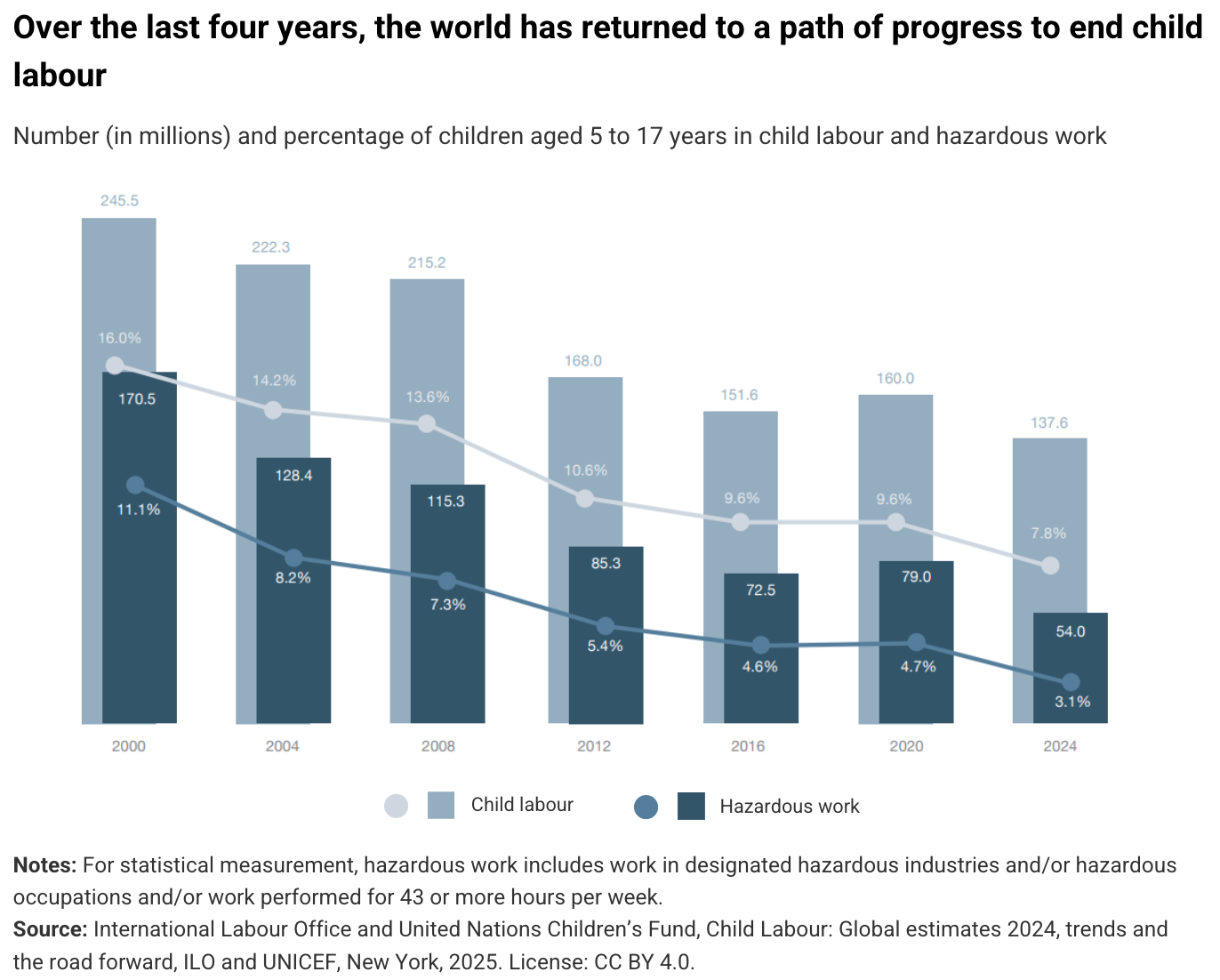
Fresh data from UNICEF reveals that the proportion of children in child labour has more than halved since the beginning of this century, thanks to a combination of tighter laws, better schooling, and poverty reduction.
After a concerning rise in child labour captured by the global estimates for 2020, a feared further deterioration in the wake of the COVID-19 pandemic has not materialized, and the world has succeeded in returning to a path of progress. There are over 100 million fewer children in child labour today than in 2000, even as the child population increased by 230 million over the same period.
Steel is China’s dirtiest industry, responsible for roughly 15% of national CO₂ emissions. But that’s changing, fast. Over 300 of China's roughly 500 steel plants are undergoing a government-mandated retrofit to meet “ultra-low emissions” standards by the end of 2025. Facilities must now slash particulate matter, sulphur dioxide, and carbon output, replacing outdated blast furnaces, capturing exhaust heat, and integrating real-time monitoring. If completed on schedule, it will be the largest decarbonisation of heavy industry anywhere in the world. BigMint
And finally: Maize may be the iconic crop of North America, but it’s pretty hard to grow, especially in Michigan’s Upper Peninsula. The crop likes long, frost-free seasons and nutrient-loaded soil, labour-intensive enough that for decades scholars thought corn was only the remit of centralised, politically complex societies, and nothing like the small-scale egalitarian tribes who lived in Upper Michigan before the arrival of Europeans. Those people ate wild rice. Right?
…not right. Archaeologists have uncovered what may be the largest intact Native American agricultural site in eastern North America, showing First Nations were growing corn at massive scale, engaging in environmental engineering on over 300 hectares of raised and ridged agricultural fields. This isn’t just cool because now we know what people ate 400-1,000 years ago, but because it demonstrates that such huge environmental engineering was achievable outside a polity based in hierarchy. “This challenges persistent ethnocentric and simplistic models that equate complexity solely with political centralization and population density.” Scienmag